Arbitrary detention of Ukrainians in the occupied territories: ZMINA spoke at an event within the framework of the UN Human Rights Council
On the margins of the 61st session of the UN Human Rights Council in Geneva on 13 March 2026, an event “Russia’s War on Civilians in Ukraine” was held, organised by Ukrainian and international human rights organisations. The event brought together human rights experts, human rights defenders, analysts and representatives of Ukrainian and international organisations, and drew attention to the systematic persecution of Ukraine’s civilian population.
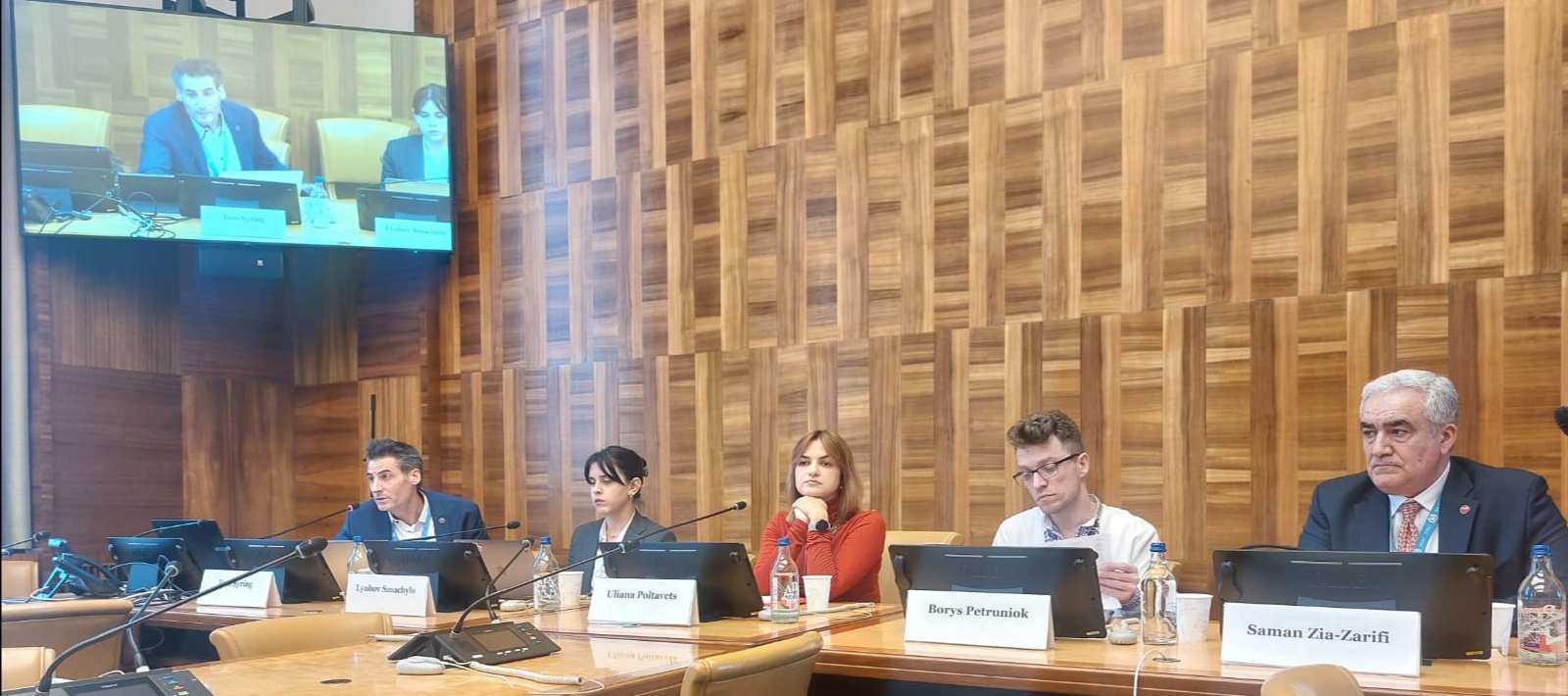 Photo: Tom Syring, Liubov Smachylo, Uliana Poltavets, Borys Petruniok, Saman Zia-Zarifi
Organisers and participants: Human Rights Research League, the Human Rights Centre ZMINA, the Media Initiative for Human Rights, Centre for Civil Liberties, World Organisation Against Torture, Physicians for Human Rights.
The event highlighted the issue of arbitrary detentions of civilians in the temporarily occupied territories, systematic practices of politically motivated criminal prosecution, and attacks by Russian forces on civilian infrastructure.
Speakers:
- Oleksandra Matviichuk, Head of the Centre for Civil Liberties (online);
- Borys Petruniok, Researcher and Analyst at the Documentation Department of the Human Rights Centre ZMINA;
- Uliana Poltavets, International Advocacy and Ukraine Program Coordinator of “Physicians for Human Rights” (PHR) in Ukraine;
- Liubov Smachylo, Head of the Analytical Department of the Media Initiative for Human Rights;
- Tom Syring, Head of the Human Rights Research League.
Moderator: Saman Zia-Zarifi, Executive Director of Physicians for Human Rights.
The event began with a speech by Oleksandra Matviichuk, who emphasized the humanitarian dimension of the war and the extremely difficult winter that Ukrainian cities have endured this year due to Russia’s massive shelling of energy infrastructure.
“This winter, since the start of the full-scale invasion, has been extremely harsh. Russia is deliberately destroying the energy infrastructure on which the civilian population’s survival depends. In January and February, temperatures dropped to –25°C, and Ukrainian cities were literally freezing“, Matviichuk emphasised.
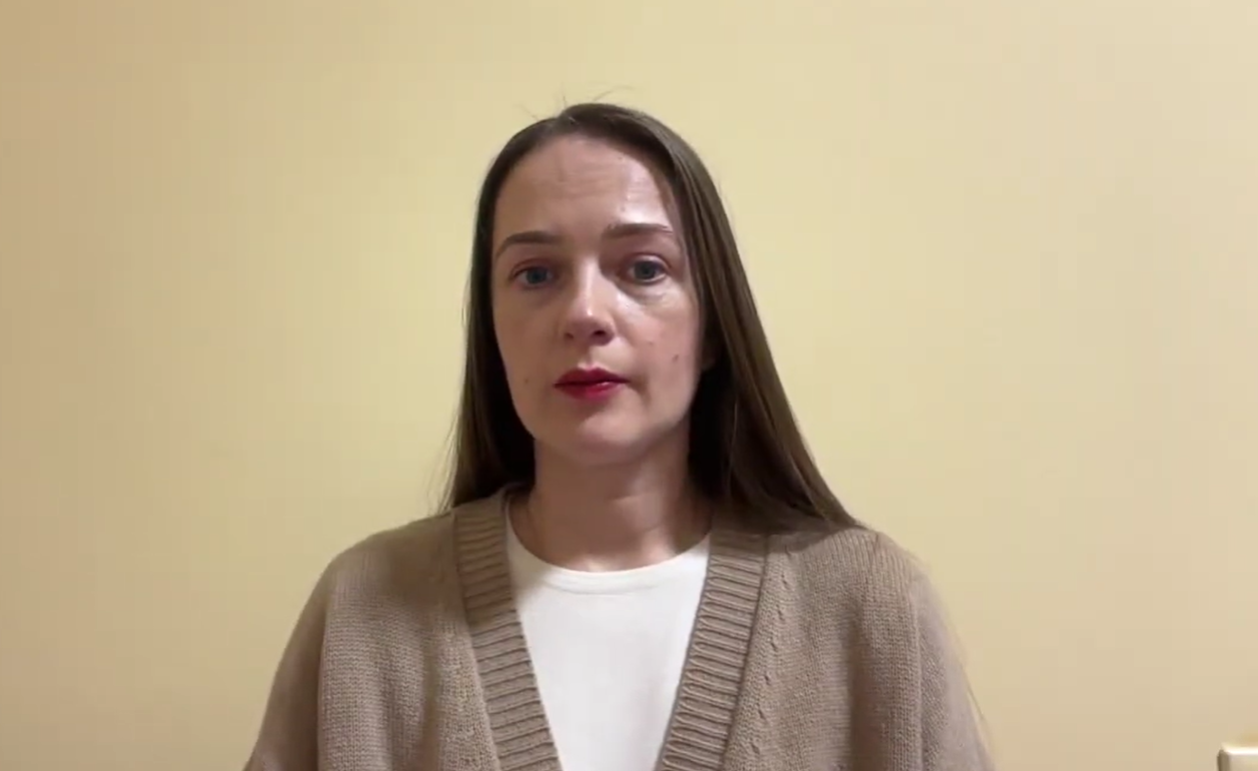 Photo: Oleksandra Matviichuk
She noted that millions of people had limited or no access to heating, water and electricity, which had become a matter of survival.
Matviichuk also highlighted the lack of attention paid by politicians to the human dimension of the conflict: “Politicians discussed natural resources, Russia’s territorial claims, geopolitical interests, and even Putin’s view of Ukrainian history, but they said almost nothing about the people. That is precisely why the Russians decided that there were no red lines for them and that they could do whatever they wanted. We must bring the human dimension back into the political process. Without it, it is impossible to find a path to lasting peace“.
Borys Petruniok noted during his speech that Russia is creating an “alternative legal reality” in the occupied territories. In October 2022, the Russian Federation openly declared the annexation of four Ukrainian regions and established its own system of “authorities”, “police” and “courts” there. Propaganda “normalised” and justified crimes committed against the civilian population, attempting to present them as part of the “routine work” of the police and the FSB in accordance with their powers.
He emphasised that the establishment of Russian institutions in the occupied territories created additional risks of politically motivated criminal prosecution for civilians. At the same time, a significant number of civilians continue to be held incommunicado without criminal charges being brought: “The Russian Federation systematically targets civilians for any manifestations of Ukrainian identity, which is perceived as an unconditional sign of disloyalty. Russian citizenship is imposed on the civilian population, and other forms of pressure and terror are also widespread“.
A key focus of the discussion was the fabricated charges and “show trials” that became a regular practice in the occupied territories. Petruniok emphasised: “In politically motivated criminal prosecutions, the Russian Federation typically uses “anti-terrorism” articles, charges of “espionage”, “treason” and so on. Civilians are held incommunicado until formal charges are brought, and may be subjected to torture in an attempt to extract confessions to a “crime”. The systematic nature and scale of these offences indicate that they should be considered crimes of persecution“.
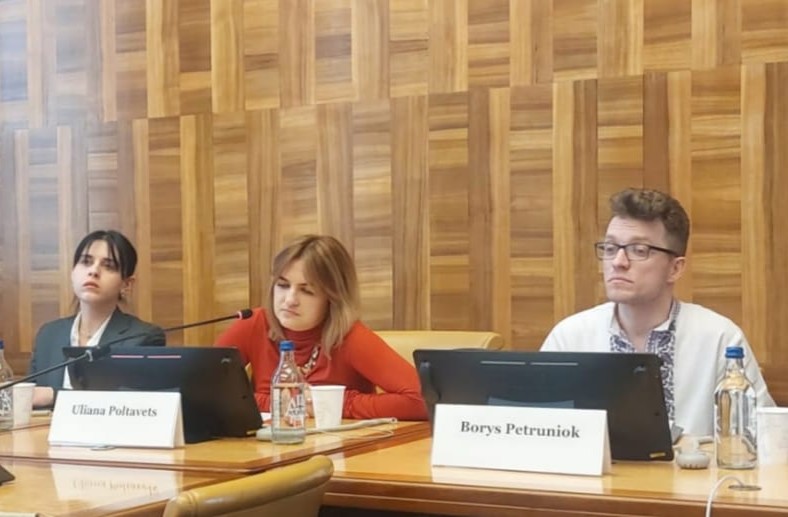 Photo: Liubov Smachylo, Uliana Poltavets, Borys Petruniok
Liubov Smachylo spoke about how politically motivated trials constitute yet another form of repression.
“The harsh sentences handed down to Ukrainians are no coincidence. This is the implementation of a large-scale state policy of criminal prosecution, which bears the signs of a crime against humanity“, said Smachylo. She called on states not to recognise the verdicts of Russian courts and to support investigations into violations of international law.
The expert also focused in detail on the systematic persecution of Ukrainians in the occupied territories. She provided specific data: since the start of the invasion, at least 3,895 civilians have been documented as having been unlawfully detained by Russian representatives, of whom at least 2,047 are held incommunicado. The detainees are held in 240 places of detention, including prisons in the Russian Federation and in the occupied territories.
“Permanent detention facilities are under the control of the Federal Penitentiary Service of the Russian Federation. This is yet another indication that the system of unlawful detention of civilians operates not in a chaotic way, but within the framework of state institutions“, emphasised Smachylo.
She also highlighted that torture and ill-treatment are used at various stages of detention. “Physical and psychological violence is used during arrest, during transport between detention facilities, and during detention itself. Torture is used as a means of extracting information, coercing cooperation, or inflicting punishment“, the expert noted.
The event also focused on the destruction of civilian infrastructure — medical facilities, power grids, and other critical infrastructure. Thus, Uliana Poltavets spoke about attacks on the healthcare system and emphasised that strikes on medical facilities are not a side effect of the war, but a systematic practice that undermines communities’ ability to survive and forms part of a broader strategy of warfare against the civilian population.
“When hospitals are attacked, the message is clear: there is nowhere safe. When ambulances are bombed, it terrorises the whole community and makes people afraid to seek medical help“, she said.
Poltavets cited data documenting such attacks: since February 2022, 2,591 attacks on healthcare facilities and medical staff have been documented, and in 2025, their number rose by almost 50% compared to 2024. In addition, 92% of healthcare workers reported power outages that affected surgeries, treatment, and life-saving services.
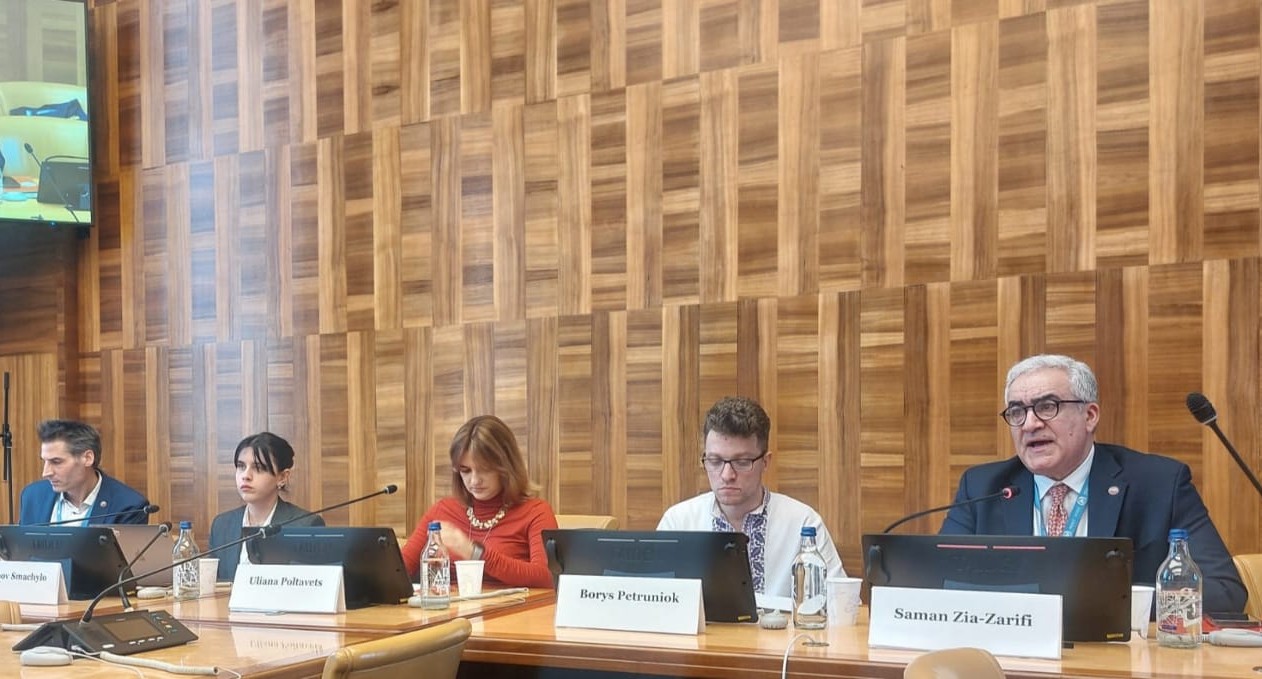 Photo: Liubov Smachylo, Uliana Poltavets, Borys Petruniok, Saman Zia-Zarifi
The event also discussed ways of ensuring accountability and protecting victims. Participants discussed how international mechanisms and UN Member States can assist in documenting crimes and supporting victims, as well as participating in reparations processes.
Since the start of the full-scale invasion in 2022, ZMINA has been systematically documenting cases of unlawful detention, enforced disappearances, torture and politically motivated criminal prosecutions both in the temporarily occupied territories and in the Russian Federation. In 2025, ZMINA published an analytical report “Denial of the right to a fair trial as an international crime during Russia’s war against Ukraine: context, practice, law and prospects“, and also investigated how the practice of arbitrary detention changed in 2023–2024.