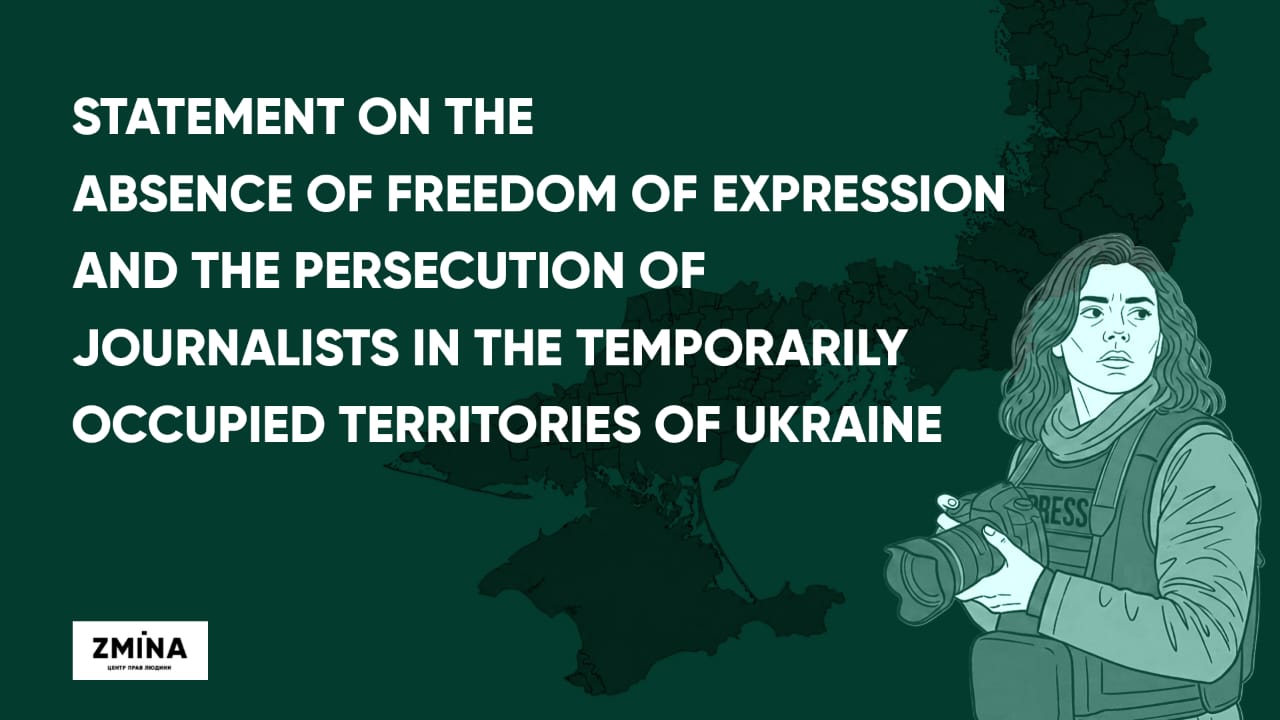
Statement on the absence of freedom of expression and the persecution of journalists in the temporarily occupied territories of Ukraine
Freedom of expression is a fundamental value of a democratic society; however, in the temporarily occupied territories of Ukraine, it is being systematically undermined through pressure on journalists. Since the occupation of the Crimean Peninsula in 2014, the Russian Federation has established a repressive system of control over the information space. Independent media have been driven out or shut down, broadcasting of Ukrainian channels and access to social media are blocked, journalists are subjected to systematic pressure by the Russian occupying authorities and criminal prosecution on fabricated charges, while the information space is saturated with propaganda. Following the start of Russia’s full-scale invasion in 2022, the scale of repression has significantly increased and expanded to newly occupied territories. Journalists have become targets not only of persecution but also of war crimes, including abductions, torture and killings, as well as violations of the right to a fair trial.
Human rights organisations continue to document unlawful detention, searches, seizure of equipment, abductions, the use of physical violence, restrictions on access to information, as well as methods of economic pressure against journalists. In the temporarily occupied territories (hereinafter – the TOT) of Ukraine, the Russian occupying authorities regularly apply articles of Russian criminal law on “extremism”, “terrorism”, “espionage”, “high treason”, “dissemination of false information” or “discrediting the Russian army” to suppress freedom of expression.
According to the Human Rights Centre ZMINA, as of the end of 2025, no fewer than 26 Ukrainian journalists remain in unlawful detention, including 17 Crimean professional and citizen journalists. Since the beginning of 2024, more than 80 cases of pressure by the occupying authorities against professional media workers and citizen journalists have been documented, including against journalists from the “Crimean Solidarity” initiative, the “Qirim” newspaper, and the outlets “Nankedzhan”, “Armanchiq” and “Crimean Process”. In 2025 alone, at least 27 cases of attacks against journalists were documented by human rights defenders in temporarily occupied Crimea, demonstrating the systematic nature of the persecution of journalists as part of the state policy of the Russian Federation aimed at suppressing freedom of expression and seeking to control the information space in the TOT of Ukraine.
It should be emphasised that the persecution of journalists in the TOT is long-standing and systematic. Some Crimean journalists have been held in Russian detention since 2016, including Oleksii Besarabov and Dmytro Shtyblikov, analysts and the Deputy Editor-in-Chief of the “Black Sea Security” journal. Crimean Tatar citizen journalists, streamers of the “Crimean Solidarity” civic initiative, have also been subjected to persecution and have remained in detention since October 2017: Seiran Saliiev, Marlen (Suleiman) Asanov, Ernes Ametov, Tymur Ibrahimov, Ruslan Suleimanov, Asan Akhtemov.
The situation is further exacerbated by the fact that a number of unlawfully detained journalists are experiencing serious health problems, which are worsened by inadequate conditions of detention, transfers to remote prisons within the territory of Russia, poor nutrition, inhuman treatment and lack of medical care. For example, citizen journalist and human rights defender Iryna Danylovych, who has been imprisoned since April 2022 and sentenced to nearly seven years in a penal colony, has lost hearing in one ear due to the denial of medical care in a Crimean pre-trial detention centre and suffered a microstroke in detention. Other journalists from the “Crimean Solidarity” civic initiative are also suffering due to the lack of medical care, including Osman Arifmemetov, Rustem Sheikhaliiev and Server Mustafaiev, who were sentenced to 14 years’ imprisonment; Remzi Bekirov, sentenced to 19 years’ imprisonment; and Amet Suleimanov, sentenced to 12 years’ imprisonment, who has a disability due to heart disease and requires life-saving surgery. Despite this, access to them by international humanitarian missions remains restricted or entirely absent.
Since 2022, Russia has imprisoned three additional Crimean Tatar journalists – Vilen Temerianov, Rustem Osmanov and Aziz Azizov – as well as at least 11 media workers from the temporarily occupied Zaporizhzhia and Kherson regions: Hennadii Osmak, Vladyslav Hershon, Anastasiia Hlukhovska, Yana Suvorova, Maksym Rupchev, Heorhii Levchenko, Serhii Tsyhipa, Oleksandr Malyshev, Denys Hlushchenko, Yevhen Ilchenko and Iryna Levchenko. Repression is not only continuing but intensifying: in late April 2026, a Russian court delivered one of the harshest sentences against Ukrainian media workers from temporarily occupied Melitopol – Denys Hlushchenko and Oleksandr Malyshev were sentenced to 26 years’ imprisonment in a high-security penal colony on fabricated charges of “espionage” and “terrorism”. These sentences are indicative: they demonstrate not only the absence of fair trial guarantees, but also a deliberate policy of intimidation of journalists and the complete suppression of independent information in the occupied territories.
Systematic repression against journalists in the TOT of Ukraine constitutes not only a violation of human rights, but also part of a broader policy aimed at destroying freedom of expression and access to reliable information. Without an immediate and decisive response from the international community, these crimes will remain unpunished, and journalists will remain unprotected.
We call on the Government of Ukraine to:
- continue efforts to secure the release of journalists by all available diplomatic and legal means;
- ensure the effective investigation of crimes against journalists committed in the TOT of Ukraine, with a view to ensuring that those responsible are held accountable;
- strengthen financial and institutional support for independent media relocated from the TOT of Ukraine;
- ensure rehabilitation and reintegration programmes for civilians released from unlawful detention by the Russian Federation, including journalists;
- seek comprehensive ways to counter disinformation by the Russian Federation regarding the occupied territories of Ukraine.
We call on the international community to:
- increase political and diplomatic pressure on Russia to secure the immediate release of all unlawfully detained journalists;
- demand regular access to detained journalists, monitoring of their conditions of detention and access to medical care, as well as facilitate communication between detainees and their families;
- strengthen international mechanisms for monitoring violations of freedom of expression in the temporarily occupied territories of Ukraine;
- ensure that those responsible are held accountable, including within the framework of the International Criminal Court and through the investigation of targeted crimes against media under universal jurisdiction;
- increase sanctions’ pressure on individuals and entities involved in the persecution of journalists;
- ensure public responses to violations and intensify the work of the OSCE Representative on Freedom of the Media and the UN Special Rapporteur on the promotion and protection of the right to freedom of opinion and expression regarding the situation of Ukrainian media representatives;
- support programmes for the protection of journalists and independent media.
We call on the Government of Ukraine, UN Member States and institutions, the OSCE, the Council of Europe, the European Union, the International Committee of the Red Cross, and civil society to take urgent and decisive action in response to the systematic persecution of journalists and the destruction of freedom of expression in the temporarily occupied territories of Ukraine. The unlawful detention of journalists, their holding in inhuman conditions, and the denial of medical care and fair trial guarantees constitute grave violations of international humanitarian law, international criminal law and human rights. At the same time, the suppression of independent journalism has become an instrument for establishing full control over the information space in the occupied territories. Any inaction by the international community only reinforces a climate of impunity and creates conditions for further repression against media workers worldwide. What is required today is not only statements of solidarity, but tangible and effective measures to protect unlawfully detained journalists, ensure access for international missions, and secure their prompt release.
Signed by:
Human Rights Centre ZMINA
NGO Crimean Process
NGO Association of Relatives of Political Prisoners of the Kremlin
Educational Human Rights House Chernihiv
Crimean Human Rights Group
National Union of journalists of Ukraine
Human Rights House Crimea
Institute of Mass Information
European Centre for Press and Media Freedom
Women Press Freedom Initiative
Women In Journalism Canada
Coalition For Women In Journalism (CFWIJ)
Article 19
SIGN- Ena Bavcic, European Centre for Press and Media Freedom – 05 May 2026, 09:47
- Anastasia Filip, Women In Journalism – 05 May 2026, 00:27
- Kim@womeninjournalism.orh, WIJ Institute Canada – 05 May 2026, 00:26
- Kiran Nazish, Coalition For Women In Journalism (CFWIJ) – 05 May 2026, 00:25