
A study on four years of practice in holding individuals accountable for collaborative activity was presented in Kyiv
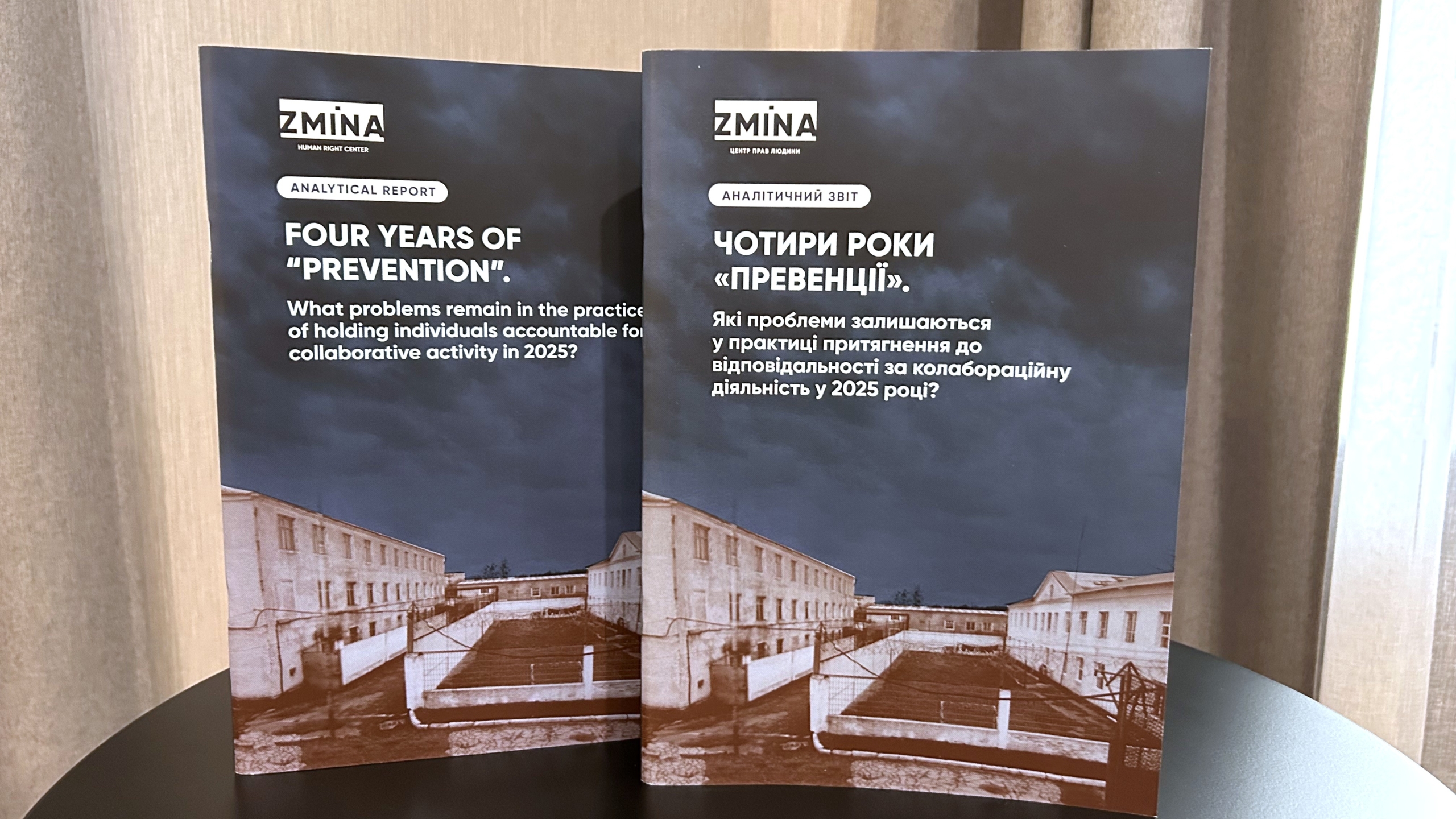
On 28 April in Kyiv, the Human Rights Centre ZMINA presented the analytical report “Four years of “prevention”. What problems remain in the practice of holding individuals accountable for collaborative activity in 2025?”.
The study analysed 1,143 judgments for 2025 out of a total of 3,103 recorded in the Unified State Register of Court Decisions. The analysis identifies persistent systemic problems in the application of Article 111-1 of the Criminal Code of Ukraine.
Diana Deputat, Legal Analyst at ZMINA, noted that in 2025, judgments under Parts 5 and 7 of the Article became dominant. The share of judgments delivered in special proceedings (in absentia) in these categories of cases exceeds 80%.
The analyst also noted that, despite certain improvements, the practice of applying preventive measures remains problematic. The priority of the investigation is the examination of offences under Parts 3-8 of Article 111-1, while the overall number of recorded proceedings under this Article is decreasing.
“The predominant measure is detention without bail. At the same time, the reasoning of court rulings is often reduced to references to the risks provided for in Article 177 of the Criminal Procedure Code of Ukraine, or simply reproduces standard wording of reasoning. The duration generally ranges from three months to three years. There are also isolated cases where, by the time the judgment enters into legal force, the person has already fully served their sentence“, Diana Deputat noted.
She also drew attention to the statistics on acquittals: out of 3,103 judgments analysed and delivered since the beginning of 2022, only 11 were acquittals. Seven of these – a record high – were delivered in 2025. As of the end of December 2025, only one such judgment had entered into legal force, with a further two as of March 2026.
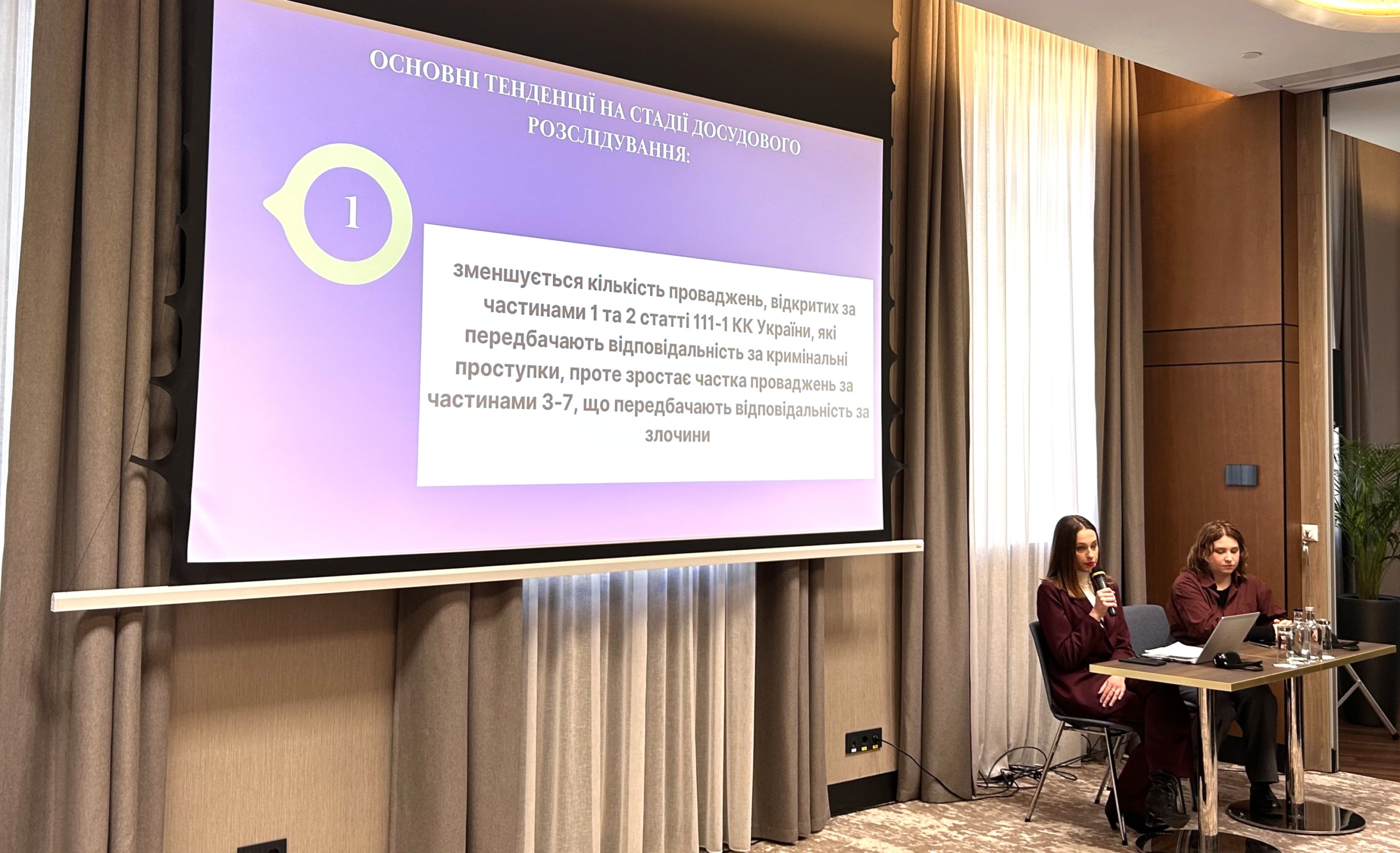 Photo: Diana Deputat, Onysiia Syniuk
Onysiia Syniuk, Head of the Research Department at ZMINA, emphasised a fundamental problem in the legislative construction of Article 111-1 itself: the lack of legal certainty in its wording leads to courts not examining the intent to cause harm to national security.
“Courts, including the Supreme Court, generally derive intent from the mere fact of holding a position. The Article does not require an examination of what work the person performed or what impact that work had: this could, in fact, be classified under another Article of the Criminal Code“, Syniuk explained.
According to her, courts also use the fact of not leaving the occupied territory as an argument in favour of the existence of direct intent or the voluntary nature of the actions. “It is difficult to say how judges assessed the possibility of leaving the occupied territory, but the fact of not leaving is used as an argument“, she noted.
The analyst also provided a specific example of inconsistent legal qualification: in both cases, the matter concerns the forestry sector and a managerial position; however, in one set of proceedings, the judgment was delivered under Part 7 (holding a position in a law enforcement body), while in the other – under Part 5 (holding a managerial position in an occupation administration).
“The judgment contains absolutely no reasoning as to why such approaches were chosen in each case. At the same time, this is critically important for sentencing: Part 7 provides for up to 15 years’ imprisonment with confiscation of property, while Part 5 provides for five to ten years. This is neither an isolated nor a one-off case“, Syniuk emphasised.
The researchers also identify as a separate problem the absence in legislation of exceptions for types of activities that international humanitarian law recognises as necessary in occupied territory: medical personnel, emergency responders, municipal services, and firefighters.
“The legislation makes no provision for any exceptions regarding these types of activities. Consequently, they are not taken into account in any way when considering cases involving those who provide housing and communal services or serve as firefighter-rescuers“, Syniuk emphasised.
The full text of the analytical report is available in Ukrainian and English.
ZMINA has been monitoring the practice of applying Article 111-1 of the Criminal Code of Ukraine since 2022. Previous studies were published in November 2022, September 2023, July 2024, and May 2025. Cross-cutting problems identified through this consistent monitoring include the failure to take into account the context of occupation, a formalistic approach to assessing the actions of the accused, and insufficient examination of intent and coercion.