OSCE WHDC side event: Russia’s Policy of Unlawfully Detaining Ukrainian Civilians and Implications for Lasting Peace
The side event “Russia’s Policy of Unlawfully Detaining Ukrainian Civilians: Implications for Lasting Peace” takes place on October 14, 2026, at 9:00 — 10:00 in the Opera room on the margins of the OSCE Warsaw Human Dimension Conference (WHDC). It is organized by the Ukrainian Legal Advisory Group, Human Rights Centre ZMINA, Ukrainian Archive Mnemonic and Norwegian Helsinki Committee.
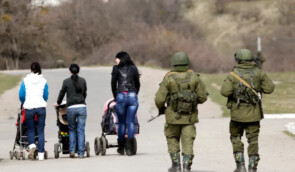
Russia’s enforced disappearance of Ukrainian civilians is not the isolated conduct of individual soldiers or security officers, but a systematic, coordinated policy of the Russian state, implemented through a structured system of occupation and repression. This finding is confirmed by successive monitoring mechanisms — including the OSCE Moscow Mechanism, whose 2024 report established a massive, systematic and deliberate pattern of arbitrary deprivation of liberty of Ukrainian civilians, the UN Commission of Inquiry, and ODIHR’s continuing monitoring — alongside civil society and media investigations, legal action, advocacy and victims’ engagement.
Methods first employed in Crimea from 2014 were subsequently institutionalized and expanded across territories occupied after 2022. Unlawful detention within this system is routinely coupled with prolonged incommunicado imprisonment, coercive interrogation, conviction in violation of fair-trial rights, and torture or other inhuman and degrading treatment.
Within this broader pattern, one case stands apart: that of three former OSCE Special Monitoring Mission staff members, whose international status makes their treatment a direct test of guarantees the OSCE itself will need for any future monitoring role. Dmytro Shabanov, Maksym Petrov and Vadym Golda were detained in 2022 in the temporarily occupied territories of the Luhansk and Donetsk regions despite their international immunity and security guarantees, they were held without proper access to legal assistance or family contact and without the guarantee of a fair trial, before being convicted on fabricated charges of “espionage” and “high treason.” Shabanov and Petrov were sentenced to 13 years’ imprisonment with subsequent deportation to the Russian Federation; Golda was sentenced to 14 years in a strict-regime penal colony.
Recurring negotiations on a possible cessation of hostilities and lasting peace in Russia’s war against Ukraine are directly affected by how these categories of victims are treated. A deal that does not secure the release of civilians held in captivity leaves them in greater danger and undermines the credibility of a ceasefire, whatever form it takes. The SMM staff members’ continued detention in violation of international law is a case in point: without enforceable guarantees of security and immunity for international monitors, any ceasefire monitoring mechanism now under discussion remains vulnerable to pressure, intimidation and selective access, foreclosing comprehensive verification and depriving the parties of a reliable instrument for deterrence and de-escalation.
The event will examine this issue in the context of peace negotiations and discuss how the OSCE, its participating States and other stakeholders can advance both the release of civilians in unlawful detention and accountability for the crimes committed against them. In line with the OSCE’s own ongoing efforts to secure their release, the event will underscore that the release of Dmytro, Maksym and Vadym — and of civilian detainees more broadly — must be treated as a precondition for any credible future monitoring arrangement and achieving lasting peace.
Speakers:
- Anton Naumliuk, Independent Journalist Cooperating with Mnemonic’s Ukrainian Archive
- Ievgeniia Kapalkina, Lawyer, ULAG
- Yelyzaveta Sokurenko, Head of the International Crimes Documentation Department, Human Rights Centre ZMINA
- Representative of the Ministry of Foreign Affairs of Ukraine (tbc)
Moderator:
- Anna Farifonova, Coordinator of the International Justice Programme at the Helsinki Foundation for Human Rights
Access to the event will be granted only to registered participants of the OSCE WHDC.