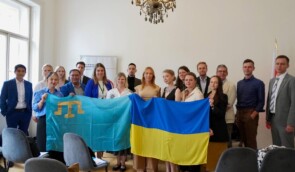
Access to justice behind bars: ZMINA presented Ukraine’s experience at international conference
On 21 September 2026, the Centre for European Constitutional Law (CECL), the European Prison Litigation Network (EPLN), the Human Rights Centre ZMINA and Forum Penal held an online conference entitled “Enforcing Rights and Accessing Justice from Pre-Trial Detention: European perspectives”. Participants from across Europe discussed the practical barriers preventing people deprived of their liberty from effectively defending their rights and accessing justice.
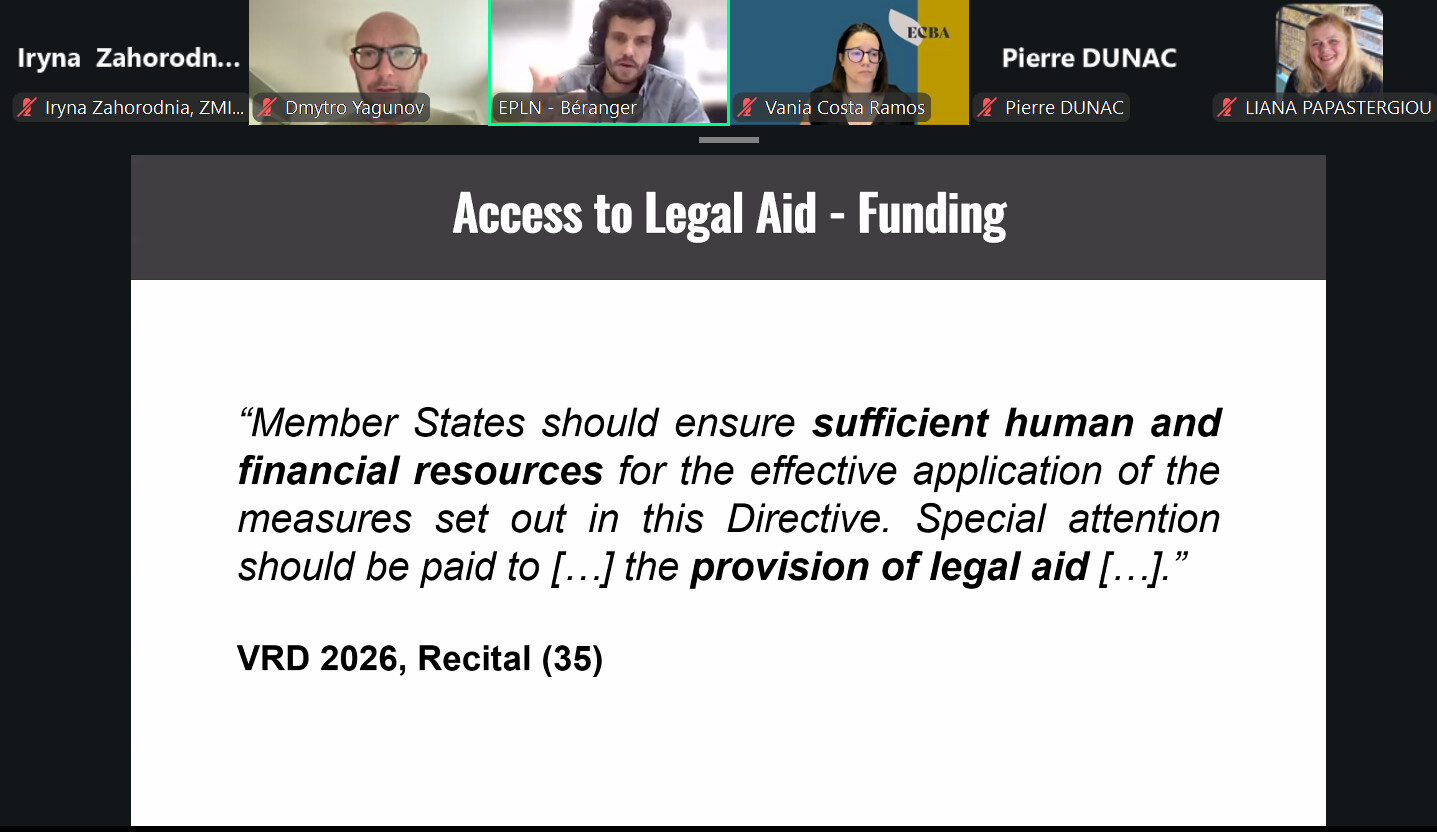
The conference brought together lawyers, judges, human rights advocates, researchers and representatives of international professional organisations from Greece, Portugal, Ukraine, France, Belgium, the Netherlands and other European countries.
The conference comprised four panel discussions. Participants examined the barriers and factors affecting access to justice for people deprived of their liberty in Greece, Portugal and Ukraine; the role of external intermediaries and legal mobilisation; access to justice amid a decline in respect for the rule of law; and international mechanisms for protecting the rights of people deprived of their liberty.
In his opening remarks, Simon Creighton, EPLN Vice-President and a lawyer, stressed the importance of discussing access to justice for people deprived of their liberty, particularly as violations of their rights remain an ongoing concern.
Access to justice in Greece, Portugal and Ukraine
The first panel focused on the barriers and factors affecting the ability of people deprived of their liberty to defend their rights in Greece, Portugal and Ukraine.
The panellists were Ioulietta Bisiouli, Director of the European Implementation Network; Marina Daliani, Vice-President of the Hellenic League for Human Rights; Diana Silva Pereira, Secretary-General of Forum Penal – Associação de Advogados Penalistas; and Mariia Savina, Programme Director at the Human Rights Centre ZMINA.
Mariia Savina presented the findings of a study conducted as part of the DIGNITY project on access to justice for people deprived of their liberty in Ukraine. The report examines not only the legal guarantees of access to legal assistance and judicial protection, but also how these guarantees operate in practice.
According to Savina, Ukrainian law generally guarantees people deprived of their liberty access to legal assistance, judicial protection and complaints mechanisms. In practice, however, these safeguards are applied inconsistently, while Russia’s full-scale war against Ukraine has created further obstacles to accessing justice, particularly due to logistical and security challenges faced by lawyers.
Among other issues identified in the study, Savina highlighted the limited effectiveness of domestic protection mechanisms and additional barriers faced by vulnerable groups, including women, minors, people with disabilities, foreign nationals and stateless persons.
 Mariia Savina
To improve access to justice for people deprived of their liberty, Mariia Savina called for completing reforms to the justice system for people in detention, introduce procedures for effectively challenging inadequate conditions of detention, develop specialisation in prison law, ensure that lawyers have consistent physical access to their clients across different regions and under varying security conditions, and provide predictable funding for the National Preventive Mechanism and civil society.
How to address the power imbalance between prisoners and prison authorities
The second panel focused on the role of lawyers, human rights advocates and other external actors in ensuring access to justice for people deprived of their liberty.
The discussion brought together Pascal Montfort, a judge at the French Court of Cassation; Corentin Durand, a researcher at the French National Centre for Scientific Research (CNRS); Hanna Skrypka, a lawyer and co-founder of the NGO Protection for Prisoners of Ukraine; and Marc Nève, President of Belgium’s Central Prison Monitoring Council and President of the European Prison Litigation Network.
The conference also addressed the role of public oversight in safeguarding the rights of people deprived of their liberty. Hanna Skrypka discussed the practical application of Article 24 of Ukraine’s Criminal Enforcement Code, which allows certain individuals, including representatives of civil society, to visit penitentiary institutions without special permission.
Her organisation conducts around 40 monitoring visits each year. During these visits, civil society representatives inspect conditions of detention, speak with convicted prisoners and assess whether they are receiving adequate medical care. They document cases of torture, ill-treatment or failure to provide medical care and report them to law enforcement authorities, while also providing support to victims and their lawyers.
Marc Nève presented the Belgian model of independent prison monitoring and its mechanisms for handling complaints from people deprived of their liberty.
In Belgium, monitoring is carried out by commissions attached to individual prisons and made up of volunteer members of the public, including lawyers and healthcare professionals. Separate complaints commissions examine complaints from prisoners, while a central body coordinates their work and provides legal support. According to Marc Nève, this system enables civil society to play an active role in independent human rights monitoring.
He also stressed the importance of gradually making the prison system more open. In his view, this is essential not only for monitoring conditions of detention, but also for ensuring access to legal assistance and protecting the rights of everyone within the prison system, including foreign nationals.
Access to justice amid a decline in respect for the rule of law
The third panel focused on prisoners’ access to justice amid a decline in respect for the rule of law.
The panellists were Salvador Guerrero Palomares, Chair of the Criminal Law Committee of the Council of Bars and Law Societies of Europe (CCBE); Benoît David, a member of the Paris Bar Council; Nancy Dekens, Secretary of the Netherlands Association of Criminal Defense Lawyers and a criminal defence lawyer; and Mariarosaria Guglielmi, President of European Judges for Democracy and Liberties (MEDEL).
International perspectives on access to justice
The final panel, “International perspectives on prisoners’ access to justice”, focused on international mechanisms for protecting the rights of people deprived of their liberty and ways to strengthen these safeguards at the European level.
The discussion brought together Vânia Costa Ramos, Chair of the European Criminal Bar Association and a member of the European Committee for the Prevention of Torture; Dmytro Yahunov, a member of the European Committee for the Prevention of Torture; Pierre Dunac, a criminal defence lawyer, Vice-President of the Conference of Presidents of French Bar Associations and a member of the CCBE Criminal Law Committee; and Béranger Dominici, a representative of the European Prison Litigation Network.
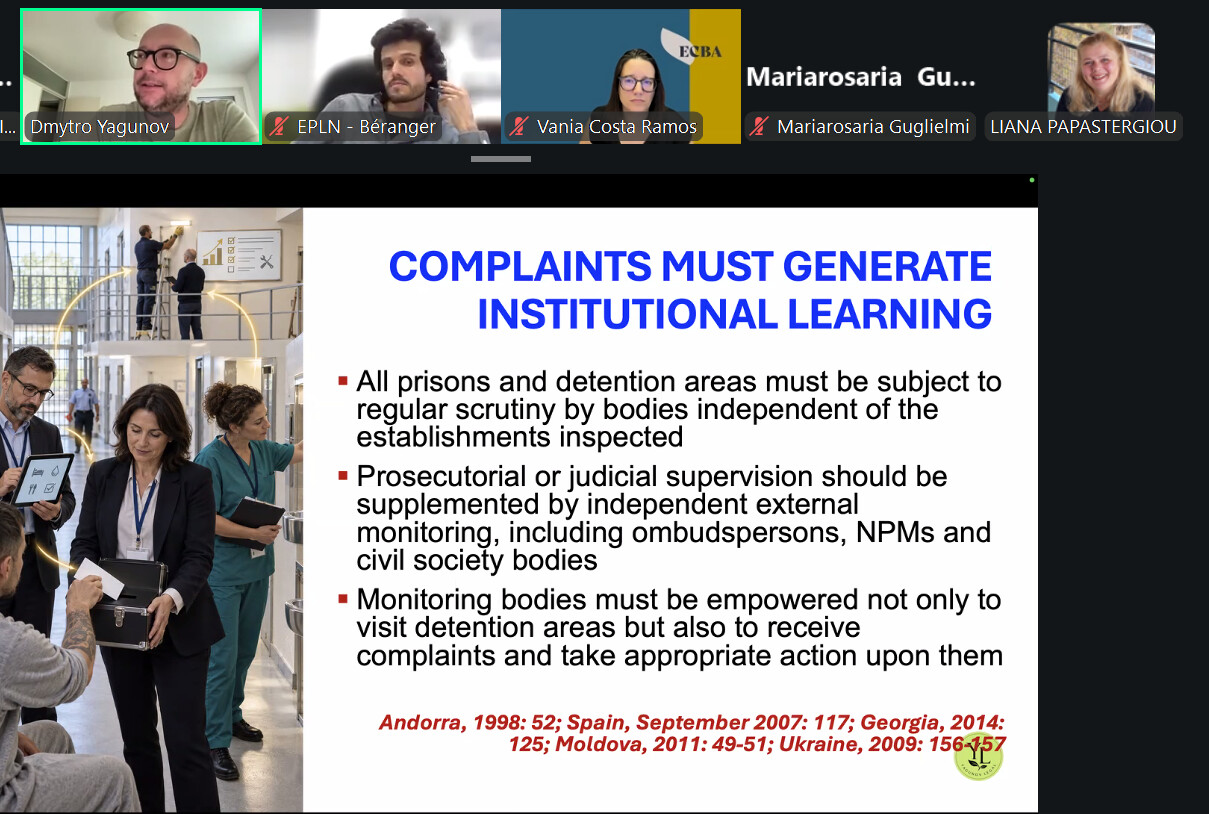
Dmytro Yahunov stressed that the ability of people deprived of their liberty to lodge complaints is not a privilege but a right. Exercising this right requires appropriate infrastructure and accessible mechanisms for submitting and handling complaints.
Pierre Dunac discussed strengthening the role of bar associations in monitoring the prison system and stressed the importance of independent oversight to ensure respect for human dignity in places of detention.
In closing, participants noted that although prisoners’ right of access to justice is recognised, exercising this right remains difficult in practice. People deprived of their liberty must navigate different national, European and international legal procedures, access the legal information they need, gather evidence and overcome practical barriers when bringing cases against penitentiary authorities.
The conference also featured the Prison Law Knowledge Hub, a collaborative platform bringing together legal and practical resources for those defending prisoners’ rights across Europe. The platform is designed to support lawyers, litigants and civil society organisations in their litigation and advocacy work, with resources available in multiple languages to make them more accessible.
The conference was held as part of the DIGNITY project.
More information about the DIGNITY project and its results is available on the project’s LinkedIn page.
The DIGNITY Project aims to improve access to justice and protect the procedural rights of people held in pre-trial detention. The project conducts research, provides training and develops practical tools for professionals. It is implemented by the Centre for European Constitutional Law (CECL) in partnership with the European Prison Litigation Network (EPLN) and the Human Rights Centre ZMINA, with financial support from the European Union.