Ukraine’s European integration: reforms, political will, and the role of civil society
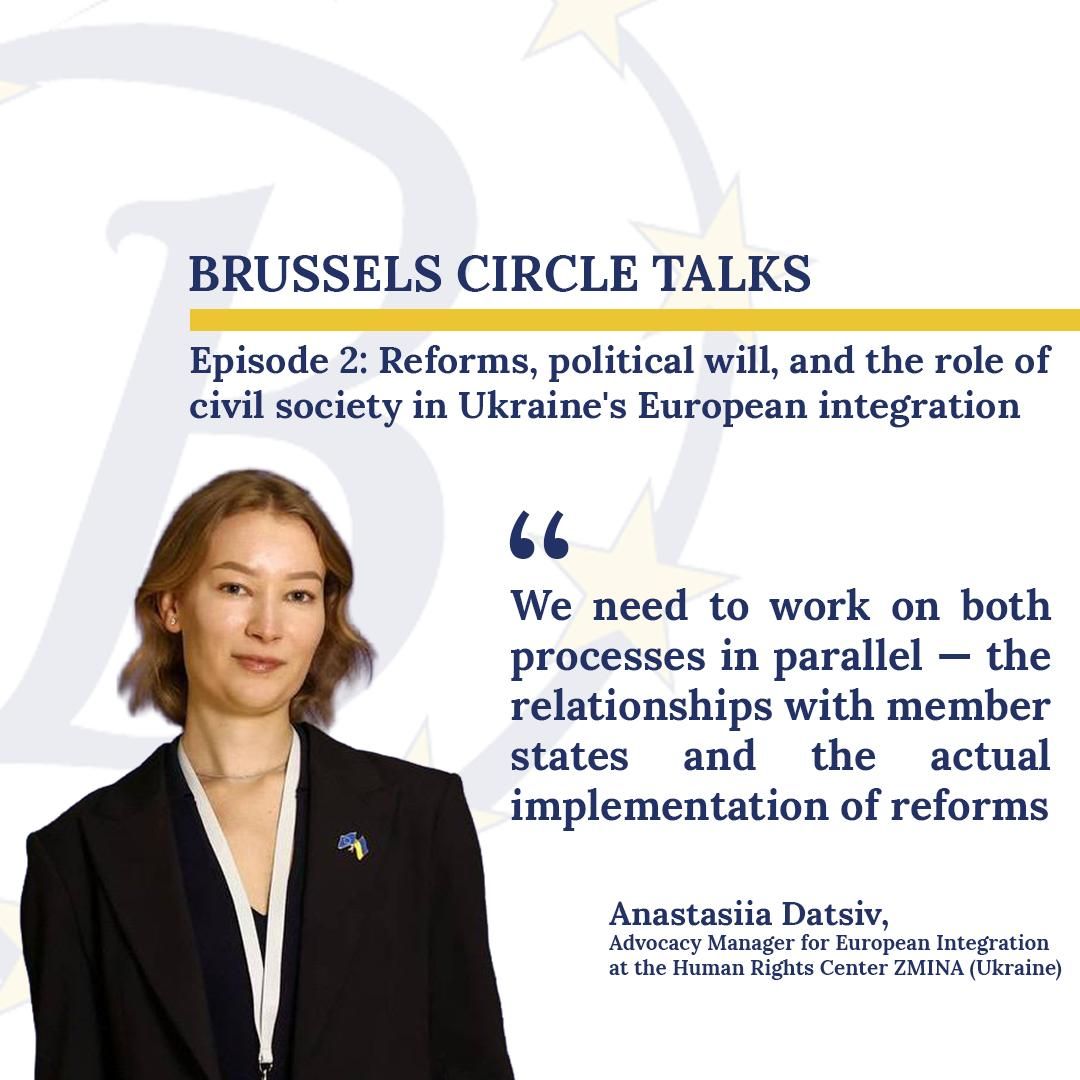
In this conversation, Anastasiia Datsiv, Advocacy Manager for European Integration at the human rights center ZMINA, shares her perspective on the current state of Ukraine’s negotiation process with the EU, the role of civil society, the change of power in Hungary, and the prospects for Ukraine’s EU membership.
BLOCK I. UKRAINE AND THE EU: WHERE DO WE STAND?
Interviewer: Anastasiia, tell our readers and listeners — where does Ukraine currently stand in the EU accession process?
Anastasiia Datsiv: I work in the human rights civil society sector — at ZMINA, as an advocacy specialist on European integration and national advocacy. From the perspective of civil society, we are currently in a somewhat difficult period. We have roadmaps approved nearly a year ago, and they clearly show how stuck we are in the process. Many indicators with deadlines have already been missed — both for the third quarter of 2025 and the first quarter of 2026. At the same time, there are processes that are supposed to be moving us forward but are actually pushing us backward. Literally two hours ago, a new draft civil code was passed in its first reading — and it is highly discriminatory and makes it impossible to adopt the legislation needed for European integration. Personally, I am very skeptical about any progress in this context — there are far too many warning signs.
Interviewer: Are there real safeguards against Ukraine remaining in the status of a permanent candidate — like Serbia or North Macedonia? How do we avoid falling into the trap of endless negotiations?
Anastasiia Datsiv: There is a concept in Western political science called “facade reforms” — and it very aptly describes what we are seeing. Bills are passed with the right titles and explanatory notes, but when you read the text, it turns out they change nothing of substance. Just checkboxes on a to-do list. But facade reforms can only work in the beginning. When negotiations conclude, everything under the first cluster is reviewed again — and it becomes clear that no real changes have taken place. The safeguard against this trap is avoiding the simulation of change: clear accountability for those responsible and actual implementation of reforms, rather than passing the buck between ministries and committees.
Interviewer: Is EU accession about reforms and criteria, or is it primarily about the bloc’s political will to expand?
Anastasiia Datsiv: I share this view — even though the term “political will” is starting to irritate me a little, because our MPs often use it to justify their own inaction. But in essence — yes, that’s exactly right. We saw this over the past year, when Hungary was actively blocking Ukraine’s accession while simultaneously supporting Moldova’s, Serbia’s, and North Macedonia’s progress. That difference in positions is purely about the political incentives and interests of specific actors, not about reforms. Reforms are not being cancelled in the process: even after joining the EU, societies continue to change. So we need to work on both factors in parallel — both the relationships with member states and the actual implementation of reforms.
Interviewer: Is there a risk that by the time we join, the EU itself will have become a more closed bloc due to the rise of right-wing forces and external influences?
Anastasiia Datsiv: I have a counterpoint: external crises may, on the contrary, weaken the EU and lower its standards. Yes, there is a risk that the bloc will restructure and become less strict in upholding its own principles. There is very active discussion right now about abandoning unanimity in favor of majority voting. As a Ukrainian who needs help right now — perhaps that’s a good thing. But at a deeper level, it undermines the foundational philosophy of the EU: coherence and consistency in all decisions. Without the unanimity principle, it is no longer the European Union it was created to be. So it’s difficult to give a clear answer: crises can either unify processes or destabilize them. My subjective view — it’s 50/50.
BLOCK II. HUNGARY AFTER THE ELECTIONS
Interviewer: Power recently changed in Hungary. Péter Magyar has spoken out against Ukraine’s rapid EU accession. Can Hungary shift its policy of persistent blocking?
Anastasiia Datsiv: We need to distinguish between two parallel tracks: Hungary’s relationship with the EU and its relationship with Ukraine. On the EU side — restoring relations and funding is one of Magyar’s cornerstones. That is expected. In Ukraine — the approach remains cautious and pragmatic. Magyar is someone who came from within the Fidesz system, worked there for a long time, and came out of the worldview that party has shaped over 30 years. He primarily protects the interests of his own country and his own citizens. On financial aid — Hungary itself is in a very difficult financial situation, so participation in financial packages for Ukraine is not planned. On military support — the army is small, and the concept of non-interference is maintained. These positions are entirely understandable and expected.
Interviewer: Should we expect a genuine reset in relations between Ukraine and Hungary anytime soon?
Anastasiia Datsiv: A reset is possible in the sense that new people have appeared who are open to dialogue. There are frozen issues — for example, a draft law on educational rights and the language question that was sent to Hungary back in October–November. Five months later, no response. We hope the new government will at least return to the agenda. But it must be clearly understood: Ukraine is not Magyar’s top priority. There are relations with the EU, NATO, and the Western Balkans. Ukraine may be useful mainly as a tool for unlocking certain European funds — a kind of “you scratch my back, I’ll scratch yours” arrangement. Personal will and strategic prioritization are most likely not going to materialize here.
How likely is it that Hungary will return to more constructive engagement with the European Commission?
Anastasiia Datsiv The EU is more than ready. The first positive signal came with the European Parliament elections, when Tisza already won seats at that point. Importantly, shortly after the Hungarian elections, a European Commission delegation led by von der Leyen visited — I cannot recall such a precedent with other countries. This shows that the EU took the signal seriously. That said, it is important not to conflate Tisza and Fidesz — in the European Parliament they have often voted the same way. But at the bilateral level, the European Commission’s relationship with the new Hungarian parliament is already being rebuilt.
BLOCK III. THE ROLE OF CIVIL SOCIETY
Interviewer: To what extent does civil society genuinely influence the European integration agenda? Does the government listen — or merely pretend to?
Anastasiia Datsiv Since August 2024, civil society participation has been formally enshrined in the negotiation process. Working groups were formed across all chapters — with representatives from government structures, civil society, business, and sometimes academia. We are involved, we are consulted. But whether all our proposals are taken into account — that’s a different question. It depends on the topic. In judicial reform and anti-corruption, the influence is greater. In human rights protection — it is considerably harder, because these topics are not a priority for Ukrainian lawmakers or for some European partners. It can be put this way: we are heard, but not always listened to. There are personal and commercial interests, there is the influence of the church, there are various lobbying groups. The channels for influence exist, but so do the obstacles.
Interviewer: The government is proclaiming EU accession by 2027. How realistic is this, and is there a communications strategy at play?
Anastasiia Datsiv As a communications strategy — it’s great. The populist element of our public administration tradition works well here: it creates an image of readiness and resolve. For an external audience — perfect. But from an expert standpoint — no analyst would agree that 2027 is a realistic accession date. When we talk about 2027, we mean it as the year for fulfilling preconditions — not actual membership. Negotiations within the EU continue even after all requirements are met. That is an important distinction. For a domestic audience, this rhetoric already draws irony — from the inside, we understand the actual state of affairs. But in external forums — it signals the seriousness of intent.
BLOCK IV. BRUSSELS FROM THE INSIDE AND LESSONS FOR UKRAINE
Interviewer: How can the experience of Ukrainian interns in Brussels be turned into a real lobbying instrument? What can we learn from Poland and Hungary?
Anastasiia Datsiv: First of all — we are still citizens of a third country. Comparing our influence to that of Polish or Hungarian colleagues is not fair: we play by different rules. The influence of Ukrainians in Brussels is primarily through information and communication campaigns, actions, and sharing what is happening. And not only in Brussels: decisions are shaped in all capitals and cities across Europe, not only in the “heart” of the EU. Access to the European Commission for Ukrainians is limited — it is a large bureaucratic machine with strict processes. It is easier with the European Parliament, which is more open and offers more opportunities for engagement. A particular hope lies with Ukrainians who hold dual citizenship — who are formally EU citizens and have greater opportunities to lobby for Ukraine’s interests from the inside.
Interviewer: How closely does what the EU says publicly about Ukraine’s European integration match what is actually discussed inside the institutions?
Anastasiia Datsiv: I would say it aligns completely. Moreover — even in personal conversations, I have seen such a high level of support for Ukraine and admiration for what we are doing that sometimes it is hard not to start thinking skeptically: do they really have access to all the information and understand the situation from the inside? But both the external and internal communication genuinely align. As for the support — it is sincere.
Interviewer: You studied Euroscepticism and democratic backsliding academically, and now you work with this in real time during a war. What did you have to revise from what you believed as a researcher, and what was confirmed?
Anastasiia Datsiv: Most of what I studied has been confirmed. Of course, my research concerned other countries, but it maps onto our reality very well. For example, Euroscepticism in candidate countries is explained by processes very similar to what is happening here. I studied democratic backsliding through the lens of economic and financial crises. And in our case, we have a war, which affects the economy, which in turn affects the level of democracy and electoral sentiment. A very important lesson concerns the pace of accession: Poland and Hungary joined quickly — and within 10 years we saw powerful Euroscepticism and right-wing radical governments there. Too slow an accession in the Balkans — and citizens begin to ask: “Why do we even need this?” These are two opposing examples — and both serve as warnings. Effectively, a manual of what can and cannot be done.
EXPERT RECOMMENDATIONS
Interviewer: What book or resource would you recommend for understanding the dynamics within the EU?
Anastasiia Datsiv: The books that made the greatest impression on me were by the Bulgarian political scientist Ivan Krastev — in particular After Europe and The Light That Failed. I devoured them while preparing for my Master’s degree. They build an understanding of how countries should be moving toward the EU — and what happens when they don’t. Highly recommended.
Interviewer: If you were speaking to students — how would you motivate them to pursue an internship at EU institutions?
Anastasiia Datsiv: It’s a glimpse into that bright future we can all have — if we work persistently on improving our country. That’s probably the best way to put it.
Source: Brussels Circle