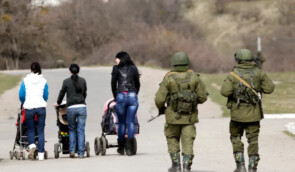
On the margins of the OSCE conference in Warsaw, ZMINA calls on international partners to help protect journalists and volunteers from drone attacks
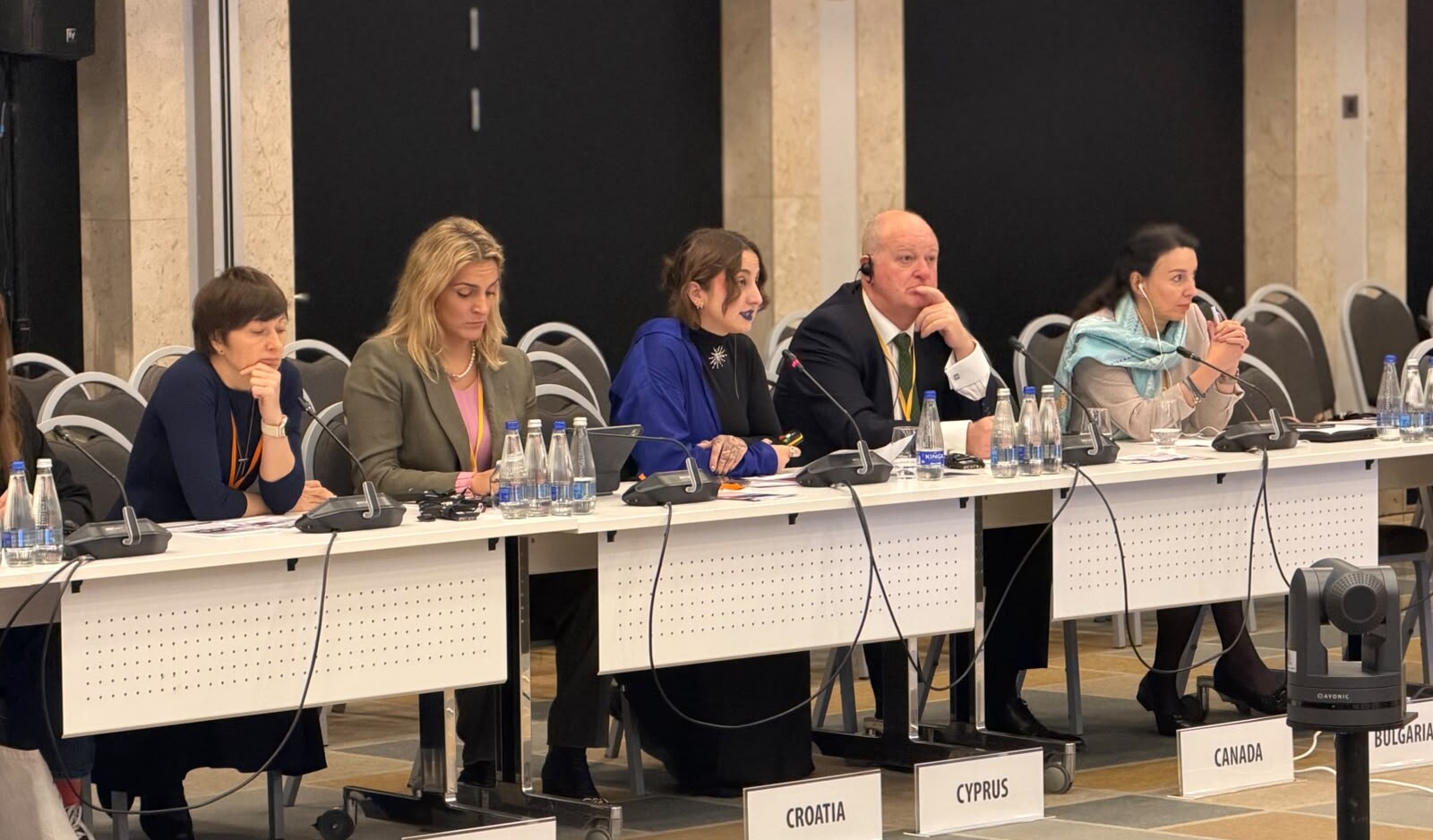
On 13 October 2026, on the margins of the OSCE Warsaw Human Dimension Conference (WHDC), the Human Rights Centre ZMINA, together with the Institute of Mass Information (IMI) and the Permanent Mission of Ukraine to the International Organisations in Vienna, held a side event titled “Under Fire: Journalists and Volunteers Facing New Challenges of Drone Warfare”. Participants discussed ways to protect journalists and volunteers from drone attacks and called on the international community to reconsider how international humanitarian law is applied in light of the realities of modern warfare.
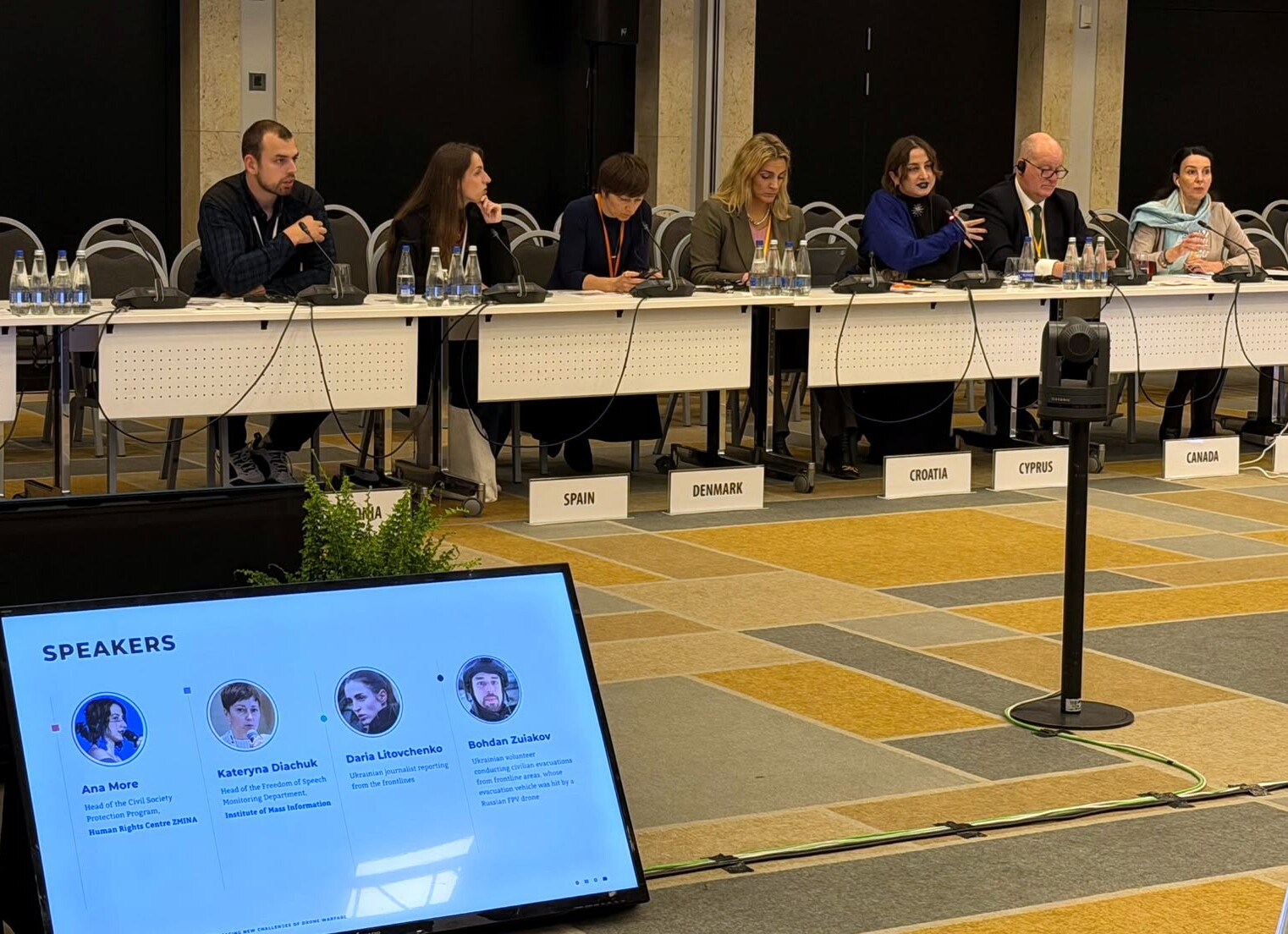
The event was co-sponsored by the Permanent Delegation of the EU to the OSCE, the Permanent Delegation of the UK to the OSCE and the Netherlands Helsinki Committee. ZMINA’s participation was financially supported by the European Union. The content of the event is the sole responsibility of the Human Rights Centre ZMINA and does not necessarily reflect the views of the European Union.
The discussion focused on the emerging threats that drone warfare poses to civilians working near the front line. Russian forces target journalists documenting the impact of the war and war crimes, as well as volunteers evacuating civilians and delivering humanitarian aid. At the same time, life-saving equipment designed to protect against drones can raise questions about its dual-use nature and affect how the civilian status of those using it is assessed.
In her opening remarks, Catalina Bolma-Dupont, Deputy Permanent Representative of the European Union to the OSCE, stressed the importance of addressing these challenges at the international level.
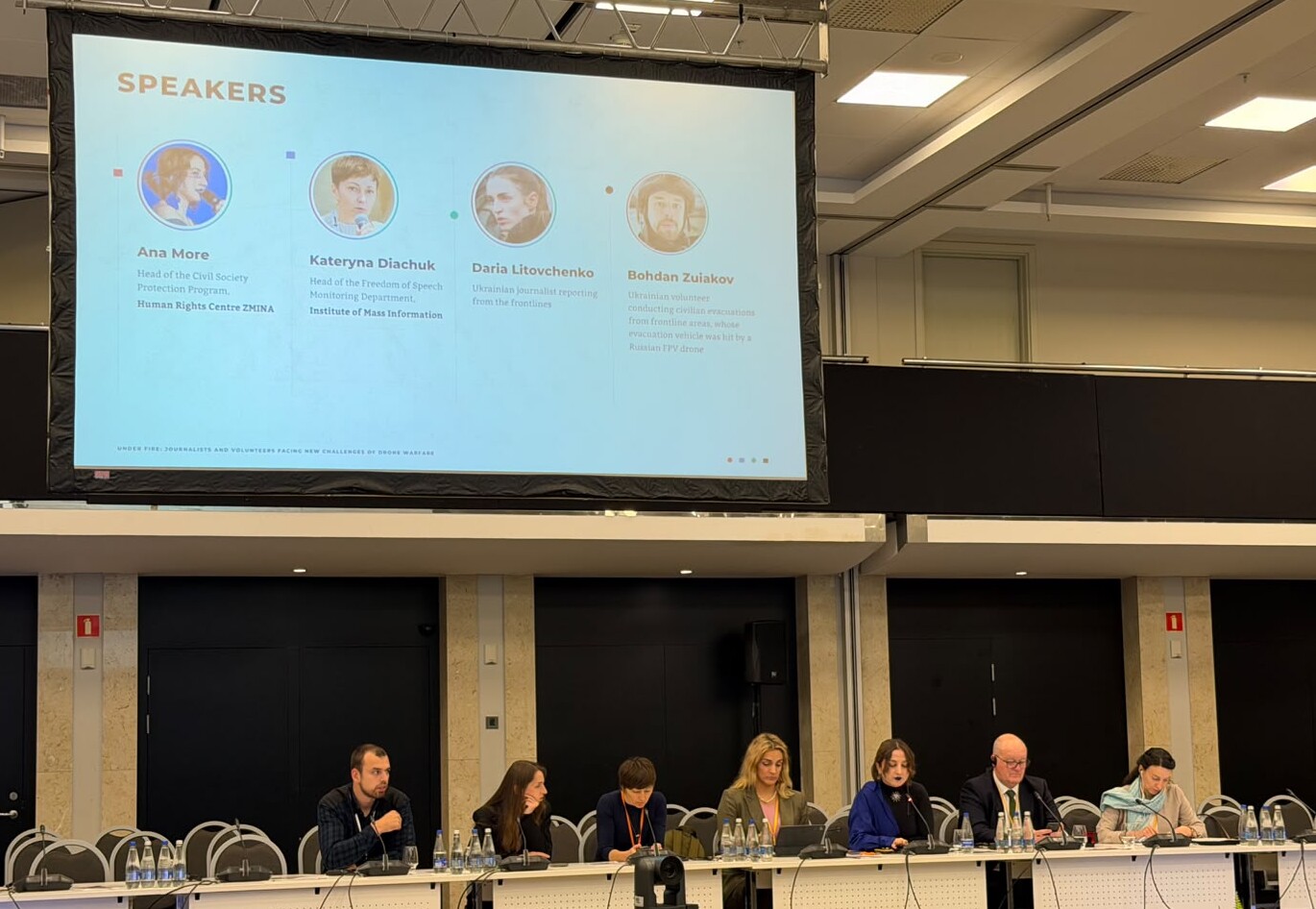
Ana More, Head of the Civil Society Protection Programme at the Human Rights Centre ZMINA, stressed that international humanitarian law and the approaches taken by international partners must reflect the realities of modern warfare. She said journalists and volunteers must be able to use drone detectors and other protective equipment to continue their work and stay alive.
According to IMI, 139 media workers have been killed as a result of Russia’s aggression during more than four years of full-scale war, including 15 who died while carrying out their professional duties. At least 27 civilian Ukrainian media workers remain in Russian captivity.
According to the Committee to Protect Journalists (CPJ), 129 media workers were killed worldwide in 2025, including 39 in drone strikes. By comparison, two media workers were killed in such attacks in 2023. These figures show how rapidly drones are becoming a serious threat to journalists around the world.
ZMINA has also documented the deaths of 115 civilian volunteers, including 15 foreign nationals, killed by Russian forces while carrying out humanitarian missions. They were evacuating people from combat zones, delivering food, water and medicine, helping to rebuild destroyed homes, clearing mines and searching for the bodies of those killed.
“After the event, many partners expressed surprise that drone detectors are even considered dual-use equipment. Some said this was the first time they had heard about it. We very much hope that our partners will raise this issue in their own countries, with their governments and international donors. The experience of Ukrainians can save the lives of journalists and humanitarian workers around the world, as drone attacks are becoming increasingly dangerous beyond Ukraine as well. International humanitarian law must respond to reality,” Ana More said.
According to More, drone detectors, electronic warfare (EW) equipment and other counter-drone systems can be used to protect civilians rather than to take part in hostilities. The mere use of non-lethal protective equipment should therefore not automatically call into question the civilian status of a journalist or volunteer.
ZMINA called on OSCE participating States and international donors to fund drone detectors, safety training, shelters, armoured vehicles and first aid training.
Daria Litovchenko, a war correspondent at the international multimedia broadcasting platform Freedom UATV, shared her experience of reporting from the Kherson region, where Russian drones have become a constant threat to journalists and civilians.
She recounted the story of 66-year-old Iryna, who was grazing goats near a cemetery on 7 July. When she spotted a Russian drone, she tried to flee. She survived the attack but lost her left leg. With Russian drones operating in the area, medical personnel were unable to reach her, so police officers evacuated her with the help of the military.
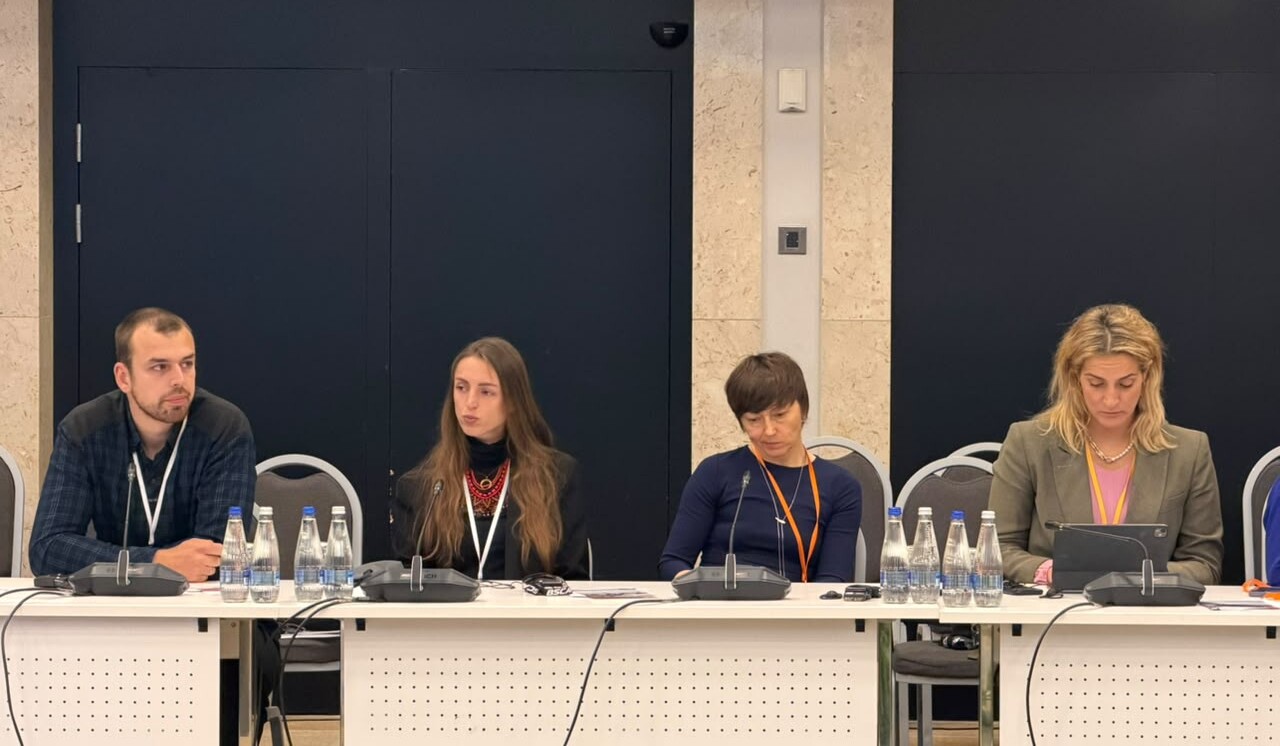
According to Litovchenko, such accounts show that Russian forces attack civilians even when they pose no threat. Journalists must nevertheless continue their work to document such incidents, collect witness accounts and seek accountability for these crimes.
“PRESS markings have long since stopped guaranteeing our safety. Quite the opposite – they have made us targets. Russia has been ignoring international conventions for more than a decade. We need to blend in rather than identify ourselves as press,” Daria Litovchenko stressed.
The journalist said she always carries a drone detector, even when going out for everyday errands, and makes sure to use it in her car. She said the device had helped her escape danger on several occasions by giving her a few seconds to react. However, detectors cannot detect every type of drone, including fibre-optic drones, while Russian forces change operating frequencies to evade existing protective systems.
Litovchenko also recalled the deaths of journalist Olena Hubanova and cameraman Yevhen Karmazin, who were killed in a Russian Lancet drone strike in Kramatorsk in October 2025. Another member of the film crew, Oleksandr Kolychev, was seriously injured.
According to Litovchenko, existing safety protocols no longer reflect the conditions in which journalists work near the front line. Drone detectors should therefore become an essential part of their protective equipment, alongside body armour, helmets and first aid kits.
Humanitarian volunteer Bohdan Zuiakov, who carries out evacuation missions in frontline areas, described how the widespread use of FPV drones has changed the conditions in which volunteer teams operate.
At the start of the full-scale invasion, evacuations were possible even near Russian military positions, but the area within striking range has since expanded significantly. According to Zuiakov, the danger comes not only from attacks on humanitarian vehicles but also from Russian forces deliberately pursuing ordinary civilian cars used by people trying to escape.
Zuiakov’s team has lost six vehicles during evacuation missions over the past two years. One of the most tragic incidents occurred during a mission to Kostiantynivka, where volunteers were trying to evacuate an injured man who had lost an arm in a drone strike. An FPV drone struck their vehicle, killing a volunteer named Viacheslav and injuring two other team members. According to Zuiakov, the injured man they had gone to rescue died that same evening before help could reach him.
Zuiakov said that in the most recent incident, their vehicle was attacked three times in a single week. The third attack destroyed it. The vehicle was still attacked despite displaying humanitarian organisation stickers and the team carrying no weapons.
These accounts show that marking vehicles as humanitarian does not guarantee their safety and that evacuation missions are becoming increasingly dangerous. Volunteers need not only appropriate equipment but also international recognition of their right to use devices that help them detect threats in time and avoid attacks.
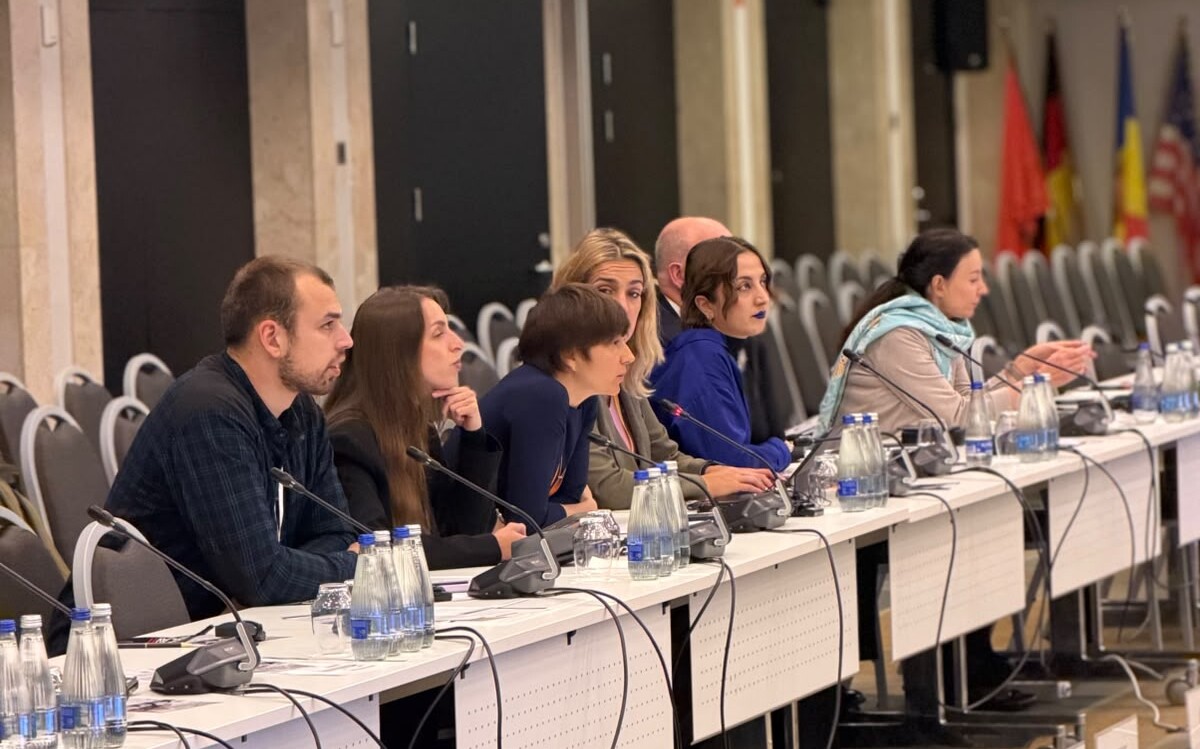
Kateryna Diachuk, Head of the Freedom of Speech Monitoring Department at the Institute of Mass Information, stressed that Russia’s full-scale war remains the greatest threat to Ukrainian media and that drones became one of the main means of attacking journalists in 2024–2026.
According to IMI, Russia has committed 977 crimes against journalists and media outlets since the start of the full-scale invasion. The organisation has also documented at least 85 deliberate attacks on media offices and the closure of at least 337 media outlets.
Kateryna Diachuk pointed out that the threats extend beyond physical attacks. Russia continues to unlawfully detain Ukrainian civilian journalists, persecute media workers in occupied territories, impose lengthy prison sentences on them and carry out cyberattacks against national and regional media outlets.
Despite the war, Ukraine’s independent media continue to operate, investigate crimes and counter disinformation. In 2026, Ukraine rose seven places in the Reporters Without Borders World Press Freedom Index, ranking 55th out of 180 countries.
According to the IMI representative, emerging threats require changes to international approaches to protecting journalists. The use of drone detectors and other non-lethal protective equipment should not automatically be regarded as participation in hostilities, as these devices are intended to help civilians avoid attacks.
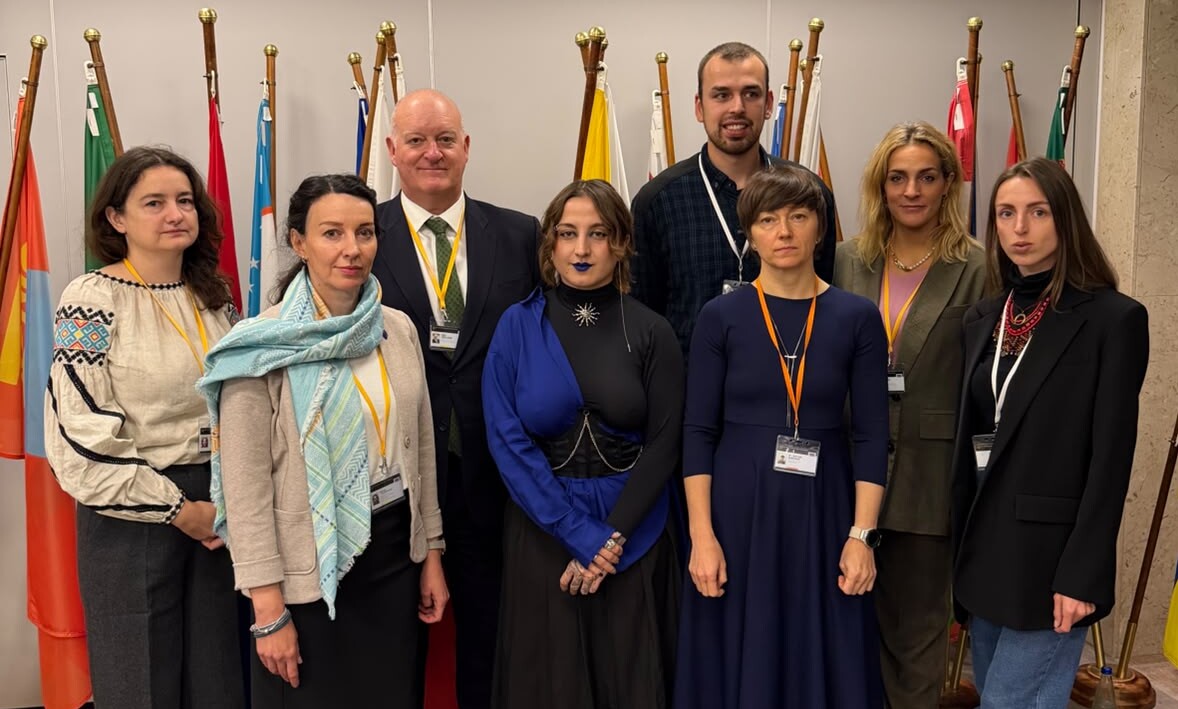
Participants stressed the need to develop clear guidelines distinguishing between passive threat detection, protective electronic equipment and offensive counter-drone operations. They also called for support for the systematic documentation and independent investigation of attacks on journalists and humanitarian workers.
Ambassador Neil Holland, the UK Permanent Representative to the OSCE, thanked Ukraine, ZMINA, the Institute of Mass Information and the EU delegation for organising the discussion.
He stressed that participants’ first-hand accounts help shed light on the real consequences of the war and identify ways to address emerging threats. He said the UK supports the protection of media freedom, journalists’ safety and accountability for attacks on media workers.
The ambassador called on OSCE participating States and international partners to continue work on the recommendations discussed at the event.