From supporting political prisoners to reintegrating people from occupied territories: ZMINA at Donbas Media Forum 2026
The Human Rights Centre ZMINA took part in Donbas Media Forum 2026, held in Kyiv from 8 to 10 October.
Letters to illegally imprisoned journalists
On the opening day, 8 October, ZMINA held a solidarity event called “Letters to Captivity” in support of 27 Ukrainian journalists illegally detained by Russia. Viktoriia Nesterenko, a human rights defender and project manager at ZMINA, and Dzhemilie Abliakimova, a cultural manager, activist and co-founder of the Kitap Qalesi publishing house, took part in the event. They advised forum participants on how to write letters or sign postcards while following safety guidelines.
“Letters are a powerful source of moral support for imprisoned journalists. It is also very important for journalists who are illegally detained to receive news from territories that are not under occupation. They need to know that they have not been forgotten, that people are still fighting for them, and that their voices and the work they did under occupation have not been forgotten and still matter to the public,” Viktoriia Nesterenko stressed.
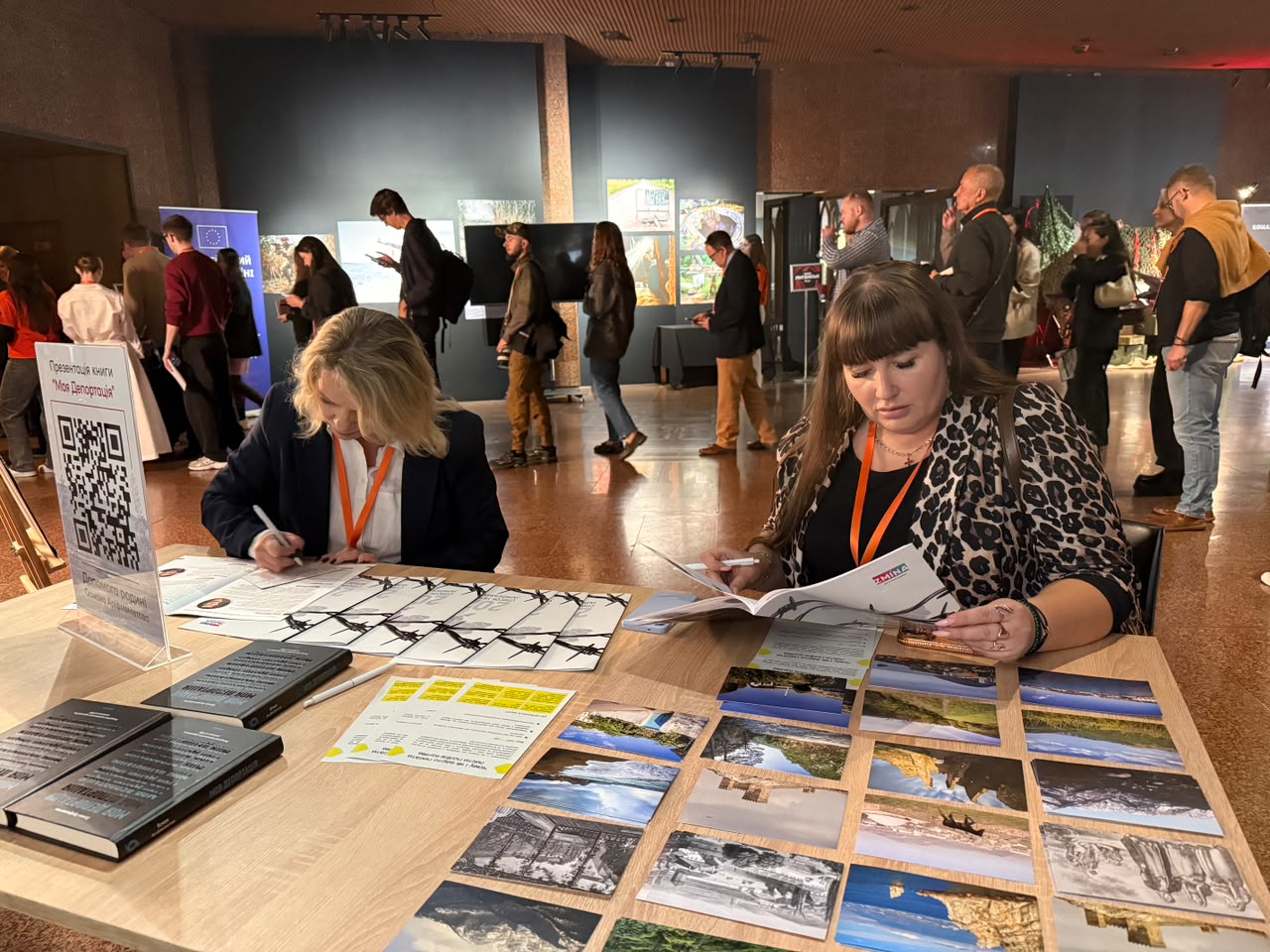
Forum participants could choose which journalist to write to, using the guidelines for writing letters to political prisoners. The initiative aims to support journalists illegally detained by Russia, maintain contact with them and remind them that their work and voices still matter.
Discussion: Invisible People, Visible Territories: How Not to Lose People in the Fight for Square Kilometres
The following day, 9 October, Alena Lunova, ZMINA’s Advocacy Director, took part in a discussion titled “Invisible People, Visible Territories: How Not to Lose People in the Fight for Square Kilometres”. Other participants included Serafyma Kruk, who had left occupied territory; Nataliia Humeniuk, co-founder and executive director of the Public Interest Journalism Lab; and Iryna Ivanova, head of the NGO “Association for the Promotion of Population Self-Organisation”. The discussion was moderated by Anna Murlykina, editor of the 0629 news outlet and coordinator of a relocated media cluster. The participants discussed the obstacles faced by residents of occupied territories when leaving for Ukrainian government-controlled territory and after their arrival, state reintegration policy and the role of the media in reporting on life under occupation.
 Anna Murlykina, Alena Lunova, Serafyma Kruk, Iryna Ivanova, Nataliia Humeniuk
Alena Lunova: Ukraine lacks a unified approach to working with people from occupied territories
Alena Lunova stressed that the problems people face after leaving occupied territories are systemic. One of the main obstacles is obtaining Ukrainian documents. Lengthy identity verification procedures leave young people from temporarily occupied territories without passports for months, preventing them from renting accommodation, finding formal employment, accessing healthcare or receiving state benefits.
According to Lunova, the problem lies not only in the procedures themselves but also in how they work in practice. Ukrainian authorities require extensive evidence to verify a person’s identity, yet documents issued by the occupation authorities are not used for identification, even when they contain basic information such as a person’s name, date of birth and photograph. As a result, people who have left occupied territories find themselves unable to prove their identity or exercise even their most basic rights.
 Alena Lunova
Alena Lunova also pointed out that one reason for this situation is that residents of occupied territories are seen primarily as potential security risks. This attitude was reflected, in particular, in the findings of public opinion surveys presented at the start of the discussion. However, ZMINA’s Advocacy Director stressed the need to distinguish between the experience of living under occupation and collaboration with Russia, and to assess specific risks rather than treating everyone who has lived under occupation with suspicion.
Alena Lunova identified the lack of a coordinated state policy as another systemic problem. Different government bodies operate within their respective mandates and follow their own approaches, but their decisions are not always aligned. For example, measures aimed at the reintegration of young people cannot work effectively if a person is unable to enter Ukraine or lacks the passport needed to access education, services and other opportunities.
Furthermore, Alena Lunova stressed that the lack of a clear government approach also affects people’s decisions about whether to leave occupied territories. The prospect of lengthy procedures, difficulties obtaining documents and challenges adjusting to life in government-controlled territory may discourage them from leaving, even when they have the opportunity to do so.
“After 12 years, we cannot pretend that occupied territories do not exist and only start helping people once they become internally displaced. We need to shift our focus and talk more about the demographic risks facing Ukraine. Ukrainians living in occupied territories can contribute to the country’s development. But if we want people to leave occupied territories, we must simplify entry and reintegration procedures,” ZMINA’s Advocacy Director said.
Serafyma Kruk: People are afraid to leave occupied territories because they are unsure whether they can integrate into Ukrainian society
Serafyma Kruk, who grew up in occupied territory and lived in Donetsk, shared her experience of reaching Ukrainian government-controlled territory. She managed to leave in May 2026 with the help of volunteers from the NGO “Compass of Dreams”, after spending three years trying to leave on her own. Persecution by Russian occupation authorities and a lack of documents made her departure difficult and dangerous.
According to Kruk, people living under occupation often distrust volunteer organisations. Russia uses fake pro-Ukrainian initiatives to identify and persecute people with pro-Ukrainian views. As a result, information about safe ways to leave is more often shared through trusted personal contacts.
 Serafyma Kruk
However, the difficulties do not end once people cross the contact line or leave occupied territory. Kruk said she had been living in Ukrainian government-controlled territory for several months without the necessary documents, making it difficult for her to build a stable life.
“I cannot get a job. I cannot access healthcare, receive state benefits, open a bank account or buy train tickets. I am left on my own, just hoping that somehow I will find a way through this. It should not be like this,” she said.
Kruk stressed the need to introduce temporary documents that would allow people to access basic services while their identities are being verified. She also highlighted people’s fears of facing prejudice in Ukraine.
“You are very afraid of collaborators, and we are very afraid that you will call us collaborators,” Serafyma Kruk stressed.
According to Kruk, Russian propaganda constantly tries to convince residents of occupied territories that Ukraine has forgotten about them and is not waiting for them to return. It is therefore important not only to counter these claims but also to create practical conditions that enable people to leave occupied territories and receive support.
Nataliia Humeniuk: Media should report more on everyday life under occupation
Nataliia Humeniuk stressed that the media should report more responsibly on life in occupied territories rather than portraying them as places about which Ukrainian society knows nothing. She noted that, over 12 years of war, journalists and human rights defenders have gathered extensive testimony about life under occupation, including accounts of war crimes and repression.
 Nataliia Humeniuk
 She also highlighted the responsibility of editors and journalists when reporting on occupation. A lack of understanding of the subject and insufficient communication with human rights defenders and those working on issues related to occupied territories can result in reporting that harms people and exposes them to additional risks. Humeniuk therefore called for support for media outlets that cover the subject responsibly and for critical scrutiny of reporting that contains errors or could put residents of occupied territories at risk.
Serafyma Kruk added that some media reports about her and her departure from occupied territory had included details that could identify her and her relatives, despite prior warnings. Disclosing such information can pose additional risks to people whose loved ones remain under occupation.
Iryna Ivanova: State strategy needs a concrete action plan
Iryna Ivanova discussed the development of a state strategy for reintegrating people from occupied territories.
She noted that a strategy alone would not solve these problems without concrete steps, designated institutions responsible for carrying them out and mechanisms for implementation. According to Ivanova, it is also important to take into account the distrust of state institutions among residents of occupied territories. State policy must therefore include not only formal procedures but also safe communication, practical assistance and clear rules for engaging with people.
 Iryna Ivanova
 Donbas Media Forum is an annual conference organised by journalists for journalists. The first Forum took place in 2015, after Russia launched its war in 2014, when journalists from the Donetsk and Luhansk regions were among the first to face new professional challenges, from relocating newsrooms to reporting on developments along the front line.
In 2018, the Forum became the leading platform for regional journalists and local media outlets from across Ukraine. Following Russia’s full-scale invasion, it became the country’s largest media event.
 Anna Murlykina, Alena Lunova, Serafyma Kruk, Iryna Ivanova, Nataliia Humeniuk
 Photo: Donbas Media Forum, by Roman Chorniy.