Russia systematically seizes property in occupied territories: Onysiia Syniuk discussed legal mechanisms and accountability at a JustTalk discussion
On 9 October 2026, a JustTalk discussion titled “Property under Occupation: From Unlawful Seizure to Accountability” took place in Kyiv. It focused on practices used to deprive Ukrainians of their property rights in the temporarily occupied territories, legal mechanisms for protecting victims and holding those responsible to account. Onysiia Syniuk, Head of Research Department at the Human Rights Centre ZMINA, took part in the discussion. She also prepared a discussion paper examining unlawful property seizures and assessing them from a legal perspective.
 Onysiia Syniuk, Viktoriia Kramarenko, Olha Kuryshko, Marharyta Sokorenko, Daria Svyrydova (holding the microphone)
 The discussion was moderated by Daria Svyrydova, a lawyer and partner at the Azones law firm. Other speakers included Olha Kuryshko, Permanent Representative of the President of Ukraine in the Autonomous Republic of Crimea; Marharyta Sokorenko, Government Agent before the European Court of Human Rights; and Viktoriia Kramarenko, Head of the Department for Countering Crimes Committed in Armed Conflict at the Prosecutor’s Office of the Autonomous Republic of Crimea and the City of Sevastopol.
Russia uses property seizures as a means of controlling occupied territories. Since 2014, the occupation authorities have used various methods to deprive people of their property, including so-called nationalisation, compulsory re-registration under Russian law, declaring property “ownerless” and rulings by occupation courts. These are not isolated incidents but part of a systematic policy aimed at subjugating the population and consolidating Russia’s control over the occupied territories.
In the discussion paper, Onysiia Syniuk examines how these methods have evolved, their legal implications and the challenges Ukrainian authorities face in documenting violations and investigating crimes against property.
During the discussion, Olha Kuryshko stressed that property seizure practices in Crimea have developed over 12 years of occupation, with compulsory re-registration, “nationalisation” and the deprivation of property rights becoming part of a broader policy of putting pressure on the population.
“If we look beyond property rights to human rights violations more broadly, the situation from 2014 to 2022 was significantly different from what we have seen since 2022. Russia is using an increasing number of coercive measures. In particular, it actively identifies people with pro-Ukrainian views, and property seizures have become one way of putting pressure on them. Before 2022, the occupation authorities tried to give such actions an appearance of legality, including through court rulings. Since 2022, however, the procedure has changed. Occupation administrations now decide which individuals and legal entities to add to the relevant lists, based on recommendations from the so-called anti-terrorism commission. Their property is then re-registered in the name of the occupation administration,” explained the Permanent Representative of the President of Ukraine in the Autonomous Republic of Crimea.
Olha Kuryshko also noted that the occupation authorities rent out or auction off seized property. According to figures she made public, rental income has reached 34 billion roubles. The occupation administrations claim that proceeds from the sale of certain properties are used to fund activities related to the war against Ukraine.
A separate mechanism for seizing property targets land plots, the Permanent Representative added. After parts of Crimea were designated as border areas, Ukrainian citizens who had not re-registered their land under Russian law faced the risk of losing their property. Monitoring has documented 128 court rulings ordering the seizure of such plots. In addition, the occupation authorities are seizing unclaimed agricultural land shares. According to available information, this process has affected around 39,000 hectares of land.
 Olha Kuryshko
 Olha Kuryshko reported that at least 759 individuals and legal entities have been documented as having had their property seized, including 77 cases in Sevastopol. Information on approximately 2,000 properties has been gathered from publicly available sources, but these figures are not final, as the occupation authorities have restricted access to information about property transactions since 2022.
In closing, Olha Kuryshko stressed the need to document these violations and ensure they are taken into account in future compensation mechanisms.
“We are essentially dealing with figures, but behind them are people who have lost their property. It is important to speak with them and gather information about these cases. It is equally important to ensure that the Register of Damage for Ukraine takes account of these violations dating back to 2014, because property seizures have been taking place since the beginning of the occupation, not just since the full-scale invasion,” she concluded.
Onysiia Syniuk explained that the methods used to seize property in occupied parts of eastern Ukraine differed from those Russia used in Crimea. This was because, in 2014, Russia did not recognise the occupied parts of the Donetsk and Luhansk regions as part of its territory, instead operating through the so-called “DPR” and “LPR” under its control. These entities had their own property management systems and registers, although their legislation largely replicated Russian practices.
One method of exerting pressure was to make confirmation of property ownership dependent on a person’s political loyalty. Onysiia Syniuk cited a practice introduced in 2016 in the so-called “LPR”, under which Ukrainian property documents had to be legalised and applications were referred to the “ministry of security” for review. The ministry was tasked with determining whether applicants were engaged in activities that the occupation authorities considered a threat to the entity’s security or political development.
“There was no clear procedure for determining whether a person fell into these categories. In practice, the relevant authority could arbitrarily decide whether to allow the documents to be legalised. Without legalisation, people could no longer prove their ownership of the property,” explained the Head of Research Department at ZMINA.
According to Onysiia Syniuk, the practice of declaring property “ownerless” began spreading in occupied parts of eastern Ukraine as early as 2015. In 2021, the so-called “DPR” and “LPR” adopted new legislation setting out more detailed procedures for declaring real estate “ownerless”. In particular, occupation administrations could classify property as “ownerless” if its owner failed to confirm their ownership rights in person within a specified period.
 Onysiia Syniuk
After 2022, these practices spread to the occupied parts of the Kherson and Zaporizhzhia regions. Following the illegal declaration that these territories had been incorporated into Russia, efforts began to standardise property registration rules. In December 2025, Russia passed a federal law establishing procedures for declaring real estate ownerless. Property can be classified as ownerless if it is not registered in the Russian property register, utility bills have not been paid or occupation authorities determine that it is “not in use”. It can then be allocated for use by Russian citizens who have lost their homes because of the war, as well as Russian civil servants, education professionals, law enforcement officers and military personnel. According to Syniuk, cases of such transfers have already been documented.
One of the main challenges, Onysiia Syniuk stressed, remains establishing the true scale of property seizures. Unlike in Crimea, where some decisions by the occupation authorities can be tracked, there is no single source systematically collecting data on property rights violations in eastern Ukraine dating back to 2014.
“Some government bodies and civil society organisations tried to assess the scale of the problem, but information was never collected systematically. Many sources have since been lost, and how to recover this data remains an open question. Some people who have lost their property may not even have documents proving that they owned it,” Onysiia Syniuk said. She added that these were not isolated incidents but part of a systematic policy aimed at establishing control over the occupied territories and their populations.
Viktoriia Kramarenko discussed investigations into crimes against property in occupied Crimea. According to Kramarenko, the Prosecutor’s Office is investigating more than 150 criminal offences involving the unlawful appropriation of property. Since the occupation began in 2014, Russia has nationalised more than 6,000 properties.
She noted that Russia continually changes its methods of expropriating property. While such decisions were previously made mainly by occupation courts, they are now also approved by occupation administrations. This complicates investigations, as Ukrainian law enforcement officers have no access to the occupied territory and many Russian registers are not publicly accessible. In addition, victims are not always able or willing to cooperate with law enforcement because of security risks or a lack of documentation.
 Viktoriia Kramarenko
Despite these obstacles, the Prosecutor’s Office gathers evidence from accessible registers and decisions issued by occupation courts and administrations, and works with victims and witnesses. According to Viktoriia Kramarenko, several representatives of the occupation authorities have already been notified of suspicion. They include two heads of occupation administrations in Crimea who were involved in nationalisation decisions and two occupation judges who ruled on the compulsory expropriation of land plots belonging to Ukrainian citizens. The judges were notified of suspicion in 2026.
The Head of the Department for Countering Crimes Committed in Armed Conflict at the Prosecutor’s Office of the Autonomous Republic of Crimea and the City of Sevastopol also drew attention to the appropriation of cultural heritage. Russia extended its legislation to cultural heritage in occupied Crimea, established Russian institutions by taking over Ukrainian research institutes and museums, and transferred property to them, including real estate and museum collections. These assets have since been included in the Museum Fund of the Russian Federation and may now be located either in Crimea or in Russia.
Marharyta Sokorenko stressed the importance of judgments by the European Court of Human Rights (ECtHR) in establishing a pattern of property rights violations in occupied territories and protecting the rights of victims. She explained that, in inter-state cases, Ukraine had demonstrated the existence of an administrative practice of property rights violations by Russia. In individual applications, however, the Court assesses each applicant’s circumstances separately.
 Olha Kuryshko, Marharyta Sokorenko (holding the microphone), Daria Svyrydova
In particular, in its judgment in Bazhenov and Others v. Russia and Ukraine, the ECtHR examined complaints from people who had lost their land plots in occupied Crimea after Russian occupation courts revoked their ownership rights. The Court confirmed that the unlawful application of Russian legislation in occupied territory and rulings by occupation courts cannot serve as grounds for depriving people of their property. However, not all applicants received a favourable judgment: the Court assessed how each applicant had acquired ownership rights and the circumstances in which they had lost them.
“The ECtHR does not simply establish that Russia systematically violates property rights in occupied territories. It will examine each individual case in detail. That is why it is so important to document violations and gather evidence now, as it may become much harder over time to prove the circumstances of a case and obtain a favourable judgment,” Marharyta Sokorenko said.
The discussion also addressed the risk of criminal prosecution faced by Ukrainians who were forced to re-register or sell their property under Russian procedures. Such cases require an individual legal assessment that takes into account each person’s circumstances and the security risks associated with occupation.
The speakers also offered advice to those affected and stressed the importance of preserving documents that could establish ownership rights and the circumstances in which those rights were violated. These may include documents establishing ownership, correspondence with occupation authorities, notices, decisions and other property-related records. Where possible, people should also check whether their ownership rights are registered under Ukrainian law.
At the same time, information must be collected and shared with due regard for the safety of those affected. For people who remain in the temporarily occupied territories, communicating with Ukrainian institutions may expose them to additional risks of persecution.
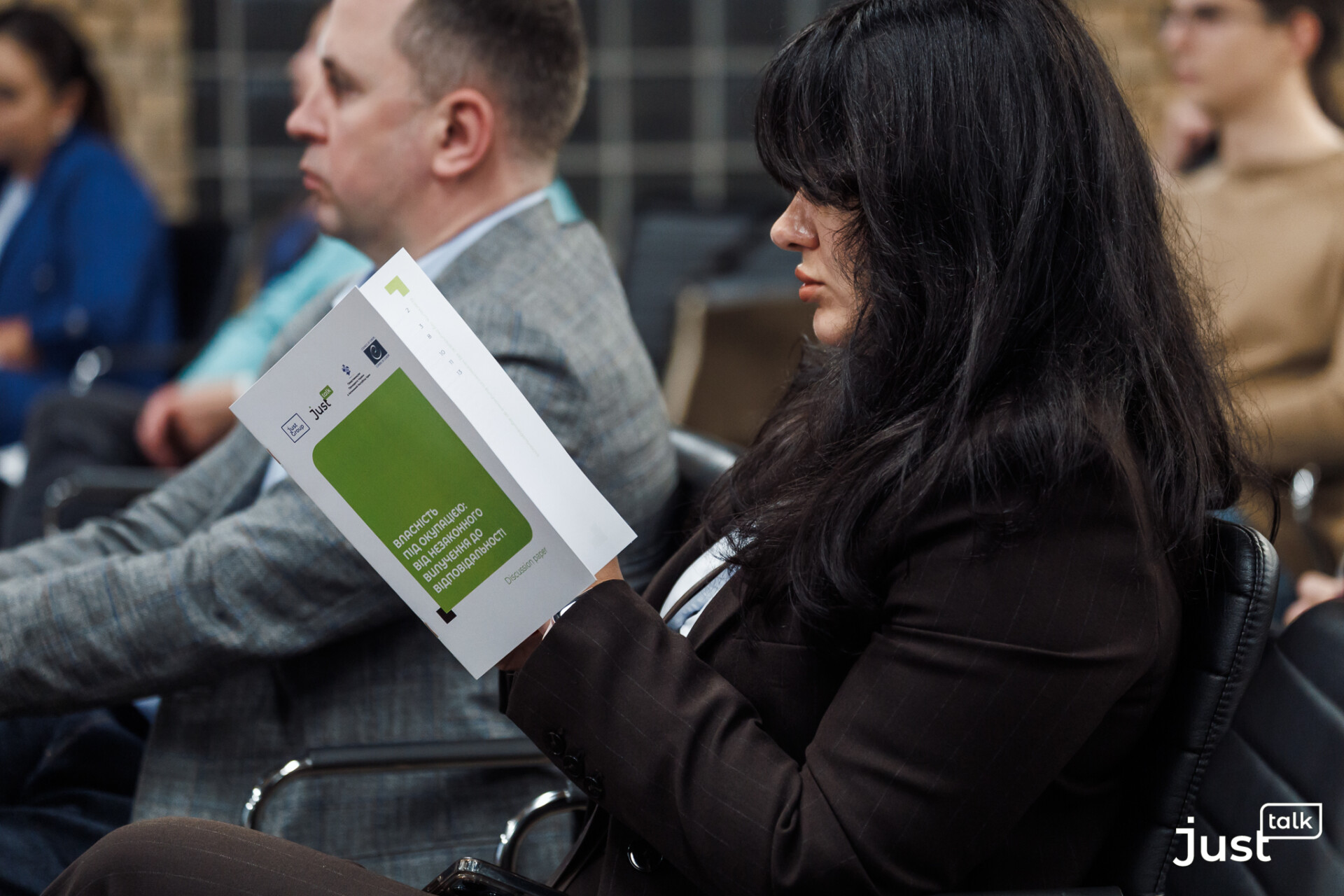
You can read Onysiia Syniuk’s discussion paper here.
Watch the recording of the discussion: https://www.youtube.com/live/TWPUS-NBw4w
The discussion was organised by JustGroup in partnership with the Mission of the President of Ukraine in the Autonomous Republic of Crimea, with support from the Council of Europe Office in Ukraine.
Photos courtesy of the organisers.