Reflections by a Southern human rights defender on Ukraine’s battle for self-determination
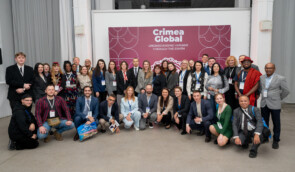
After many years of following remotely news of the revolution and war coming from Ukraine, I finally had the opportunity to see it for myself. With a group of human rights defenders, journalists and academics from Asia, Africa and Latin America, I attended the conference: Crimea Global: Understanding Ukraine through the South. It was organised by the Mission of the President of Ukraine in the Autonomous Republic of Crimea, Crimea Platform, Media Initiative for Human Rights, and ZMINA Human Rights Center. The journey to and from Kyiv was an adventure into a brave country at war since 2014 and now for over 4 years since the full-scale invasion by the Russian army in 2022.
Daily life is disrupted by warning sirens for incoming Shahid drones and cruise missiles. People are advised to rush to shelters. Then a drum-like sound of missiles ground impact, another loss, another fire to be extinguished, followed by the announcement “the air raid is over” in apps everybody installs on their mobile phones.
In the two cities, Lviv and Kyiv, I was struck by the resolve and composure of Ukrainians in the face of such terror. With only little and momentary panic during air strikes, life continues, pedestrians respect traffic lights, the streets are clean, the good old Lviv tram sneaks through its paved streets, gardens are open, museums, shops and cafes are teaming with visitors. The Ukrainian flag proudly waves over the living but bends over dead souls in cemeteries.
At Lviv military cemetery, hundreds of graves are dug to accommodate an ever-growing number of fallen soldiers, with their photos surrounded by flowers and lanterns. “Women visit their dead partners on Valentine’s Day, play old videos and weep”, a veteran military doctor, my age, said, striking my heart. He survived many battles before dedicating his life to looking after brothers in arms, their families and his now sick mother. Walking through lines of graves, a boy called me, only 22 years old, he had many flowers but barely any lanterns, I gave him mine. Rest in peace Ilya Volodymyrovych. By the time I left the cemetery, another grave was being dug for another soul. It will call another wandering visitor.
At the Lviv medical rehabilitation center (Unbroken Center) we were observed by war survivors in wheelchairs at the entrance garden, slowly smoking and exhaling out the smell of the frontline trenches. Covered by the national health insurance scheme, war survivors train on how to resume their lives now with prosthetic limbs, burns or lost eyes, patching their psychological traumas. Many prisoners of war (POWs) were subjected to torture at the hands of their captors. As highlighted in a recent report by Media Initiative for Human Rights, a Ukrainian NGO, the torture methods of today’s Russia echo those of the USSR. Bad habits die hard. When I asked our tour guide why the Russians torture POWs she said either for information or to break them psychologically by forcing them to sing or speak in the Russian language for example.
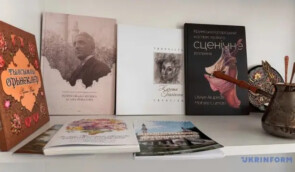
Notwithstanding complex geopolitical reasons, the invasion is driven by Russia’s imperialism, it seeks to crush the Ukrainian national identity, constructed and being now consolidated around the values of democracy, pluralism and human rights. Although at the periphery of Europe, Ukrainians chose to look west, they revived their national identity as a sovereign and multicultural demography on a common ancestral land imbued by Cossacks legacy (thought to originally be a Turkish word meaning “free person” or “adventurer” – referring to fiercely independent horsemen who inhabited stretches of Eastern Europe). They seek to break decades of subordination from their eastern giant. Statues of Lenin and Pushkin were removed from Ukrainian cities. Ukrainian cities globally known by their Russian spelling are now shown in maps in their Ukrainian spelling. Kyiv not Kiev is an example. But Ukrainians will need to do much more to present their heritage and culture to the world. In a bookshop in Kyiv, I could not find translated versions of novels written by Ukrainian writers before being offered “The Gates of Europe” by Serhii Plokhy, who examines Ukraine’s historical search for its identity.
With a growing population of wounded soldiers seeking treatment and rehabilitation in Lviv, far from the frontlines, the Lviv city council’s politicians faced the challenge of attending to the special mobility needs of this new demography and the financial pressure on the Lviv population already contributing a substantial percentage of the city budget to the war effort. The council made the smart choice of helping both populations by implementing a roads and buildings accessibility program that would benefit both the wounded and the elderly in Lviv. They also built new temporary accommodation for the wounded and their families where they can live free of rent during their rehabilitation period. At the entrance of the city council, I saw a sole man freely protesting alleged corruption.
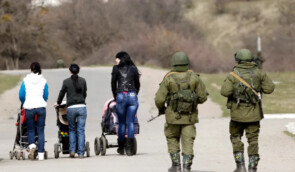
In Crimea and other occupied regions in the south, thousands, including children, have disappeared or were forcibly deported to Russia. Those who were released are taken care of by the Unbroken Center in Lviv or Save Ukraine, an NGO specialised in rehabilitation of children from the occupied lands. Survivors speak of the Russification of all aspects of life in their hometowns, including schools. Some leave their families behind and flee to Ukraine’s government-controlled territories before they turn 18 years old to avoid military conscription in the Russian army. A journalist from Luhansk told me she is unable to speak with her friends and family given internet connection issues residents face over there. In the occupied territories, resistance means keeping their Ukrainian identity alive while everything around them is being turned Russian. I was told children are taught to inform on their parents if they speak badly of Russia. In the eyes of children there, overnight the flags of Ukraine were taken down and replaced by Russian flags, and suddenly everything around them expects them to behave as Russians.
Russia is also engaged in population transfers to break communities in the occupied territories and change its demographics like the USSR did in many Soviet republics. Russians are brought to live and work in Crimea in a settler colonial effort. This is not new, in a meeting organised by Crimea Platform, a Crimean Tatar MP Tamila Tasheva spoke of her family’s history of unrooting from Crimea under the USSR and deportation to Uzbekistan back in the 1940s. The Crimean Tatar, a largely Muslim population, is an indigenous people with specific cultural traits now again suffering from Russian occupation. This policy of population transfer and settler colonialism echoes with crimes committed by the Israeli authorities in the Palestinian Occupied Territories of the West Bank and Jerusalem since 1967.
I also visited Chornobyl, where the shadow of the nuclear catastrophe remains alive in Ukrainian memories and the scientists who watch over what remains of the nuclear complex. They recount the human sacrifices to contain the nuclear fallout since 1986. Even there, a drone attack hit the protective shell recently built over the exploded reactor. Scientists rushed to contain the damage and watch over it all day and night. Everyone in Ukraine does what they can to keep the country alive and free, soldiers in the frontlines and civilians at their workplaces alike. Meanwhile, in Chornobyl’s Exclusion Zone, brownish short Przewalski’s horses roam free in the surrounding forests and ghost towns, much to the jubilation of Ukrainian visitors, a testament to the stubbornness of life in the face of the nuclear catastrophe.
In a meeting in Kyiv with Ukrainian government, parliament and civil society representatives as well as a young survivor from Crimea, all participants’ name tags equally showed “Ukraine” which speaks a lot about national unity in the country, where speaking to foreigners on behalf of Ukraine, as a nation, is not a monopoly of government officials. This show of unity reveals the source of strength and solidarity among Ukrainians.
Civilian control over the reins of power in Ukraine, in a time of war, is an important trait that distinguishes it from authoritarian governments. I was struck when I learned that Ukraine does not have a separate system of military courts since 2010 and that calls during this war to reinstate them have been faced with much resistance. For an Egyptian like me, this vindicates a long-standing position for the abolition of special courts, even in times of national emergency and war. However, according to ZMINA Human Rights Center, a member of OMCT’s SOS-Torture Network, much more is needed to prevent ill-treatment during military conscription of Ukrainian men and for the ombudsman mechanisms to effectively address violations in the domestic criminal justice system.
In the old town of Lviv I was stopped by a young university student only to tell me how much she lounges for her country to stay free and one day join the European Union. She was keen to know how (as a Middle Eastern looking man) I have, miraculously in her mind, made it into Ukraine. She spoke to me as if she had a message to send out to the world which boils down to: we deserve our freedom like all freedom loving people. I promised to relay the message, and I hope through this text I have fulfilled a bit of my promise.
Before leaving Ukraine, I visited Maidan, the famous square in Kyiv and epicenter of the Ukrainian revolution, during the orange revolution in 2003-2004 and the Euromaidan in 2013-2014, and before that in early 1990s during students’ protest for independence. There I sought to breathe in the vibes that brought this country down this path for independence, freedom and democracy.
As a human rights defender from the South, I encourage all those who fight for democracy and human rights to stand by Ukraine, the frontline against authoritarian rule. I also expect Ukraine to come out stronger from this war as a force for democracy and human rights everywhere and a value-based supporter of all people’s struggle for their right to self-determination.
By Mohamed Lotfy, Executive Director of the Egyptian Commission for Rights and Freedoms (ECRF) and member of the World Organisation Against Torture’s executive council.
Source: World Organisation Against Torture (OMCT)