International Covenant on Economic, Social and Cultural Rights in Situations of Armed Conflict: human rights defenders made a submission
On 15 May, the Coalition of organisations dealing with the protection of the rights of victims of armed aggression against Ukraine made its submission to the UN Committee on Economic, Social and Cultural Rights for the drafting of the General Comment on the Application of the International Covenant on Economic, Social and Cultural Rights in Situations of Armed Conflict.
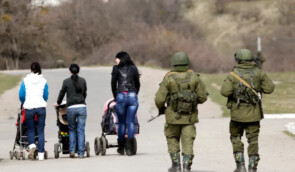
 Russian police in Crimea, archival photo. Photo credit: Anton Naumliuk / Graty
The Comment is being prepared in response to a global request concerning how states should fulfil their obligations in the field of economic, social and cultural rights during war, occupation and protracted humanitarian crises.
In their submission, human rights defenders describe how the Russian occupation of Ukrainian territories affects the enjoyment of fundamental human rights. Particular attention is paid to the situation in the temporarily occupied territories of Ukraine, where, according to estimates by civil society organisations, millions of Ukrainian citizens are currently living.
The authors of the submission draw attention to a number of systemic problems arising in the context of the prolonged occupation of Ukrainian territories, including the criminalisation of work under occupation, forced passportisation and restrictions on access to healthcare, the Russification and militarisation of children, the digital isolation of occupied territories, and the obstruction of humanitarian access.
Work under occupation
Human rights defenders stress that civilians in occupied territories must not be forced to choose between starvation and the risk of criminal prosecution after de-occupation.
Human rights defenders call on the Committee to clarify that, when assessing liability for work performed under occupation, it is necessary to take into account the context of occupation, limited opportunities for survival, and the norms of international humanitarian law. This concerns, in particular, employment in sectors necessary to meet the basic needs of the population.
Healthcare and forced passportisation
The Coalition also draws attention to the Russian Federation’s systematic practice of restricting access to healthcare for people without Russian citizenship in occupied territories.
The submission provides examples of people without Russian passports being denied medical care or access to life-saving medication. Human rights defenders stress that using access to healthcare as a tool to coerce people into changing their citizenship is contrary to the International Covenant on Economic, Social and Cultural Rights (ICESCR).
A separate section is devoted to the situation of unlawfully detained civilians. The Coalition documents cases of denial of medical assistance to Ukrainian political prisoners and civilian hostages held in places of detention in the occupied territories and in the Russian Federation.
Education and the militarisation of children
The submission describes in detail the policy of indoctrination and militarisation of children in the occupied territories of Ukraine.
Human rights defenders stress that the Russian Federation is systematically altering educational programmes, displacing the Ukrainian language from the educational process, persecuting families for distance learning in Ukrainian schools, and involving children in militarised movements such as “Young Army” and the “Movement of the First”.
The Coalition calls on the UN Committee to explicitly state that imposing political and military loyalty to the occupying state through the education system is incompatible with the right to education.
Digital isolation of occupied territories
A separate section of the submission is devoted to access to critically important information.
The authors of the submission stress that media and digital infrastructure are now essential conditions for the exercise of the rights to education, healthcare and humanitarian assistance. The Coalition describes how the Russian Federation blocks Ukrainian online services, messaging applications and educational platforms in the occupied territories, effectively cutting millions of people off from the Ukrainian education system, telemedicine and humanitarian information.
Humanitarian access
Human rights defenders also call on the Committee to establish that humanitarian access is an essential condition for the realisation of basic social rights under occupation. The submission provides examples of the humanitarian crisis in the occupied part of the Kherson region, where civilians face restrictions in access to water, food, medical care and evacuation.
General Comments of UN committees are not international treaties; however, they have a significant influence on the development of international standards and the practice of interpreting human rights.
Human rights defenders stress that the Russian Federation’s current war against Ukraine has created a number of challenges that international law still does not address with sufficient clarity, particularly with regard to prolonged occupation, digital isolation, forced passportisation, and the protection of the social rights of populations under the control of an occupying state.
The proposals submitted by the Coalition aim to help shape international standards that will strengthen the protection of civilians’ rights during contemporary armed conflicts and occupation.
For reference
The Coalition includes the following organisations: NGO Donbas SOS (http://www.donbasssos.org), NGO CrimeaSOS (http://krymsos.com/), Right to Protection Charitable Foundation (www.r2p.org.ua), CF East SOS (https://east-sos.org/), NGO Civil holding GROUP OF INFLUENCE (https://www.vplyv.org.ua/), CF Stabilization Support Services (https://sss-ua.org), NGO Human Rights Centre ZMINA (https://zmina.ua/), NGO Crimean Human Rights Group (https://crimeahrg.org/), NGO Crisis Insight (https://uk.ci-ngo.com/).