
Prisoners’ access to justice: ZMINA and its partners presented a study on barriers to enforcing this right in Ukraine, Greece and Portugal
The European Prison Litigation Network (EPLN), together with Human Rights Centre ZMINA (Ukraine), the Centre for European Constitutional Law – Tsatsos Foundation (Greece), and Forum Penal – Associação de Advogados Penalistas (Portugal), has published an international study on prisoners’ access to justice in Ukraine, Greece, and Portugal.
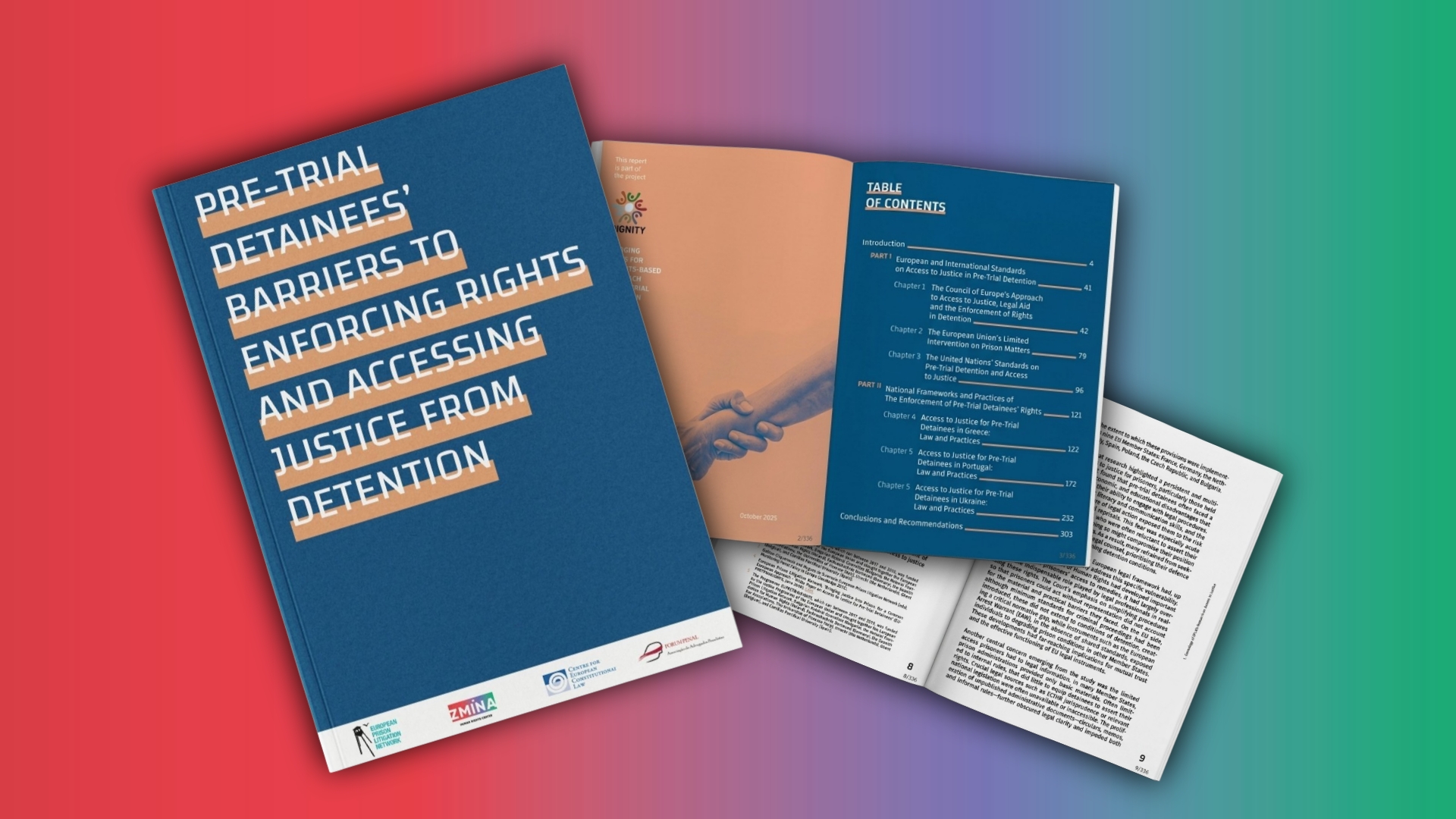
The study builds on and updates the findings of an earlier study conducted between 2017 and 2019 in nine European countries (France, Germany, the Netherlands, Belgium, Italy, Spain, Poland, Czechia, and Bulgaria).
The new analysis is based on materials collected in 2024–2025 and seeks to identify the legal, procedural, and structural barriers that restrict prisoners’ access to justice and the effective protection of their rights. The authors examined how key safeguards of access to justice function in places of detention – environments where the need for human rights protection is particularly acute and opportunities to exercise those rights often remain limited.
The study focuses on Greece, Portugal, and Ukraine. It examines these countries’ national experiences in the context of broader international and regional standards, with a view to strengthening both European and global efforts to protect one of the most vulnerable groups within criminal justice systems.
What these three countries have in common is that they have all been required to address structural problems within their penitentiary systems and introduce effective remedies in this context (see Nisiotis v. Greece, no. 34704/08, 10 February 2011; Petrescu v. Portugal, no. 23190/17, 3 December 2019; Sukachov v. Ukraine, no. 14057/17, 30 January 2020).
The study pays particular attention to Ukraine. Unlike the other participating countries, Ukraine’s penitentiary and justice systems continue to operate in the context of the full-scale war, creating additional challenges for safeguarding the rights of persons deprived of their liberty. The report analyses the impact of martial law on prisoners’ access to legal aid, complaint mechanisms, judicial protection, and other safeguards of fair treatment.
More information about the Ukrainian context and the findings of the national study can be found in Human Rights Centre ZMINA’s analytical report, “Prisoners’ access to justice: national legislation and practice“, which examines the legislative framework, its implementation in practice, and the challenges faced by people held in custody or serving sentences in Ukraine.
Despite the different legal traditions and socio-political contexts of these three countries, and, in Ukraine’s case, the extreme circumstances of a war that threatens the very survival of the state and complicates comparisons of its experience against commonly accepted benchmarks, the researchers identified a number of shared challenges regarding prisoners’ access to justice.
In particular, prisoners’ ability to exercise their rights is constrained by structural, procedural, and financial barriers that hinder access to effective remedies.
Across all three countries, prisoners were found to have limited access to legal information. The systems intended to inform prisoners about their rights remain fragmented, outdated, and largely ineffective in practice. As a result, the information available to prisoners is often limited and provided predominantly by the state.
Although the right to legal aid in Portugal, Greece, and Ukraine is guaranteed by the state for persons under investigation, the analysis found that its provision is largely confined to matters related to criminal proceedings. Legal aid is rarely available in proceedings concerning disciplinary sanctions. This leaves prisoners to navigate complex administrative and judicial procedures on their own – a task that is often insurmountable given their isolation and limited access to information.
In addition, low levels of state-funded remuneration for lawyers and delays in payments constitute further obstacles to the effective exercise of the right to legal aid.
In Greece and Portugal, the absence of an organised network of lawyers specialising in strategic prison litigation has not been compensated for by civil society. NGOs and university legal clinics working in prisons focus almost exclusively on psychosocial support, education, or reintegration rather than on providing ongoing legal representation. In Ukraine, civil society organisations play a more active role in assisting prisoners and monitoring detention conditions. However, their efforts are constrained by insufficient funding, war-related logistical difficulties, and additional responsibilities related to documenting war crimes and supporting victims, which require them to redirect a significant share of their resources.
Overall, the findings from all three countries underscore that prisoners’ genuine access to justice depends not merely on the formal recognition of rights on paper, but also on the establishment of effective mechanisms in practice, professional expertise, and the legislative changes necessary to ensure that these rights can be effectively enforced.
This study was conducted within the framework of the project “DIGNITY: Bridging views for a rights-based approach to pre-trial detention“, funded by the European Union.
The full text of the study is available in English on the Human Rights Centre ZMINA website.