Ukraine needs a coherent policy on accountability for core international crimes: Onysiia Syniuk took part in a side event on the margins of the OSCE Warsaw Human Dimension Conference
On 8 October 2026, a side event titled “A State Policy on Accountability for Grave Crimes: Toward a Comprehensive Justice Architecture in Ukraine” was held in Warsaw on the margins of the OSCE Warsaw Human Dimension Conference 2026. The event was organised by the Ukrainian Legal Advisory Group (ULAG) and Civil Rights Defenders.
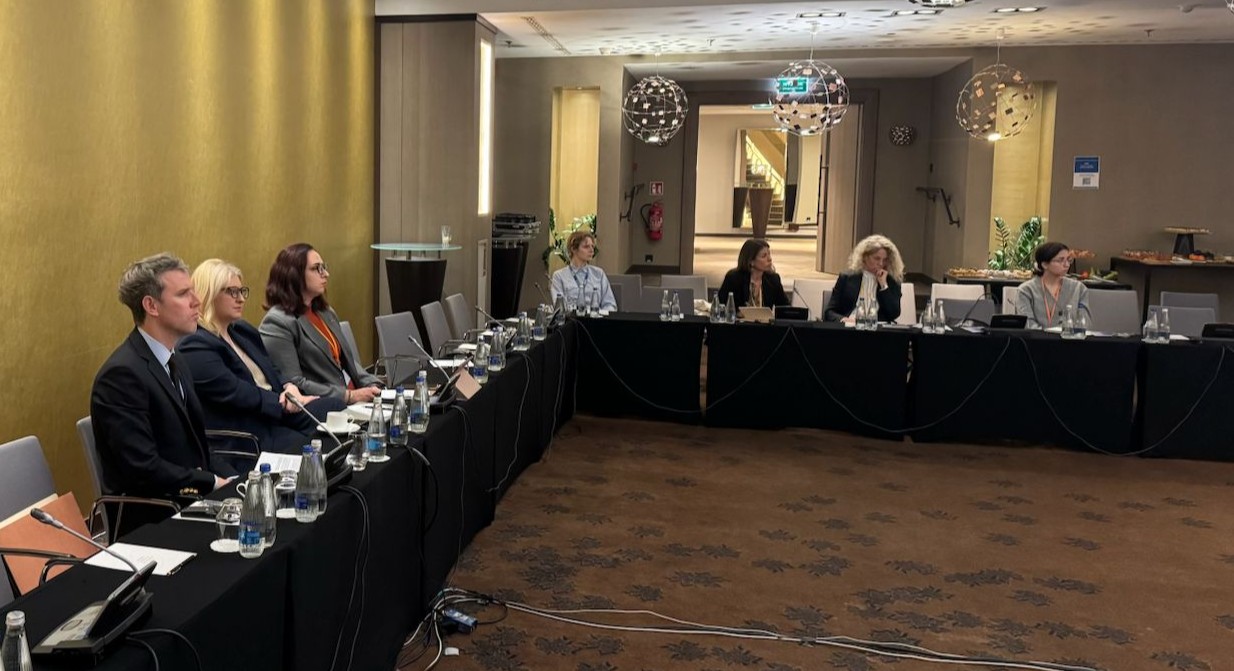
The discussion focused on developing a coherent state policy on accountability for international crimes, coordinating different areas of justice and establishing a sustainable justice framework in Ukraine.
The speakers were Alina Pavliuk, Legal Coordinator and Analyst at the Ukrainian Legal Advisory Group (ULAG); Onysiia Syniuk, Head of Research Department at the Human Rights Centre ZMINA; Denys Lysenko, Deputy Head of the Department for Combating Crimes Committed in Armed Conflict at the Office of the Prosecutor General; Ivan Dulkai, Senior Investigator at the Main Investigation Department of the National Police of Ukraine; and Tinna Goletiani, Head of the Accountability for International Crimes and Transitional Justice Pillar at PravoJustice4EU. The discussion was moderated by Christopher D. Russell, Rule of Law Officer at the OSCE Office for Democratic Institutions and Human Rights (ODIHR).
According to the organisers, Ukrainian law enforcement agencies have registered more than 260,000 criminal proceedings concerning conflict-related core international crimes since the start of the full-scale invasion. However, the response remains largely fragmented, and some state institutions lack a shared vision of how the justice system should be structured.
Alina Pavliuk highlighted the practical and institutional obstacles Ukraine has faced over 12 years of investigating international crimes. Although specialised units have been established within law enforcement agencies, the courts still lack the necessary specialisation. She also identified the need to adapt legislation, difficulties in gathering evidence and supporting victims and witnesses, and shortages of resources and qualified personnel.
The ULAG analyst stressed the need for a single strategic document setting out the principles for prosecuting core international crimes, ensuring continuity in established approaches and cooperation with international justice mechanisms.
“All these separate elements must be brought together in a single national strategic document that will ensure the justice system can consistently address core international crimes and provide institutional support for the approaches developed so far,” Alina Pavliuk stressed.
 Christopher D. Russell, Tinna Goletiani, Alina Pavliuk
 During the event, Onysiia Syniuk discussed how to coordinate different areas of justice, clarify the responsibilities of state institutions and ensure consistency in approaches to accountability for the most serious crimes.
She stressed that policies on accountability for international crimes, transitional justice, a broader human rights approach and European integration reforms must take account of one another, even though each has its own objectives.
According to Syniuk, the approach to transitional justice must take account of the criminal justice system’s actual capacity: which crimes it can address, how many cases it can bring to a verdict and how many of those cases will be tried in absentia.
At the same time, other accountability mechanisms must take account of the limitations of criminal justice. Some victims may feel that a sentence is insufficient if the convicted person does not actually serve it. Certain crimes may also never be addressed through traditional accountability mechanisms because of insufficient evidence or the inability to locate suspects and bring them to justice.
“Policies cannot be developed in isolation. They should not take on objectives beyond their own scope, but they must take account of one another,” Onysiia Syniuk said.
The Head of Research Department at ZMINA also pointed out that different approaches to accountability within Ukraine’s justice system often develop separately, despite facing common challenges. In particular, accountability for international crimes overlaps with accountability for crimes against national security. This includes crimes committed in occupied territories, overlapping groups of victims and witnesses, and cases where the same conduct may constitute different criminal offences.
 Onysiia Syniuk (on screen)
 According to Syniuk, without a clear vision at the state level, it remains unclear who is responsible for specific areas of work, what powers state bodies need and who should coordinate the various institutions and assess progress.
A consistent policy is also important for working with victims and civil society. Without one, approaches may change whenever the leadership of state institutions changes, weakening institutional memory and making it harder to communicate with people affected by international crimes.
“Without a clear policy, there is no clear understanding of what can realistically be achieved, what resources we have, whether they are sufficient and what steps we can take. We cannot clearly communicate to victims what they can expect when the system itself does not recognise its own limitations,” Onysiia Syniuk said.
Photos courtesy of the organisers.