Professional development and educational needs: the second networking event for journalists from relocated media outlets took place in Kyiv
On 19 March 2026, the second networking event for journalists and representatives of relocated media outlets, organised by the Human Rights Centre ZMINA, took place in Kyiv. The event brought participants together to discuss the educational needs of newsrooms and to jointly develop future training programmes.

The event continued a series of meetings launched in October 2025, when the first networking event was held, focusing on the challenges of funding independent media amid a decline in international support. The second event, in turn, deepened this discussion by shifting the focus to professional skills development and strengthening the capacity of newsrooms through training.
The purpose of the meeting was to create an open space for discussing the educational needs of media outlets working on issues related to the temporarily occupied territories or those that have been relocated, as well as to engage journalists themselves in shaping future training sessions, seminars, and learning initiatives.
During the opening session, participants were presented with the results of a survey on professional training needs. Human rights defender and ZMINA Project Manager Viktoriia Nesterenko opened the event and outlined its key objectives.
Nari Usenko, Analyst of ZMINA, presented the results of a survey on professional training needs, which covered 21 relocated media outlets and enabled a systematic assessment of their challenges and needs: “We focused on the needs of media outlets in their professional activities and the challenges they face. The survey consisted of three sections: general information about the media, challenges and needs.“
 Photo: Nari Usenko
Among the key challenges identified in the study were the lack of stable funding, loss of material and technical resources, staff shortages, the absence of a shared physical workspace for teams, professional burnout, and security risks. Participants also highlighted the difficulty of obtaining reliable information from the temporarily occupied territories, as well as tensions within the media community.
At the same time, the priority areas of training include data analytics and working with big data, storytelling, SMM, solutions journalism, monetisation and advertising sales, the use of artificial intelligence, legal literacy, OSINT, as well as security training and mentoring programmes for editorial managers.
“Relocated media outlets often simply lack the resources for training. Some team members were lost following relocation, and now a small number of people are forced to simultaneously produce content, maintain contact with sources in the occupied territories and keep the newsroom running,” – Viktoriia Nesterenko.
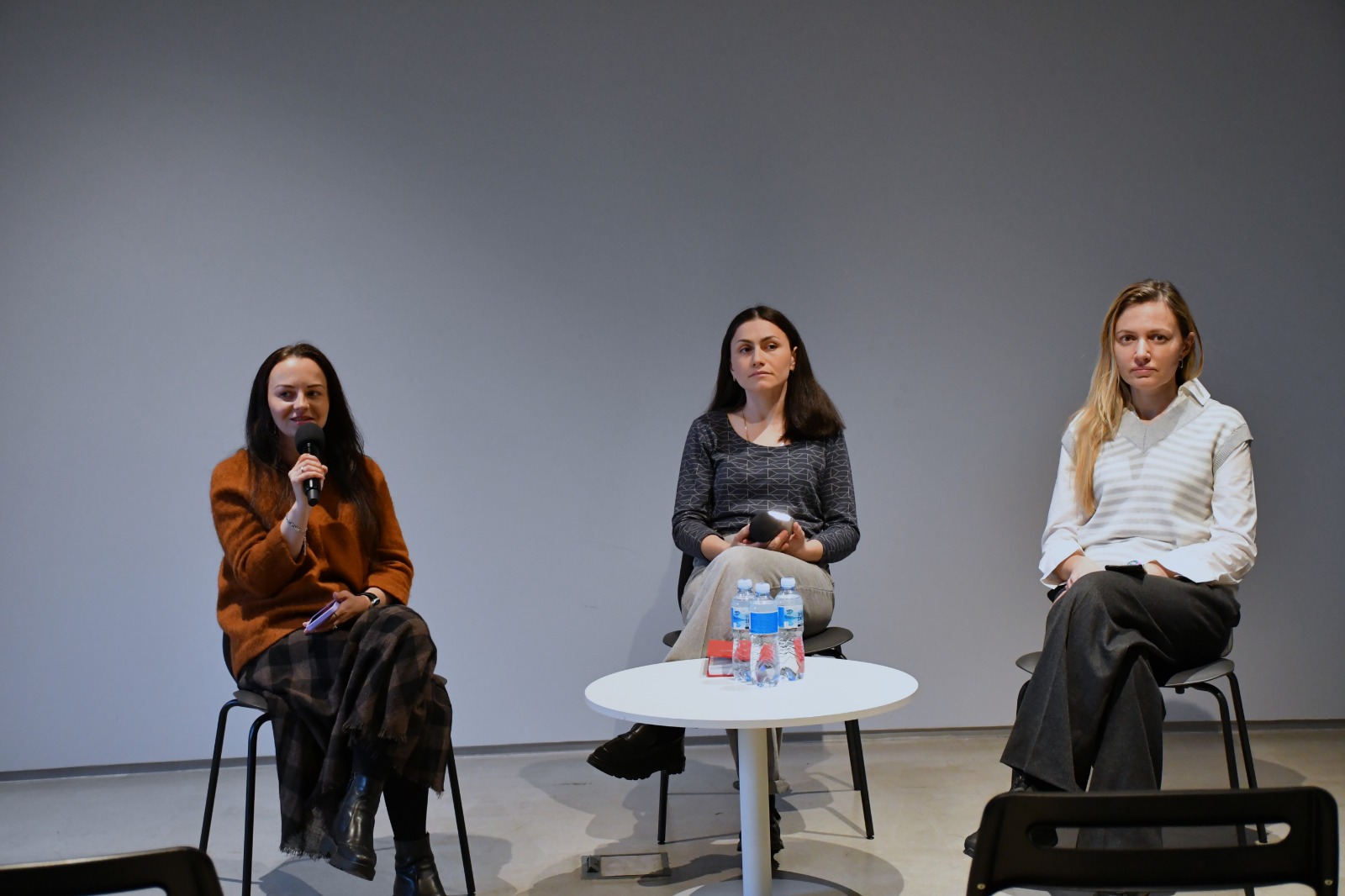 Photo: Viktoriia Nesterenko, Nari Usenko, Liubov Rakovytsia
The participants paid particular attention to the vision for future educational programmes for the pool of relocated media outlets. Liubov Rakovytsia, Media Manager, Head of the NGO DII-Ukraine and the Organising Committee of the Donbas Media Forum, emphasised that despite the fatigue caused by training, it remains critically important in the context of ongoing crises: “We are in the midst of a major crisis and already have experience in overcoming it. But crises will continue, and we need to be prepared for them. Training is an essential part of this preparation.“
According to her, it is important to change the approach to training programmes: “Training courses often become repetitive, are delivered to participants at different levels using identical programmes, and turn into a mere formality. As a result, they can be perceived as a waste of time. Therefore, it is important to make them more tailored to the actual needs of newsrooms.“
 Photo: Liubov Rakovytsia
Rakovytsia also highlighted both the importance of and the lack of digital security expertise: “Media outlets that have relocated and are working with audiences in the occupied territories are one of the main targets. At the same time, newsrooms often lack both the resources and the specialists needed for digital security. That is precisely why such training is critically important.“
During the open-mic session, participants also focused on the gap between theoretical recommendations and the actual working conditions of relocated newsrooms. In particular, Hanna Drobot, a journalist of the publication Tochka Skhodu, noted that most relocated media outlets are already operating at the limits of their resources: “We are often told: optimise your processes, redistribute tasks. But we have already done this dozens of times. We work with the resources and time we have. That is why it is important for training to take these real-world conditions into account, rather than being detached from practice.“
According to her, newsrooms need a more personalised approach to training, one that meets the specific needs of each media outlet. The journalist also highlighted the critical importance of security — both physical and digital. She explained that once investigations begin, newsrooms may face pressure and cyberattacks: “When we started our investigations, we immediately faced attacks – server overloads, suspicious messages, and unclear signals. This showed that security is not a theoretical issue, but a daily necessity. And we are critically lacking in relevant knowledge and training.“
She also highlighted the challenges of working with sources in the temporarily occupied territories: “People there cannot simply get in touch with unknown journalists – it’s dangerous. Cooperation is only possible through personal trust and established connections. There are no random contacts in such situations, as the consequences could be very serious.“
 Photo: Hanna Drobot
The final part of the event was devoted to informal networking. It is expected that the outcomes of the meeting will form the basis for developing a relevant programme of training activities aimed at supporting relocated media outlets, strengthening their professional capacity and fostering professional connections.
As a reminder, on 24 October 2025, the first networking event, “Media in Times of Instability: Support, Funding and Networking”, took place, focusing on the challenges faced by relocated media outlets due to cuts in grant funding from the US.