ZMINA and ULAG presented a new study on the risks of the “Hochu k svoim” initiative and civilian “exchanges”
The Human Rights Centre ZMINA, jointly with the Ukrainian Legal Advisory Group (ULAG), published an analytical note “Exchanges” of civilians. What are the current and potential risks of existing procedures?”, in which they analysed the practice of returning Ukrainian civilians from unlawful Russian detention through the mechanism of so-called “exchanges”.
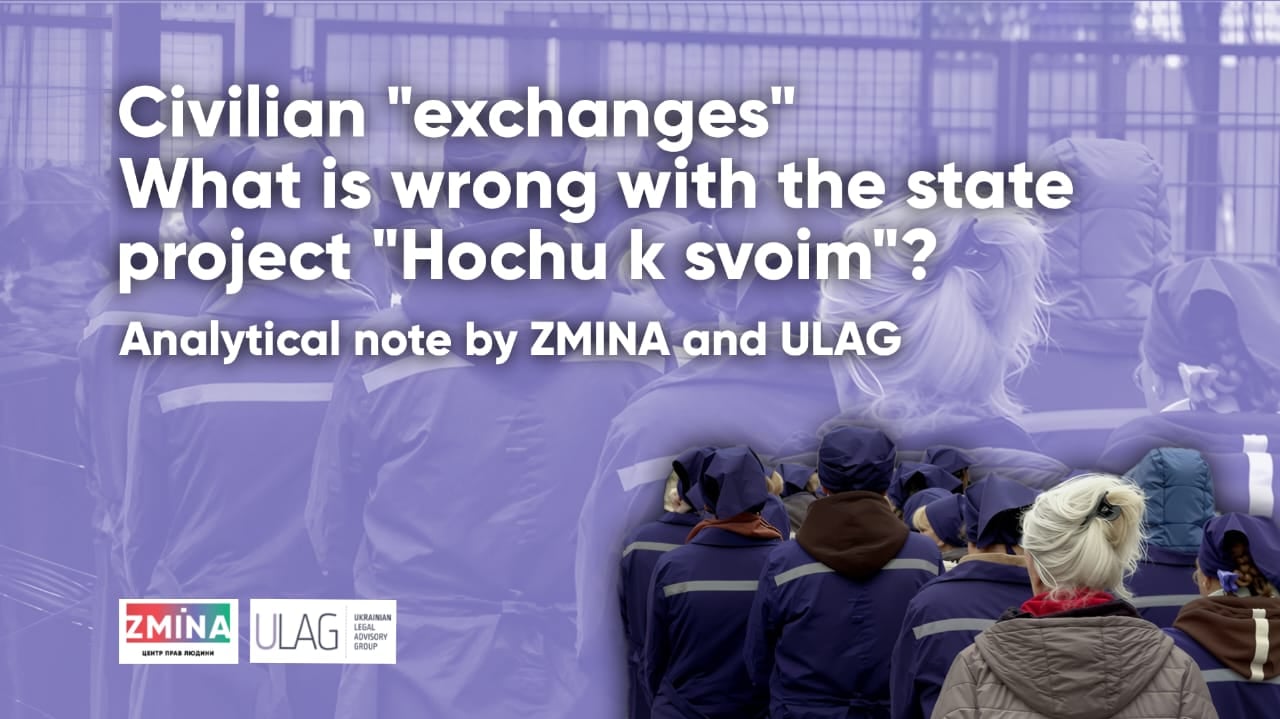
The study focuses on the state project “Hochu k svoim”, which provides for the transfer to the Russian Federation of persons convicted in Ukraine (primarily for crimes against national security) in exchange for Ukrainian civilians.
Human rights groups say that under international humanitarian law, civilians are a protected category and are neither granted prisoner-of-war status nor subject to “exchange” procedures. They should be released unconditionally, rather than being treated as part of an “exchange pool”.
At the same time, current practice effectively treats civilians as prisoners of war through formal legal mechanisms. This runs counter to the Geneva Conventions and creates risks of breaching Ukraine’s international obligations.
The analytical note highlights that such approaches create a set of interrelated risks. In particular, they raise the risk of violating international humanitarian law and human rights standards. Transferring civilians to another state, especially in circumstances where there is documented evidence of systemic human rights violations in the Russian Federation, may result in breaches of the rights to liberty and security, as well as the prohibition of torture, and could provide grounds for applications to international courts.
Procedural aspects also raise serious concerns. The lack of clear criteria for compiling “exchange” lists, the opacity of the process, and the conditions in which people give their consent while held in detention without adequate safeguards call into question the voluntariness of such decisions and whether individuals fully understand their consequences.
Another dimension of the problem concerns the individuals’ safety. The state does not have sufficient information about their fate after transfer, creating risks of persecution or ill-treatment. In some cases, this may also involve potential violations of the right to citizenship.
Human rights groups also point to the long-term consequences for Ukraine’s legal system. Such practices may undermine trust in the justice system, contribute to a sense of impunity for crimes against national security, and weaken institutional safeguards for the protection of victims’ rights. Concerns are also raised about the independence of national human rights institutions and their ability to exercise effective oversight.
Another significant risk is the normalisation of the practice of civilian “exchanges”. The authors say this could encourage Russia to carry out further unlawful detentions of Ukrainians to replenish the “exchange pool”, effectively legitimising such actions.
ZMINA and ULAG stress that finding mechanisms to return Ukrainian civilians from unlawful detention is critically important, but such mechanisms must not undermine international law or human rights. The state should focus on developing alternative solutions that comply with international standards and do not create additional risks for those affected.
The analytical note was submitted to the Coordination Headquarters for the Treatment of Prisoners of War, the SSU, the Ukrainian Parliament Commissioner for Human Rights, and the Prosecutor General’s Office.
The full text of the analytical note is available in Ukrainian and English.