ECtHR to hold oral hearing in case concerning Russia’s abduction of ten Ukrainian children from occupied Crimea
The European Court of Human Rights (ECtHR) has scheduled an oral hearing in a case concerning ten Ukrainian children whom Russia did not return to Ukraine following its occupation of Crimea in 2014.
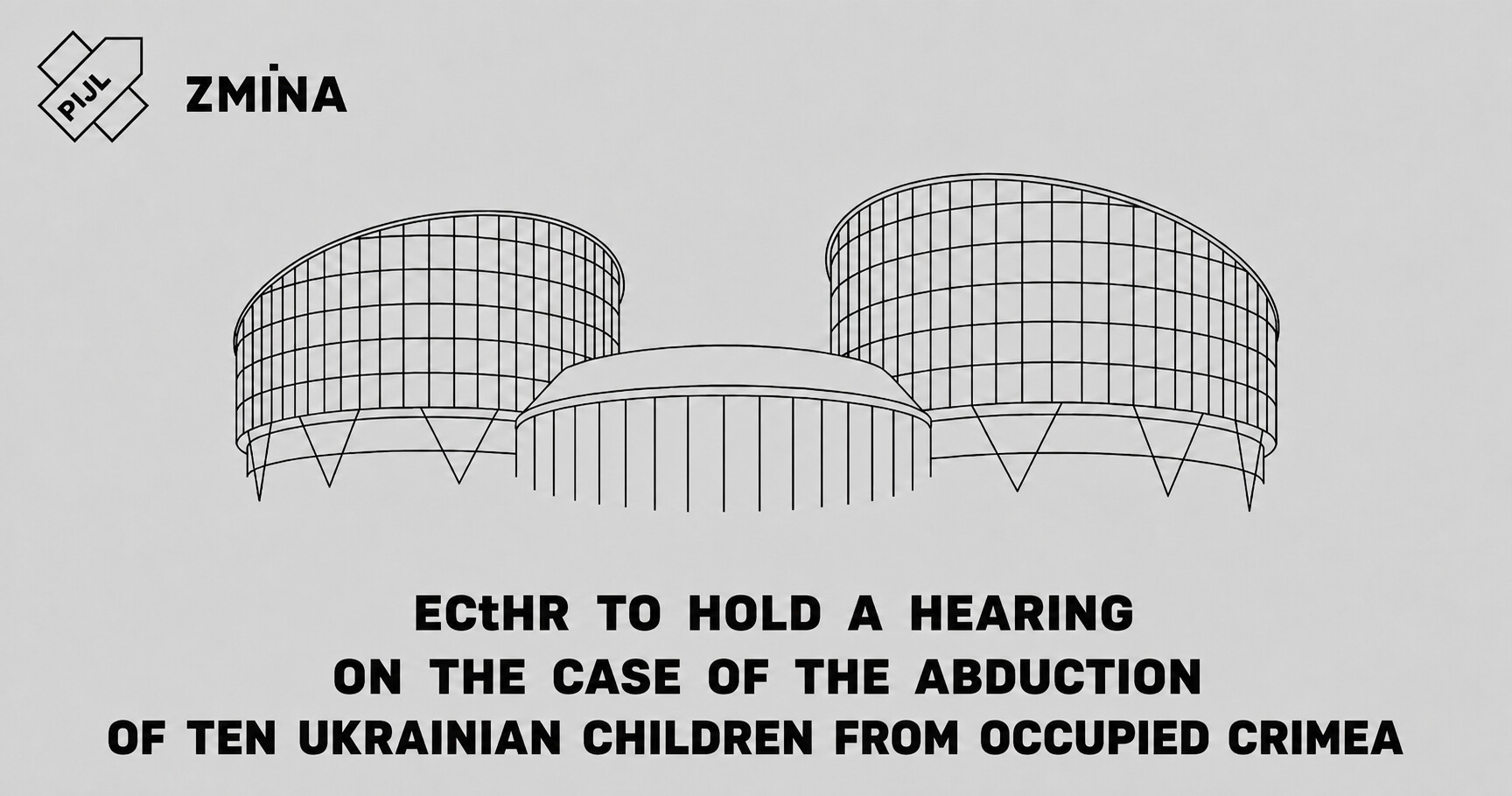
The case concerns application no. 6719/23, lodged by the Ukrainian Helsinki Human Rights Union (UHHRU) on behalf of the children. On 7 July 2026, the Court granted a request by the applicants’ representatives for an oral hearing under Rule 54 § 5 of the Rules of Court.
The hearing on the admissibility and merits of the application will take place on 22 September 2026.
According to the UHHRU, all ten children were aged between one and five and were living in state-run children’s institutions when Crimea was occupied. After Russia established control over the peninsula, the occupation authorities refused to return them to Ukraine, provided no information about their whereabouts, and later listed the children on a Russian adoption website.
Human rights defenders believe that some of the children may have been adopted, as information about them later disappeared from the platform. Following its occupation of Crimea, Russia unilaterally declared more than 4,000 Ukrainian children without parental care who were on the peninsula to be Russian citizens.
The case concerns possible violations of several provisions of the European Convention on Human Rights, including the right to respect for private and family life, as well as unlawful state interference in the lives of children who were under Ukraine’s care.
In April 2025, the ECtHR notified the Russian government of the application and invited it to submit its observations by 31 July 2025. The Court will now hold a public hearing involving the parties, at which it will consider both the admissibility and the merits of the case.
The UHHRU is represented in the case by Serhii Zaiets, a lawyer, and lawyers from the European Human Rights Advocacy Centre (EHRAC).
Speaking to ZMINA, Serhii Zaiets stressed that the ECtHR’s decision to hold an oral hearing demonstrated the particular importance of the case.
“The hearing in this case is important given the particularly serious nature of Russia’s violations of international human rights standards and the case’s significance to the public, as reflected, among other things, in the media attention it has attracted. This sets it apart from the many other cases before the Court. Human rights violations must never be tolerated, but some are particularly egregious. The decision to hold an oral hearing in this case reflects precisely that“, he said.
According to the lawyer, the oral hearing will allow the parties to explain the circumstances of the case in greater detail and provide the judges with context that cannot always be fully conveyed through written submissions.
“Much of what appears self-evident in Ukraine may not be understood beyond its borders. Under the influence of Russian propaganda, the world long failed to recognise that the occupation of Crimea was an act of aggression. It may likewise be difficult to understand the situation of the Ukrainian children who were seized along with the peninsula“, Zaiets said.
The Human Rights Centre ZMINA, together with colleagues from the Public Interest Journalism Lab (PIJL), joined the case as a third-party intervener.
Onysiia Syniuk, Head of the Research Department at ZMINA, said that the submission sought to outline the broader context in which the alleged violations had occurred.
“In particular, it addressed the imposition of Russia’s legal regime and its consequences for Ukrainian citizens, especially children, in occupied Crimea, as well as the establishment in 2014 of a system for the forcible transfer and deportation of Ukrainian children from Crimea“, the expert said.
According to Syniuk, the submission also addressed violations of the right to identity through the imposition and simplification of procedures for acquiring Russian citizenship, which inherently entails pledging allegiance to the Russian Federation, as well as the indoctrination and militarisation of Ukrainian children, their placement with Russian families under guardianship or through adoption, and the consequences of these actions.
“Particular attention was paid to restrictions on travel to and from Crimea, which prevented the children from leaving the peninsula and Ukrainian authorities and international organisations from gaining access to them“, Syniuk added.
She noted that the analysis of Russian policies was also supported by testimony from Nataliia Humeniuk, a journalist and Head of PIJL, who visited Crimea six times between March 2014 and 2020 and witnessed the system being put in place.
“From the first days of the occupation in 2014, I travelled to Crimea and documented what Russia was doing to children there. As early as May 2014, I saw preschool children wearing Russian military uniforms at a parade in Sevastopol, and later saw young children being sworn into the “Yunarmiya” (Young Army Cadets National Movement) in Yalta. That was also when passportisation began to be used as a means of control, teachers came under pressure, and the Ukrainian language was pushed out of schools“, Humeniuk said.
According to Humeniuk, these were not isolated abuses by local actors, but a consistent, carefully constructed and centralised policy.
“Following the full-scale invasion in 2022, we at PIJL saw the same system being applied in the newly occupied territories: the re-registration of schools and hospitals, the recertification of teachers, restrictions on the rights of people without Russian passports, and the removal of children from residential institutions and educational establishments, as happened in Kherson and Oleshky. Russia refined these methods in Crimea and then deployed them more rapidly and on a larger scale. Everything that shocked the world after 2022 had already been tested by Russia in Crimea. The only difference was that almost no one was watching at the time“, Humeniuk stressed.
The ECtHR invited several civil society organisations acting as third-party interveners in the case, including the Human Rights Centre ZMINA and the Public Interest Journalism Lab, to participate in the oral hearing on the admissibility and merits of the application on 22 September 2026.
Serhii Zaiets, a lawyer, believes that the judgment in this case could set an important precedent for protecting other Ukrainian children whom Russia unlawfully transferred or placed for adoption following its occupation of Ukrainian territories.
“The abduction of Ukrainian children began in Crimea. The failure to respond adequately to the situation enabled Russia’s mass abduction of children following its full-scale invasion in 2022. This case is like unravelling a ball of yarn: all subsequent events become clearer once we trace the situation back to its origins“, the lawyer stressed.