Kyiv hosted the 5th International Forum of the Crimea Platform Expert Network
On 30 June 2026, Kyiv hosted the 5th International Forum of the Crimea Platform Expert Network, bringing together representatives of the Ukrainian government, the diplomatic corps, international think tanks, human rights organisations and the expert community to discuss key challenges related to the de-occupation of Crimea, security in the Black Sea region, international justice, and human rights protection.
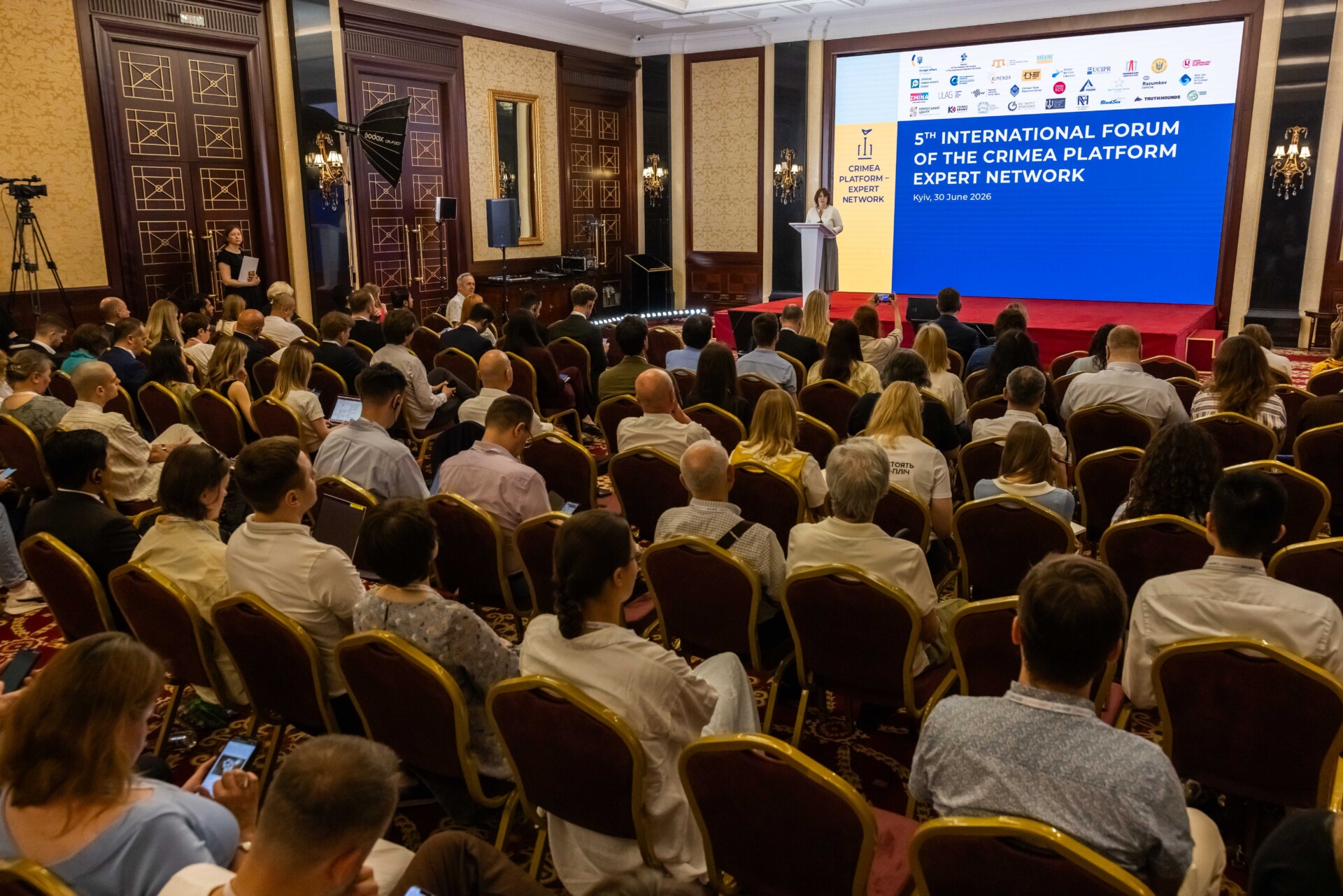
The forum brought together representatives of the Ukrainian government, the Mission of the President of Ukraine in the Autonomous Republic of Crimea, the Ministry of Foreign Affairs of Ukraine, the Mejlis of the Crimean Tatar People, Ukrainian and international experts, human rights defenders, representatives of non-governmental organisations, and the diplomatic corps. The event was moderated by Olha Skrypnyk, Head of the Board of the Crimean Human Rights Group.
The forum opened with remarks by Yevhen Perebyinis, Deputy Minister of Foreign Affairs of Ukraine, Olha Kuryshko, Permanent Representative of the President of Ukraine in the Autonomous Republic of Crimea, and Charlotte Surun, Chargé d’Affaires of the United Kingdom to Ukraine.
In his remarks, Yevhen Perebyinis stressed that the International Crimea Platform remains a long-term mechanism for consolidating international efforts to de-occupy Crimea. He said that despite Russia’s attempts to convince the world that the “Crimea issue” had supposedly been settled, the international community continues to uphold its policy of non-recognition of the peninsula’s occupation, and Crimea remains at the centre of the international agenda.
 Photo: Yevhen Perebyinis
Olha Kuryshko, Permanent Representative of the President of Ukraine in the Autonomous Republic of Crimea, drew attention to the systematic human rights violations in Crimea and highlighted the cases of political prisoners, including Iryna Danylovych, Asan Akhtemov, Vilen Temerianov and Server Mustafaiev. She also referred to Russia’s recent designation of the “Crimean Solidarity” movement as a “foreign agent”.
“Crimea is not merely militarised by Russia. Since 2014, the occupying state has used the peninsula to test its occupation policies – suppressing the media, imposing occupation legislation, controlling the information space, and influencing children and young people. For Russia, Crimea is a resource for advancing its destructive ambitions“, Olha Kuryshko said.
Kuryshko also noted that Russia has intensified its repression of residents of the occupied peninsula in recent months.
 Photo: Olha Kuryshko
Charlotte Surun, Chargé d’Affaires of the United Kingdom to Ukraine, reaffirmed the United Kingdom’s unwavering support for Ukraine, including its commitment to the policy of non-recognition of the occupation, sanctions against Russia, and efforts to hold Russia accountable for international crimes.
The forum programme featured four thematic panel discussions. Participants included Vitalii Sekretar, First Deputy Head of the Prosecutor’s Office of the Autonomous Republic of Crimea and the City of Sevastopol, Refat Chubarov, Chair of the Mejlis of the Crimean Tatar People, Olha Kuryshko, Permanent Representative of the President of Ukraine in the Autonomous Republic of Crimea, military analyst Mykhailo Samus, as well as Ukrainian and international human rights defenders, historians, and security experts.
During the first panel discussion, entitled “Through the Prism of Crimea: A Strategic View of Effective Justice for the Gravest Crimes Committed During Russia’s War Against Ukraine“, participants discussed prospects for holding Russia accountable for international crimes, the development of the international justice system, and the role of civil society in documenting crimes. The discussion was moderated by Tetiana Pechonchyk, Head of the Board of the Human Rights Centre ZMINA, and featured speakers from the Prosecutor’s Office of the Autonomous Republic of Crimea, international human rights organisations, and the expert community.
The discussion also covered the development of the international justice system following Ukraine’s ratification of the Rome Statute of the International Criminal Court, the challenges of documenting international crimes, and the role of civil society in ensuring accountability.
 Photo: Arie Mora, Tetiana Pechonchyk, Daryna Pidhorna, Vitalii Sekretar, Iryna Bartsytska
During the panel, Vitalii Sekretar, First Deputy Head of the Prosecutor’s Office of the Autonomous Republic of Crimea and the City of Sevastopol, said the prosecutor’s office is examining more than a decade of Russia’s occupation of Crimea as part of criminal proceedings under Article 442-1 of the Criminal Code of Ukraine (“Crimes Against Humanity”). The proceedings were opened in May 2026 following a submission by the Human Rights Centre ZMINA concerning the systematic persecution of Ukrainian citizens through the denial of their right to a fair trial in occupied Crimea.
According to the prosecutor, the investigation is examining not isolated incidents but a systematic policy of persecution targeting the civilian population, including unlawful detentions, enforced disappearances, the role of Russia’s law enforcement system, the use of propaganda, and the practice of handing down unlawful sentences in the occupied peninsula.
The second panel, entitled “Crimea as a Constant: A Strategy for Liberation Amid Geopolitical Change“, focused on strategies for the de-occupation of the peninsula in the new security environment, the impact of Ukraine’s military successes on the geopolitical landscape, and international support for the de-occupation of Crimea.
Alina Frolova, Security Track Coordinator of the Crimea Platform Expert Network and Deputy Chair of the Board of the Centre for Defence Strategies, said Ukraine’s military successes had already changed the international perception of the issue of Crimea.
“Ukraine’s military successes in Crimea prompted the Western world, for the first time, to abandon the narrative that Crimea was “not the right issue at the right time” and instead recognise that Ukraine is capable of defeating Russia“, she said.
 Photo: Alina Frolova, Illia Pavlenko, Mykhailo Samus
At the same time, Frolova said Ukraine must combine military pressure with active diplomatic engagement to consolidate these gains and advance pathways towards the de-occupation of the peninsula.
Participants also stressed that the actions of Ukraine’s Defence and Security Forces have deprived Crimea of its role as a safe rear base for the Russian military, creating new opportunities for the peninsula’s de-occupation.
The third panel, entitled “Rewriting the Past to Shape the Future: The Struggle for Identity in Occupied Crimea“, explored Russia’s policy of erasing Ukrainian and Crimean Tatar identities, countering Russian information influence, and ways to preserve identity after the de-occupation of the peninsula.
 Photo: Andrii Lutsyk, Tetiana Filevska, Olha Kuryshko, Refat Chubarov, Valentyna Potapova
The final panel, entitled “A Coalition Against Russia: Lessons of the Crimean War and Today’s Security Challenges in the Black Sea“, focused on reinterpreting the historical legacy of the Crimean War, shaping Ukraine’s historical narrative, and its significance for contemporary memory policy and security.
Participants also discussed compensation for people affected by the occupation of Crimea. Representatives of civil society stressed the need to extend the Register of Damage for Ukraine to cover the occupation of Crimea and parts of the Donetsk and Luhansk regions between 2014 and 2022, ensuring that people affected before the start of the full-scale invasion are also eligible for compensation.
 Photo: Yehor Brailian, Andrii Zahorodniuk, Anatolii Khromov, Andrii Ivanets, Larysa Levchenko
The forum also placed special emphasis on preserving Ukrainian and Crimean Tatar identities on the temporarily occupied peninsula.
At least 146 people took part in the forum, including 82 participants from Ukraine and 64 international participants.
The international participants represented 22 countries: Albania, Austria, Belgium, Croatia, Estonia, France, Germany, Indonesia, Japan, Latvia, Lithuania, Moldova, Montenegro, Norway, Poland, Romania, Spain, Sweden, Switzerland, Türkiye, the United Kingdom and the United States. Representatives of the NATO Representation to Ukraine and the EU Advisory Mission to Ukraine also took part in the forum.
The forum was organised by the Crimea Platform Expert Network with the support of the Crimea Platform Office, the Mission of the President of Ukraine in the Autonomous Republic of Crimea, the Ministry of Foreign Affairs of Ukraine, and the Mejlis of the Crimean Tatar People. The event’s media partner was Media Center Ukraine.
A recording of the forum is available here.
Photos courtesy of the organisers.