26 years of unfinished conversations: on Georgiy Gongadze Remembrance Day, ZMINA drew attention to journalists unlawfully imprisoned by Russia
16 September marks 26 years since the disappearance of journalist and Ukrainska Pravda founder Georgiy Gongadze. As part of Georgiy Gongadze Remembrance Week, a public discussion entitled “26 Years of Unfinished Conversations” was held in Kyiv to reflect on his impact on Ukrainian journalism and society. The discussion centred on one question: “What would you say to Georgiy today?” Nari Usenko, a researcher at the Human Rights Centre ZMINA, took part in the event.
 Photo credit: Oleksandra Yefymenko
The event began by honouring the memory of all Ukrainian journalists who have been killed. Anastasiia Abramets, Director of the Georgiy Gongadze Prize, shared the stories of three media workers killed by Russia, stressing the importance of remembering not only their names but also who they were as people. To preserve the memory of journalists killed as a result of Russia’s war against Ukraine, the Gongadze Prize, together with PEN Ukraine and with information support from the Institute of Mass Information, launched the REQuiem project – a platform dedicated to their memory.
 Anastasiia Abramets
The participants also drew attention to journalists unlawfully imprisoned by Russia. In her remarks, Nari Usenko stressed that many Ukrainian journalists today face torture, unlawful detention, arrest, psychological torture and pressure on both them and their families because of their professional work.
She noted that after Russia destroyed independent journalism in occupied Crimea, citizen journalists became the voices of the peninsula, documenting what was happening there and showing the world the truth that Russia sought to conceal.
 Nari Usenko
The ZMINA researcher named journalists unlawfully imprisoned by Russia. According to her, 27 media workers are currently known to be held in Russian captivity following arrests based on fabricated cases.
“Russia does not simply want to arrest, imprison and torture our people. It wants to take away their voice and prevent them from writing and speaking. It prevents them from corresponding with anyone, isolates them from the outside world and transfers them far away from their loved ones. So this day is also an opportunity to speak about those who are continuing Georgiy’s work and need to be released”, Nari Usenko said.
Her remarks were followed by a public discussion in which participants shared their memories of Georgiy Gongadze and spoke about his professional values, his influence on Ukrainian journalism and his contribution to the development of civil society.
The discussion featured:
- Vakhtang Kipiani – journalist, founder of Istorychna Pravda and the Press Museum-Archive, and recipient of the 2019 Georgiy Gongadze Prize;
- Myroslava Barchuk – journalist, television presenter and documentary filmmaker, and recipient of the 2021 Georgiy Gongadze Prize;
- Larysa Denysenko – writer and human rights advocate;
- Roman Romaniuk – political columnist at Ukrainska Pravda;
- Oksana Romaniuk – Director of the Institute of Mass Information.
The discussion was moderated by Tetiana Teren, Chair of the Supervisory Board and co-founder of the Georgiy Gongadze Prize, founder of the Tereny cultural agency, journalist and cultural manager.
The event was hosted by Olha Snitsarchuk, a journalist at Radio Free Europe/Radio Liberty.
 Participants in the discussion. Photo credit: Oleksandra Yefymenko
The participants recalled September 2000, when Georgiy Gongadze’s disappearance became one of the most consequential events for Ukrainian society and journalism. They discussed how the case influenced the development of independent media, journalists’ professional values and society’s willingness to defend freedom of expression.
Vakhtang Kipiani, who had seen Georgiy two days before his disappearance, said that after learning he was missing, he went to the police to share everything he knew and help with the search. According to Kipiani, numerous conflicting reports about the journalist’s possible whereabouts emerged at the time, often leading the search in the wrong direction.
“At that point, no one yet knew what had actually happened. So the events of 2 November and, later, the release of the so-called Melnychenko tapes came as a real shock. There was such a flood of news that you could drown in it…”, Vakhtang Kipiani recalled.
 Vakhtang Kipiani
The participants also reflected on what they would say to Georgiy today. Roman Romaniuk said he would ask him, “What should we do now?” – in the context of the current situation in Ukraine. Oksana Romaniuk said she would like to ask Georgiy how to move from protests towards building a system capable of consistently supporting and protecting independent journalism.
Myroslava Barchuk noted that over the past 26 years, Ukrainian journalism and civil society have made significant progress, in part thanks to Georgiy Gongadze’s principles and example. At the same time, the participants stressed that his story remains unfinished not only as a matter of remembrance, but also in terms of accountability for his murder.
Tetiana Teren recalled that the event was intended not only to honour Georgiy’s memory, but also to draw attention to the fact that those ultimately responsible for his murder have still not been officially identified.
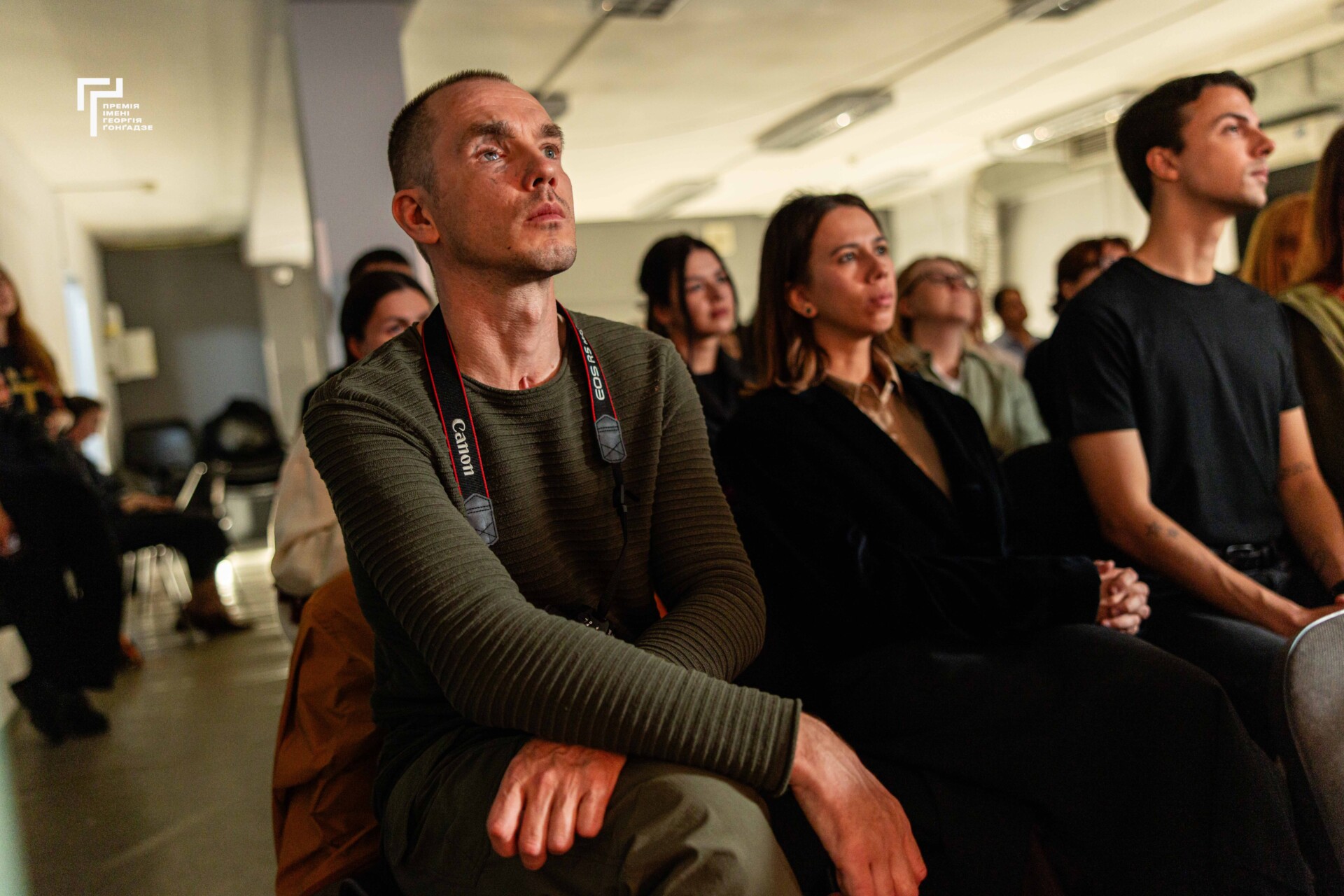
The event took place as part of Georgiy Gongadze Remembrance Week, which runs from 14 to 20 September.
Information partners of Georgiy Gongadze Remembrance Week: Ukrainska Pravda, PEN Ukraine, the Institute of Mass Information, Detector Media, Donbas Media Forum, the Commission on Journalistic Ethics, NV, the Human Rights Centre ZMINA, Suspilne, and Lviv Media Forum.
The Georgiy Gongadze Prize was established in 2018 by PEN Ukraine, Georgiy Gongadze’s family, Ukrainska Pravda, Kyiv-Mohyla Business School and its alumni.