Enemies everywhere? At Docudays UA, participants discussed how not to lose people from occupied territories
Russian aggression against Ukraine has been ongoing for more than 12 years, and around 20% of the country’s territory remains under occupation. Some children and young people have never lived in territory under the control of the Ukrainian government, while millions of citizens are subjected to the pressures of the occupation system on a daily basis.
Does living under occupation automatically mean disloyalty to Ukraine? How can the state protect itself from genuine security risks while avoiding the alienation of millions of citizens who remain in the temporarily occupied territories or leave them? And does Ukraine currently have a comprehensive policy towards its citizens living under occupation?
These questions were discussed during the panel discussion “Enemies Everywhere? The Line Between Security and the Reintegration of People from Occupied Territories”, which took place on 7 June 2026 as part of the RIGHTS NOW! human rights programme of the Docudays UA festival.
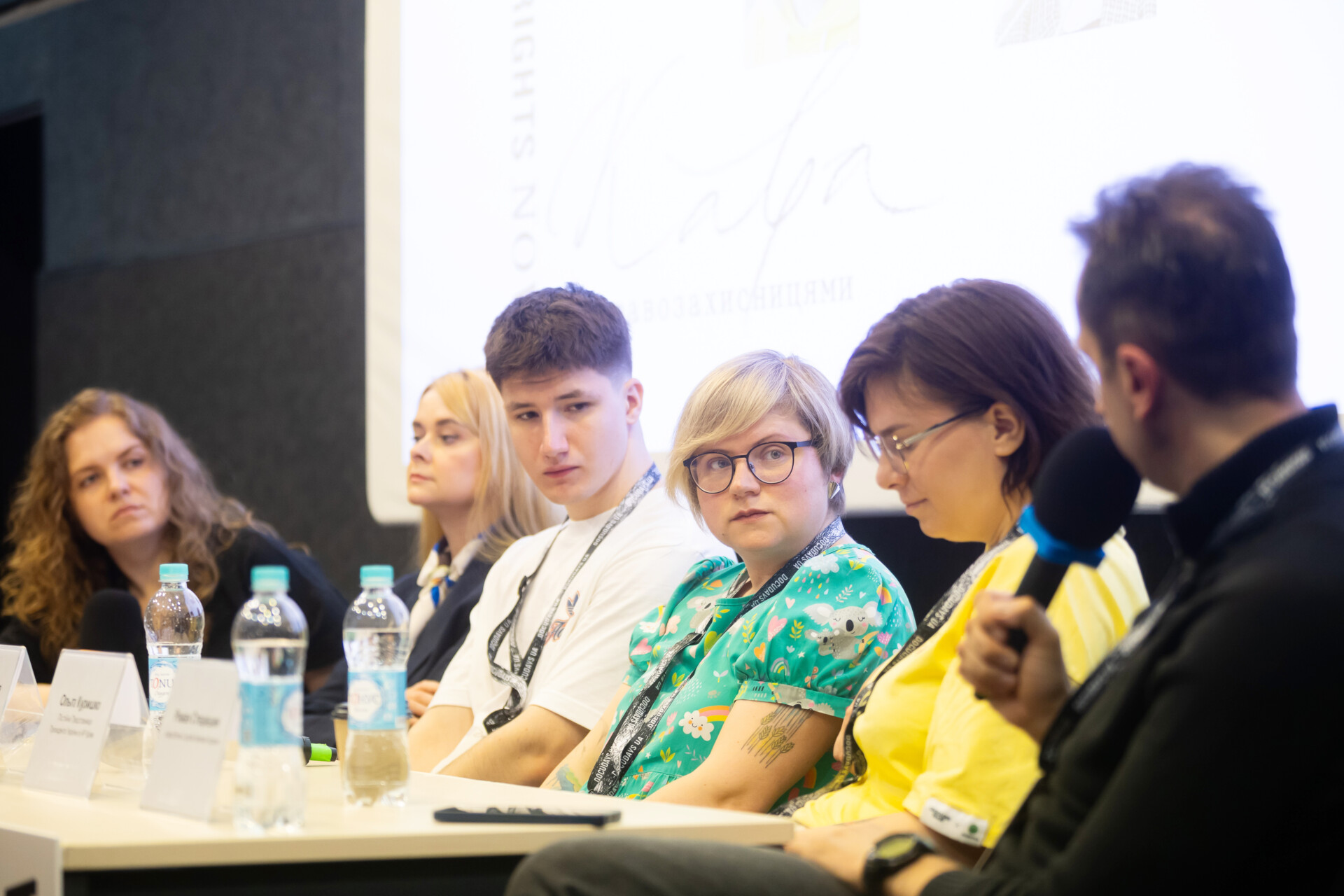
The panel featured Serhii Savchenko, a native of Donetsk who maintained a pro-Ukrainian stance while living under occupation and managed to leave at the age of 17; Alena Lunova, Advocacy Director at the Human Rights Centre ZMINA; Olha Kuryshko, Permanent Representative of the President of Ukraine in the Autonomous Republic of Crimea; Roman Stetsyshyn, an officer of the Security Service of Ukraine (SBU); and Yuliia Usenko, an expert on accountability for international crimes against children at the Bring Kids Back UA initiative. The discussion was moderated by Viktoriia Yermolaieva, Editor-in-Chief of Hromadske Radio and co-founder of the NGO Women in Media.
Serhii Savchenko, who lived in occupied Donetsk until the age of 17 and later managed to relocate to territory controlled by Ukraine, said that Ukrainians living in free territory often do not fully understand the realities of life under occupation: “People in Kyiv and other cities think it is simply life under a different flag. But if you are a pro-Ukrainian teenager living under occupation, every day you worry about being exposed, having your phone checked, or someone discovering your views“.
According to him, even attending school becomes an act of constant internal resistance. Young people are forced to participate in activities organised by Russian youth movements, including the “Movement of the First”, while at the same time trying to preserve their Ukrainian identity through music, literature, social media, and communication with people living in territory controlled by Ukraine.
“Every day feels as though you are trying to shield yourself from what is happening around you so that you do not become part of it“, Serhii Savchenko shared.
 Photo: Serhii Savchenko
He stressed that one of the most important links to Ukraine for him was communication with people living in non-occupied territories: “People from Kyiv and other cities whom I spoke with were a reliable source of information. These included civil society activists, Ukrainian media, and social media communities. It was through them that I remained connected to the Ukrainian context“.
At the same time, Serhii Savchenko highlighted the lack of information and practical guidance in Ukrainian media on issues such as documentation, education, and opportunities to leave the occupied territories. According to him, this forces many people to seek information through anonymous Telegram channels, where they may be monitored by Russian security services.
Yuliia Usenko called for the situation of Ukrainian children living under occupation to be viewed not as isolated cases of pressure or propaganda, but as part of a systematic state policy pursued by Russia.
According to her, the Russian Federation is grossly violating international humanitarian law, including the Fourth Geneva Convention, which requires the preservation of the educational and cultural environment of occupied territories.
Instead, the occupation authorities are systematically integrating Ukrainian children into their military-patriotic system: “These are not isolated campaigns or activities. This is a comprehensive system of influence aimed at reshaping children’s consciousness and identity“.
A particularly important role in this process is played by “Yunarmiya” – a Russian-created paramilitary youth movement that became part of the education system in the occupied territories after the start of the full-scale invasion.
 Photo: Viktoriia Yermolaieva, Yuliia Usenko (with a microphone), Serhii Savchenko
According to Yuliia Usenko, so-called health and summer camps in Russia and Belarus pose a particular danger, with thousands of Ukrainian children passing through them. There, children spend months exposed to Russian propaganda, studying distorted versions of history and undergoing elements of military training.
“Russia spends around 100 million US dollars every year on military-patriotic education programmes alone. This is part of the Russian Federation’s state security strategy“, stressed the Bring Kids Back UA expert.
Alena Lunova stressed that Ukraine’s state policy towards residents of the occupied territories is becoming increasingly focused on security risks.
“Today, people from the occupied territories are primarily visible to the state through a security lens. They are viewed not through the prism of support or reintegration, but rather through the prism of security risks“, she noted.
In her view, Ukraine is simultaneously demonstrating a willingness to help people from occupied territories while creating numerous barriers for them. On the one hand, there are preferential education programmes, simplified admission procedures to Ukrainian universities, and other support mechanisms for young people from occupied territories. On the other hand, there are additional screening procedures, difficulties related to documentation, and various restrictions that create a sense of distrust: “It seems that the state has still not decided what matters most to it: security or bringing people back“.
 Photo: Serhii Savchenko, Alena Lunova (with a microphone)
Lunova stressed that people are not to blame for finding themselves under occupation. She also warned against creating a presumption of guilt towards those who live or have lived in the occupied territories.
“Five, ten, or twenty years from now, we cannot continue building a system in which a person automatically faces suspicion solely because of where they live or because they have relatives in occupied territories“, stressed ZMINA’s Advocacy Director.
Roman Stetsyshyn acknowledged that the title of the discussion accurately reflects the state’s central dilemma: “If we answer the question “Are enemies everywhere?” literally, then yes – they are everywhere. But is everyone an enemy? No, certainly not“.
According to him, the state cannot ignore the fact that millions of people have spent years under the influence of a large-scale system of Russian propaganda and indoctrination.
At the same time, Stetsyshyn stressed that security and reintegration should not be seen as opposing goals: “To avoid losing people, we must guarantee national security“.
 Photo: Roman Stetsyshyn
He also focused on the debate surrounding a draft law introducing additional screening procedures for entry into the civil service. The SBU representative said that he supports the use of polygraph testing as one of the screening tools, stressing that it should not automatically restrict a person’s rights but can serve informative and preventive purposes. In his view, the state must be confident that individuals holding positions of responsibility do not pose a risk to national security.
At the same time, this position drew significant criticism from the human rights community over the potential risks of discrimination and the creation of collective suspicion towards people from occupied territories.
Olha Kuryshko stressed that the main challenge today is not only Russia’s policy in the occupied territories, but also the absence of a coherent state approach towards them: “What we are seeing now is the absence of an overarching state policy on the temporarily occupied territories“.
According to Olha Kuryshko, after the Ministry of Reintegration was dissolved, responsibility for this area was distributed among various institutions: “Each institution shapes policy according to its own vision. The Security Service has its own focus, the Ministry of Education has its own, and the Ministry of Culture has its own. But there is no single centre responsible for shaping an overall state policy“.
 Photo: Olha Kuryshko
She stressed that it is becoming increasingly difficult for the state to maintain contact with citizens living under occupation. According to her, Russia is rapidly strengthening its digital control over the population, forcing people to use Russian state services and restricting access to independent sources of information.
In Olha Kuryshko’s view, Ukraine needs a platform for systematic dialogue between state institutions, civil society, and representatives of the occupied territories. Only such coordination will make it possible to develop a long-term strategy for maintaining ties with citizens and supporting their future reintegration.
Despite differing views on screening mechanisms and the balance between security and human rights, the participants agreed on one key point: millions of Ukrainian citizens living under occupation cannot remain outside the state’s attention. Serhii Savchenko’s story clearly illustrates this and shows that even after many years of living under occupation, young people continue to preserve their Ukrainian identity.
The event was organised by a coalition of organisations that have been working since 2014 to protect the rights of victims of the armed aggression against Ukraine, as part of the RIGHTS NOW! human rights programme at Docudays UA 2026.
The coalition includes the Human Rights Centre ZMINA, NGO Donbas SOS, NGO Crimea SOS, Charitable Foundation Right to Protection, Charitable Foundation East SOS, NGO Civil Holding GROUP OF INFLUENCE, Charitable Foundation Stabilization Support Services, the Crimean Human Rights Group, and NGO Crisis Insight.
Photo credit: Yevhenii Zavhorodnii, Docudays UA