Statement on the International Day to End Impunity for Crimes against Journalists
Abductions, torture, years of detention without trial and sentences intended to intimidate: crimes against journalists from Ukraine’s occupied territories must not go unpunished.
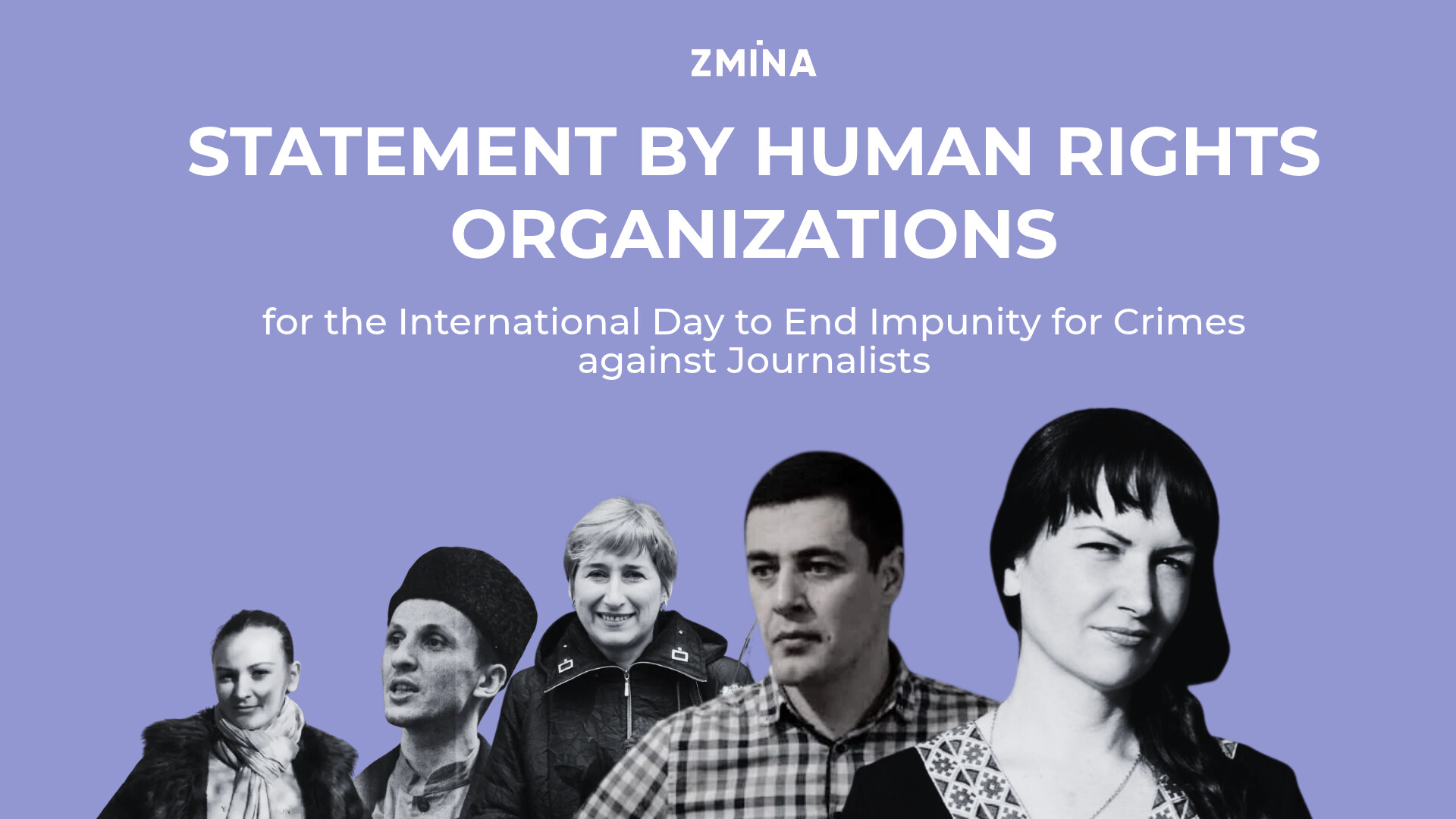
In the temporarily occupied Ukrainian territories the Russian Federation has systematically persecuted professional and citizen journalists who document events in the temporarily occupied territories and inform the public in Ukraine and abroad. They are abducted, unlawfully detained without contact with their families or lawyers, tortured and convicted in closed-door trials on charges of “terrorism”, “extremism”, “espionage” and “high treason”, before being transferred to detention facilities in Russia, thousands of kilometres from their homes.
According to a list compiled by human rights defenders and the Institute of Mass Information in September 2026, at least 27 journalists and media workers from the temporarily occupied territories remain in Russian captivity, including 17 journalists from Crimea. The list includes professional and citizen journalists, livestreamers and administrators of media channels. The cases outlined below, documented by Ukrainian and international human rights organisations, in particular ZMINA, IMI, CHRG and RSF, demonstrate the Russian Federation’s systematic policy of suppressing freedom of expression and using the judicial system to persecute media workers.
Journalists have been unlawfully detained for years, with their health deteriorating due to ill-treatment and denial of medical care.
Iryna Danylovych, a Crimean citizen journalist, was abducted by Russian security forces on 29 April 2022 and held incommunicado for 13 days. In December 2022, she was sentenced to seven years in prison for allegedly possessing explosives. Her sentence was later reduced by one month. Danylovych developed an ear infection while held at the Simferopol pre-trial detention centre, but the court continued hearing her case despite her serious health condition. During the trial, she was denied medical care, prompting her to go on hunger strike. As a result of torture and inhuman treatment at the detention centre, she lost hearing in one ear and suffered a minor stroke. Since August 2023, she has been held at Penal Colony No. 7 in Zelenokumsk, Stavropol Krai, Russia. In July 2026, Danylovych’s sister, Olha Novytska, reported that the television at the Zelenokumsk penal colony was kept at maximum volume from morning until evening. It later emerged that other prisoners regularly threaten to kill Danylovych in the presence of prison staff and that she is being subjected to torture through prolonged exposure to loud noise. Deliberately subjecting a person with impaired hearing to prolonged exposure to loud noise, alongside threats and denial of medical care, bears the hallmarks of cruel and inhuman treatment.
Server Mustafaiev, a citizen journalist and coordinator of Crimean Solidarity, has been imprisoned since May 2018. In September 2020, he was sentenced to 14 years in prison on a fabricated charge. Since September 2022, he has been held at Penal Colony No. 1 in Russia’s Tambov region, and since February 2024, he has been subjected to strict detention conditions. In August 2025, Mustafaiev’s wife reported a sharp deterioration in his health. Mustafaiev is regularly subjected to strict detention conditions and placed in cell-type confinement units. His health continues to deteriorate, yet he is denied medical care.
Amet Suleimanov, a citizen journalist with a disability caused by a heart condition, was sentenced to 12 years in prison in 2021. He has been in custody since 5 April 2023 and has been held at Vladimir Central Prison since September 2023. Following his sentencing and transfer to Russia, Suleimanov’s health deteriorated significantly, and he now urgently needs heart valve replacement surgery. On 29 March 2024, a court in Vladimir refused to release him, despite medical records documenting conditions that should preclude imprisonment. In July 2025, he suffered a hypertensive crisis. Suleimanov’s relatives periodically send him essential medication, but prison authorities have repeatedly refused to accept these parcels. In February 2026, Suleimanov’s wife reported worsening ultrasound findings, a blood clot and high blood pressure. Denying treatment to a seriously ill person poses a direct threat to their life.
The cases of media workers from occupied Melitopol reveal systematic violations of the right to a fair trial. On the night of 20 August 2023, Russian security forces abducted seven media workers associated with the Telegram channels “Melitopol is Ukraine” and “RIA Melitopol” (now “RIA Pivden”) during a raid: Anastasiia Hlukhovska, Yana Suvorova, Vladyslav Hershon, Oleksandr Malyshev, Heorhii Levchenko, Maksym Rupchov and Mark Kaliush. For weeks, their families had no information about their fate or whereabouts. Two weeks before the FSB of Russia publicly announced on 27 October 2023 that it had “uncovered an intelligence network”, Hlukhovska’s family received a letter stating that the FSB did not know Anastasiia’s whereabouts. On 29 October 2023, Russian propaganda outlets released videos of the arrests featuring the media workers’ “confessions”. A former detainee who was held alongside the female media workers in a hangar at the Ruslan-Komplekt factory reported that Hlukhovska had been subjected to electric shocks as a form of torture. Mark Kaliush, who was released in a prisoner exchange on 24 August 2025, described being beaten and tortured while in captivity.
The cases against the Melitopol media workers were brought before the Southern District Military Court in Rostov-on-Don only in May–June 2025 – almost two years after their detention. Civilians from the occupied territory were tried in Russia, even though the Fourth Geneva Convention requires courts established by the occupying power to sit exclusively in the occupied territory. Those convicted are transferred to prisons deep inside Russia, despite the requirement that accused and convicted persons be detained and serve their sentences in the occupied territory (Article 66, Article 76). Most face charges of “espionage”, “participation in a terrorist organisation” and “committing a terrorist act”, allegedly in connection with a strike on 27 March 2023 against a college building in Melitopol that housed the FSB of Russia and the Russian National Guard (Rosgvardia). According to the Kharkiv Human Rights Protection Group (KHPG), no one was injured in the strike.
The sentences were handed down after prolonged periods of isolation and under circumstances that cast doubt on whether the media workers’ “confessions” were voluntary. On 2 September 2025, the occupation authorities’ “Zaporizhzhia Regional Court” sentenced Heorhii Levchenko, an administrator of “RIA Melitopol”, to 16 years in a maximum security penal colony on charges of “high treason” and “calls for extremism”. The court also banned him from using the internet for one year. In June 2026, the Supreme Court of the Russian Federation upheld the sentence. Neither Levchenko’s family nor his editorial team has been able to establish where he is currently being held. Vladyslav Hershon was sentenced to 15 years in prison on 3 September 2025. By early October 2025, the occupation authorities were using footage of his “confession” to intimidate residents of the occupied Zaporizhzhia region. His brother told Reporters Without Borders (RSF) that Hershon was “beaten every day” while held in the Rostov region. In 2026, he was transferred to a prison in Vladimir. His health continues to deteriorate due to inadequate detention conditions.
Yana Suvorova, who was detained at the age of 18, was sentenced to 14 years in prison on 23 October 2025 following a closed-door trial. In late July 2025, she was held in overcrowded cells in Donetsk with inadequate access to fresh air and water. Since mid-August 2025, she has been held at Pre-trial Detention Centre No. 2 in Taganrog, where she shares a cell with women convicted of serious crimes. Following her transfer, her ability to make telephone calls to her family was restricted, and her last telephone contact with them was in early June 2026. Maksym Rupchov was sentenced to 15 years in prison on 13 November 2025, with the first three years to be served in prison. He was subsequently transferred to Kharp in the Yamal region – nearly 3,000 kilometres from Melitopol. Oleksandr Malyshev, an administrator of the “Melitopol Is Ukraine” Telegram channel, was sentenced to 26 years in prison on 28 April 2026. This is the harshest sentence imposed on a media worker since 2022. Court records give October 2023 as the date of his detention, although human rights defenders report that Malyshev was taken into custody on 20 August 2023 and held incommunicado from that point onwards. This discrepancy indicates that he was held for at least two months without his detention being formally recorded.
Iryna Levchenko, a 65-year-old retired journalist, was abducted alongside her husband on a street in Melitopol on 6 May 2023. She was held unofficially for 14 months in the so-called “pit”, and her arrest was not formally recorded until June 2024. She therefore spent more than a year in detention without a formal legal decision authorising it, notification of any charges or judicial oversight. Even in December 2025, after her transfer from Donetsk to Simferopol, her family had received no official information about the charges against her. In 2026, she was moved between Simferopol, Krasnodar and Donetsk, and was subsequently transported from Donetsk to Melitopol every ten days “for investigative procedures”. In early September 2026, the occupation authorities’ “Zaporizhzhia Regional Court” sentenced her to 15 years in prison for “espionage”. The court’s statement identified her only as “L., born in 1961”. Levchenko’s sister said the family had learned of the sentence from third parties rather than her lawyer. In recent months, there has been virtually no contact with her lawyer, while Iryna’s letters are censored and arrive with parts missing. On 30 September 2026, Iryna’s sister reported that the court had dismissed her appeal. Levchenko is currently held at Pre-trial Detention Centre No. 2 in Mariupol. In September 2026, while testifying in a Russian court in a separate case, she gave an account of prisoners being beaten and how she herself had been tortured with electric shocks during interrogations at a secret detention facility in Melitopol.
One of the most prolonged violations of the right to a fair trial is holding people for years without charge or trial. Anastasiia Hlukhovska has been held without formal charges or trial since 20 August 2023 – more than three years. Since August 2024, she has been detained at Pre-trial Detention Centre No. 3 in Kizel, Perm Krai, Russia. Yet in its response, the Investigative Committee of the Russian Federation stated that “no preliminary inquiries had been conducted, no criminal proceedings had been initiated, and she had not been detained by investigators from the department”. When her lawyer submitted inquiries to the Federal Penitentiary Service (FSIN), the authorities responded that she was not being held in their facilities. In August 2026, Reporters Without Borders (RSF) confirmed that Hlukhovska had neither been formally charged nor convicted, yet remained in incommunicado detention. Former detainees who have since been released reported seeing her in Kizel, while her sister has expressed concern about her health. According to human rights defenders, Yevhen Ilchenko, an administrator of the Melitopol Telegram channel “Mylyi Topol”, who was detained on 10 July 2022, is also being held without formal charges at Pre-trial Detention Centre No. 2 in Taganrog. Holding people for years without charge, access to a lawyer of their choice or judicial oversight violates not only their right to liberty but also their right to a fair trial. Everyone has the right to be promptly informed of the charges against them, to legal representation and to be tried by an independent court. Refusing to acknowledge a person’s detention and concealing their whereabouts bear the hallmarks of enforced disappearance.
Journalists are civilians and are protected under international humanitarian law unless they take a direct part in hostilities. Detained journalists are entitled to the presumption of innocence, the right to a defence, the public pronouncement of the judgment and protection against being compelled to testify against themselves or confess guilt (Fourth Geneva Convention, Article 71; Additional Protocol I, Article 75). Civilians may be interned only for imperative reasons of security, subject to regular review (Article 78). These guarantees are also enshrined in Articles 9 and 14 of the International Covenant on Civil and Political Rights. Unlawful confinement, torture or inhuman treatment, wilfully depriving a person of the right to a fair and regular trial, and the unlawful transfer of civilians from temporarily occupied territory constitute grave breaches of the Fourth Geneva Convention (Article 147). The actions of the Russian Federation described above bear the hallmarks of war crimes and crimes against humanity.
The evidence presented above calls for urgent action to protect all Ukrainian journalists unlawfully imprisoned by Russia and ensure effective investigations into the crimes committed against them.
We call on the Government of Ukraine to:
- continue efforts to secure the release of all unlawfully detained Ukrainians, particularly journalists, include them on prisoner exchange lists and prioritise older people, people with disabilities and those with serious medical conditions, including Iryna Levchenko, Amet Suleimanov, Iryna Danylovych, Server Mustafaiev, Vilen Temerianov, Tymur Ibrahimov and others;
- document and investigate torture, enforced disappearances, unlawful transfers, violations of the right to a fair trial and other crimes against journalists, preserve testimonies from released detainees and their families, and ensure the safety of witnesses;
- help the families of imprisoned journalists obtain information about their whereabouts, maintain contact with their lawyers and access legal and psychological assistance;
- ensure the rehabilitation and reintegration of released journalists and strengthen support for independent media from the temporarily occupied territories.
We call on the international community to:
- increase political and diplomatic pressure on the Russian Federation to demand the immediate release of all unlawfully detained Ukrainian journalists and to establish and disclose the fate and whereabouts of Anastasiia Hlukhovska and Heorhii Levchenko;
- demand that Russia stop trying civilians from the temporarily occupied territories in Russian courts and transferring them to Russia, and immediately release those who are illegally detained and everyone held without a lawful procedural basis for detention;
- press for regular access by the International Committee of the Red Cross (ICRC), UN monitoring mechanisms and other independent observers to detention facilities and court hearings, assessments of detention conditions and detainees’ health, and unrestricted contact between detainees and their families and lawyers of their choice;
- facilitate the Office of the United Nations High Commissioner for Human Rights (OHCHR), the Independent International Commission of Inquiry on Ukraine, the UN Human Rights Monitoring Mission in Ukraine (HRMMU), the UN Working Group on Arbitrary Detention, the UN Working Group on Enforced or Involuntary Disappearances, relevant UN Special Rapporteurs, the OSCE Representative on Freedom of the Media and other competent mechanisms to systematically document these violations, keep information on each journalist up to date and publish their findings in accordance with their respective mandates;
- strengthen coordinated diplomatic and humanitarian efforts to secure the release of journalists, including by regularly raising their cases in bilateral discussions, international negotiations and multilateral settings;
- ensure that those responsible are held accountable, including through investigations under universal jurisdiction where permitted by law;
- impose and strengthen targeted individual sanctions, including visa restrictions and asset freezes, against investigators, prosecutors, judges, prison officials and others whose involvement in the unlawful detention, torture, enforced disappearance or unfair trials of journalists is supported by properly verified evidence;
- support programmes to protect journalists and independent media operating in or reporting on the occupied territories.
We call on the Government of Ukraine, states, UN bodies, the OSCE, the Council of Europe, the European Union, the International Committee of the Red Cross and civil society to take urgent, coordinated action to release all illegally detained. Abducting people and refusing to acknowledge their detention, holding them in isolation for years without charge, forcing them to “confess” while in captivity, conducting closed-door trials in Russia and imposing prison sentences of up to 26 years are not acts of justice but tools of repression against those who speak the truth about the occupation. Impunity for such crimes only encourages further crimes. What is needed now is not just statements of solidarity, but sustained documentation of violations, access to detainees, concrete efforts to secure their release and accountability for those responsible.
Signatories:
Human Rights Centre ZMINA
NGO “Human Rights Center “DIYA”
Crimean Human Rights Group
NGO “Crimean Process”
Human Rights House “Crimea”
NGO “CRIMEA SOS”
Institute of Mass Information
Center for Civil Liberties
SIGN