14 years of ZMINA: looking back at a year of human rights work
Fourteen years ago, ZMINA began as a small initiative launched by activists and journalists who believed that human rights in Ukraine were not an abstract concept, but something that required work every day. Today, it is a team of around 50 people who document international crimes, defend activists, draft legislative proposals and raise awareness of Russian war crimes in Brussels, Vienna and The Hague. This article looks back at ZMINA’s work over the past year.
 Members of the ZMINA team on Vyshyvanka Day 2026
When pressure on the anti-corruption community intensified again
The past year proved difficult for Ukraine’s anti-corruption community. Pressure continued following large-scale searches targeting NABU staff in July 2025 and an attempt to curtail the independence of NABU and SAPO through draft law No. 12414. Anti-corruption activists and organisations continued to face criminal proceedings, searches, smear campaigns and lawsuits.
Throughout the year, ZMINA documented these cases, monitored key trials, provided legal assistance to those facing persecution and drew attention to the issue both in Ukraine and internationally. The team recorded more than 30 cases of pressure against staff of anti-corruption bodies, activists, journalists and other members of the community. It also regularly attended court hearings to document the proceedings and any human rights violations.
 Ruslan Mahamedrasulov, head of a NABU detective unit, at a Court of Appeal hearing, 12 November 2025
This work resulted in the study “Systemic pressure on anti-corruption actors: practices of 2025–2026”. ZMINA brought together 29 documented cases into a single dataset and applied a set of criteria to answer the central question: were these isolated troubling incidents, or did they amount to a broader system of persecution? The study revealed a recurring pattern: criminal proceedings, urgent searches, seizure of equipment, use of force, and media and political pressure.
On 21 July 2026, exactly one year after the mass searches targeting NABU staff, ZMINA presented the study at an expert discussion in Kyiv. Senior officials from NABU and SAPO joined members of parliament, civil society, the media and the international community to discuss not only what had happened a year earlier, but also how to prevent it from happening again, counter the pressure and strengthen mechanisms for protecting anti-corruption actors, as the persecution continues.
 Alena Lunova, ZMINA Advocacy Director; Semen Kryvonos, NABU Director; and Oleksandr Klymenko, Head of SAPO
 Documentation matters when it leads to protection. ZMINA provided legal assistance to people facing pressure because of their anti-corruption work and supported strategic litigation, including an application to the European Court of Human Rights concerning violations committed during the crackdown on NABU staff and Vitalii Shabunin. In February 2026, the ECtHR agreed to examine the joint application.
This work produced tangible results: three people whom ZMINA supported and advocated for were released from custody, while two others were acquitted or had the charges against them dismissed by the courts. One such case involved Yusuf Mameshev, who faced persecution after testifying in defence of NABU official Ruslan Mahamedrasulov. ZMINA supported his defence and monitored the proceedings: in May 2026, a court of first instance found Mameshev not guilty, and in July the Court of Appeal upheld his acquittal.
178 cases of persecution: what pressure on civil society looks like
At the same time, ZMINA worked with a broader range of people who help sustain Ukraine’s democratic space every day. Around 40 activists and journalists received initial legal assistance and representation in court and criminal proceedings. A further 30 people received emergency assistance, including security cameras, relocation to safer areas, new equipment for their work, and psychological and medical support.
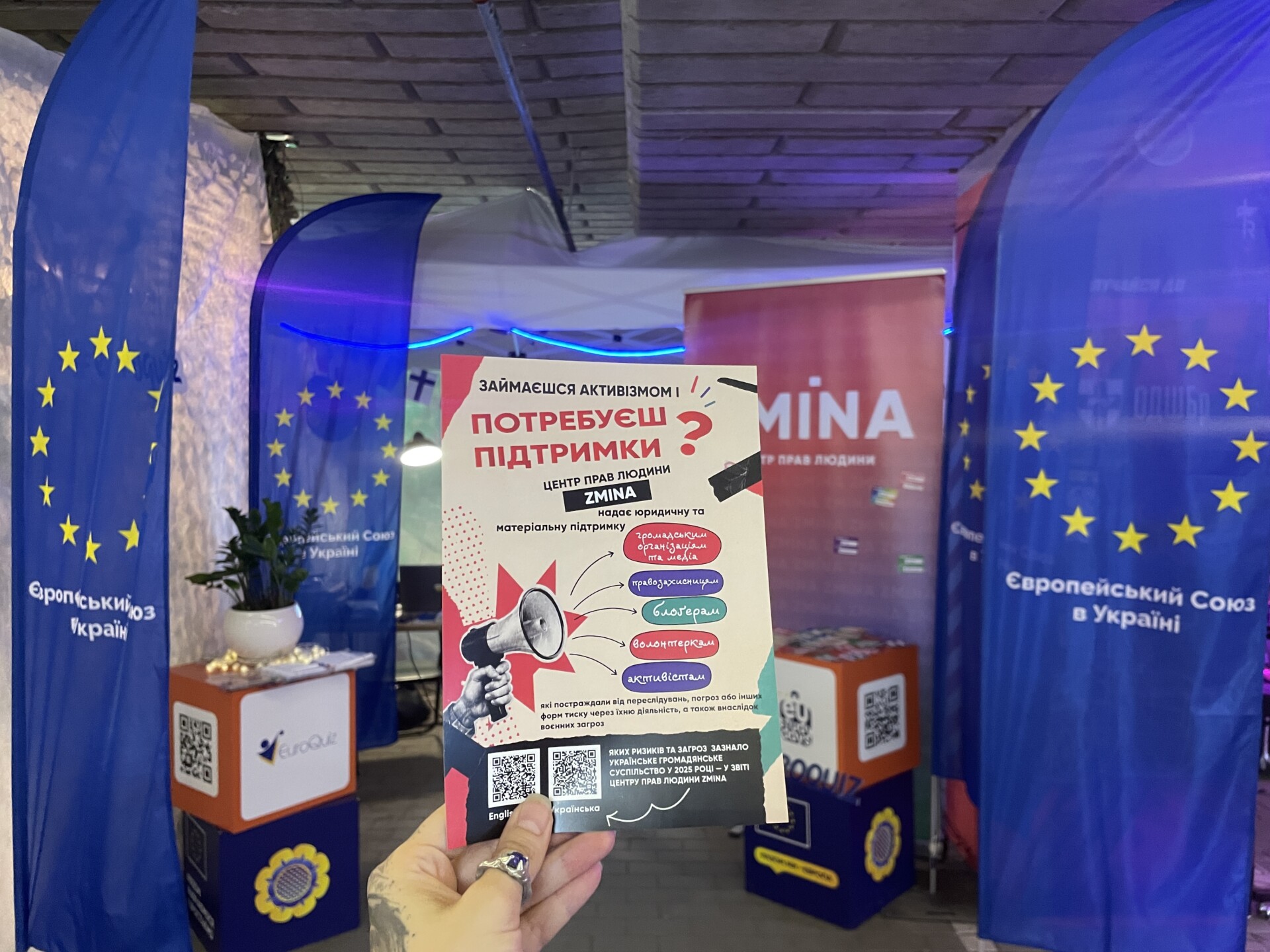 ZMINA at the Civil Society Alley at Atlas Festival, July 2026
 In April, ZMINA prepared and presented the analytical report “The situation of human rights defenders and civic activists in Ukraine in 2025”. The study documented 178 cases of persecution, attacks, pressure and losses among civil society representatives in 2025. More than 60% of them (112 cases) were linked to Russian aggression, including attacks on volunteer centres, media outlets and humanitarian warehouses. The remaining 66 cases involved domestic pressure from state bodies, law enforcement agencies, local authorities or non-state actors.
The forms of pressure documented included intimidation, online threats – experienced by almost a third of respondents – online harassment, surveillance, smear campaigns, SLAPPs and gender-based online violence targeting women activists and journalists.
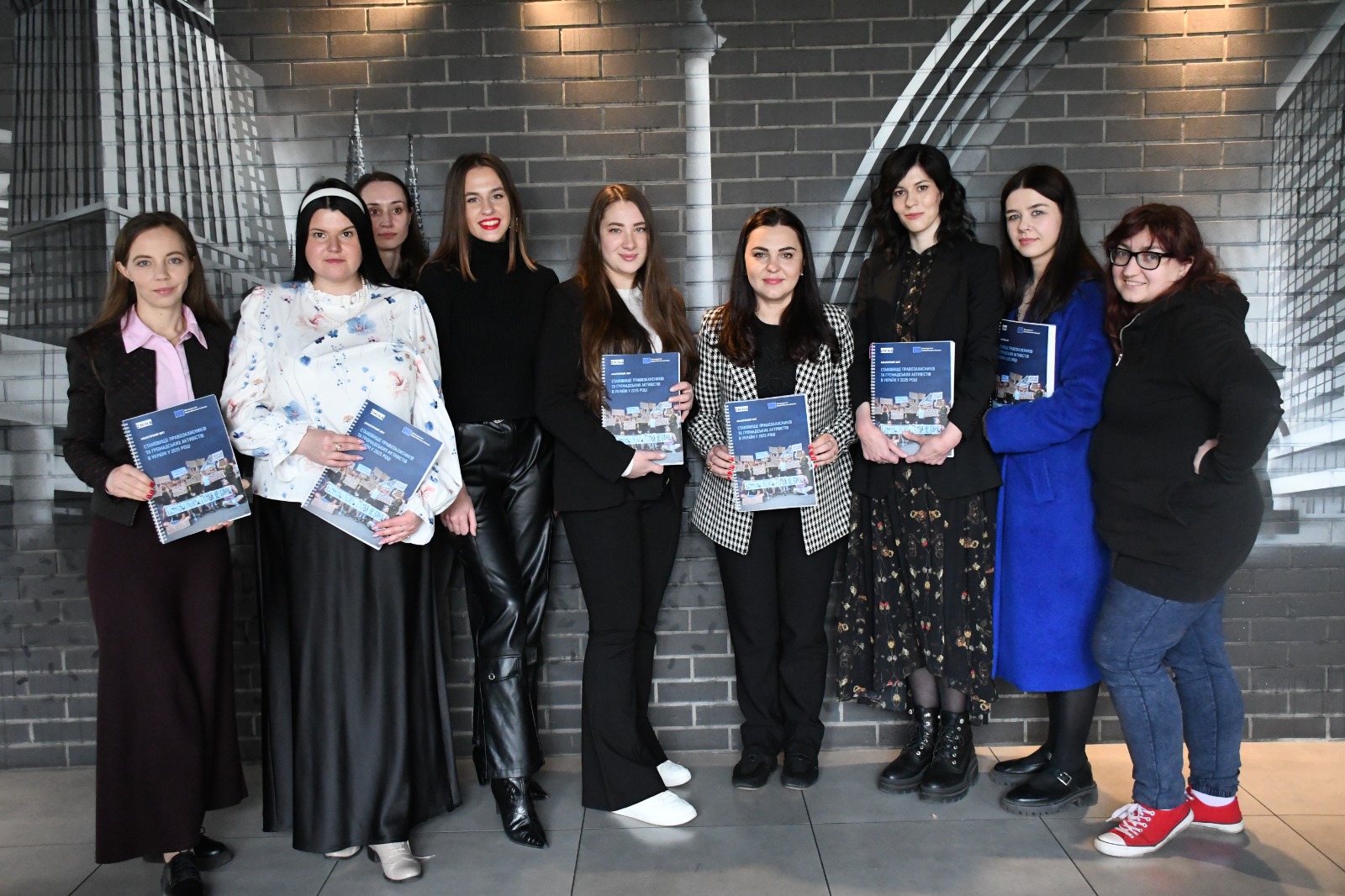 Presentation of the analytical report on the situation of civil society activists in Ukraine in 2025, Kyiv, 30 April 2026
 ZMINA devoted particular attention to women in the human rights sector. In November 2025, the organisation held a dedicated forum in Kyiv, where it presented the analytical study “Women in media and activism: challenges, risks and opportunities in wartime”. Participants discussed physical dangers, threats, persecution, burnout, psychological exhaustion, smear campaigns and gender-based pressure, as well as ways to counter them. The forum provided a space for analysis, solidarity and mutual support within the sector.
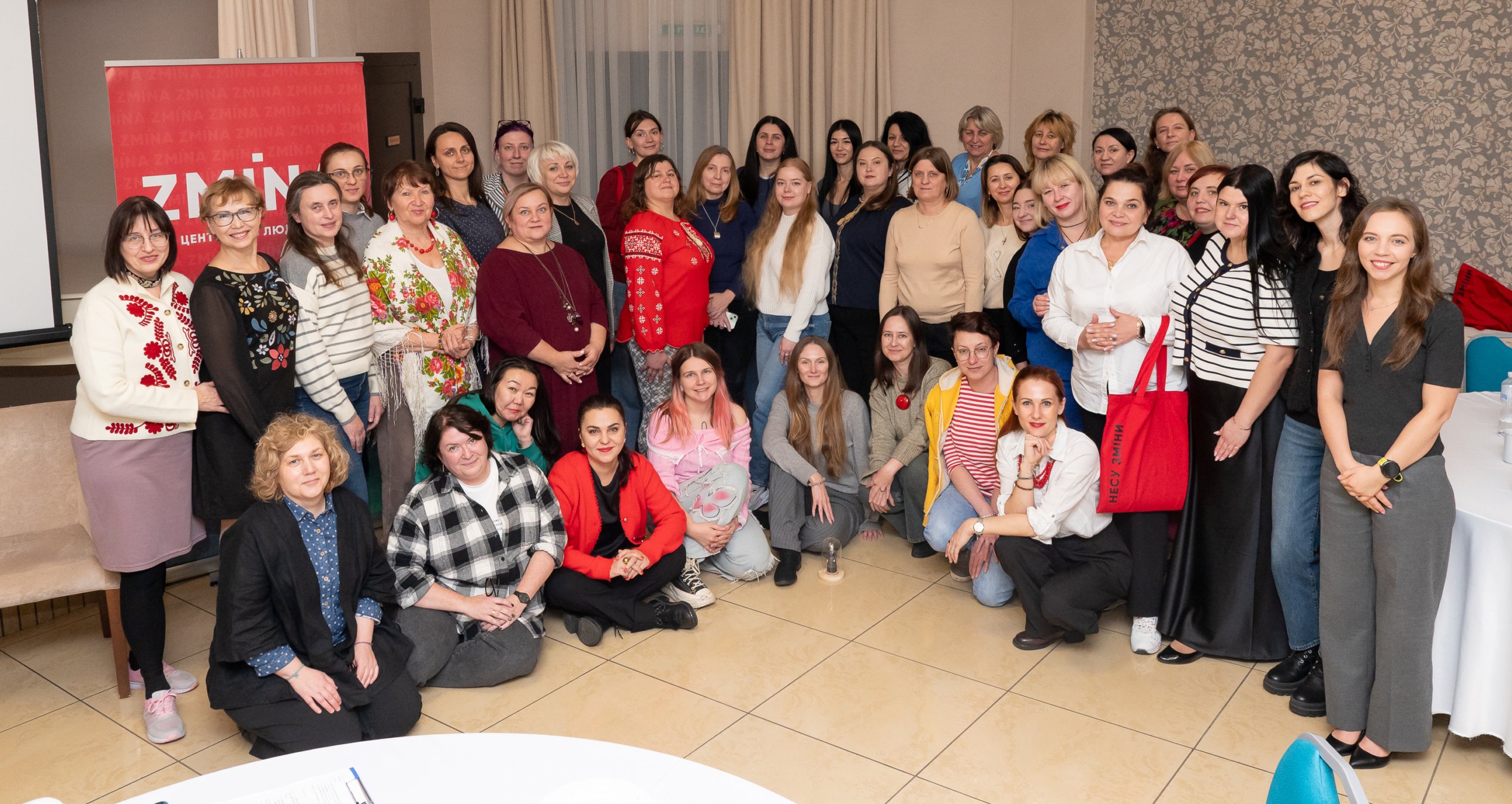 Participants in the forum “Women in Human Rights: War, Challenges and the Path to Resilience”, Kyiv, 28 November 2025
One story best illustrates why this work matters. In May 2026, the fabricated criminal proceedings against Transcarpathian journalist Olena Mudra and environmental activist Oksana Stankevych-Volosianchuk were officially closed. Officers from the Zakarpattia regional police had spent ten months “investigating” the case on the basis of an unfounded complaint filed by a non-existent person. ZMINA took on the case, brought it to public attention during the presentation of its April report and raised it internationally at an OSCE event in Vienna in May 2026. The combined media attention, legal support and advocacy by the Human Rights Centre ZMINA and other organisations compelled the police to acknowledge that no criminal offence had been committed and close the case.
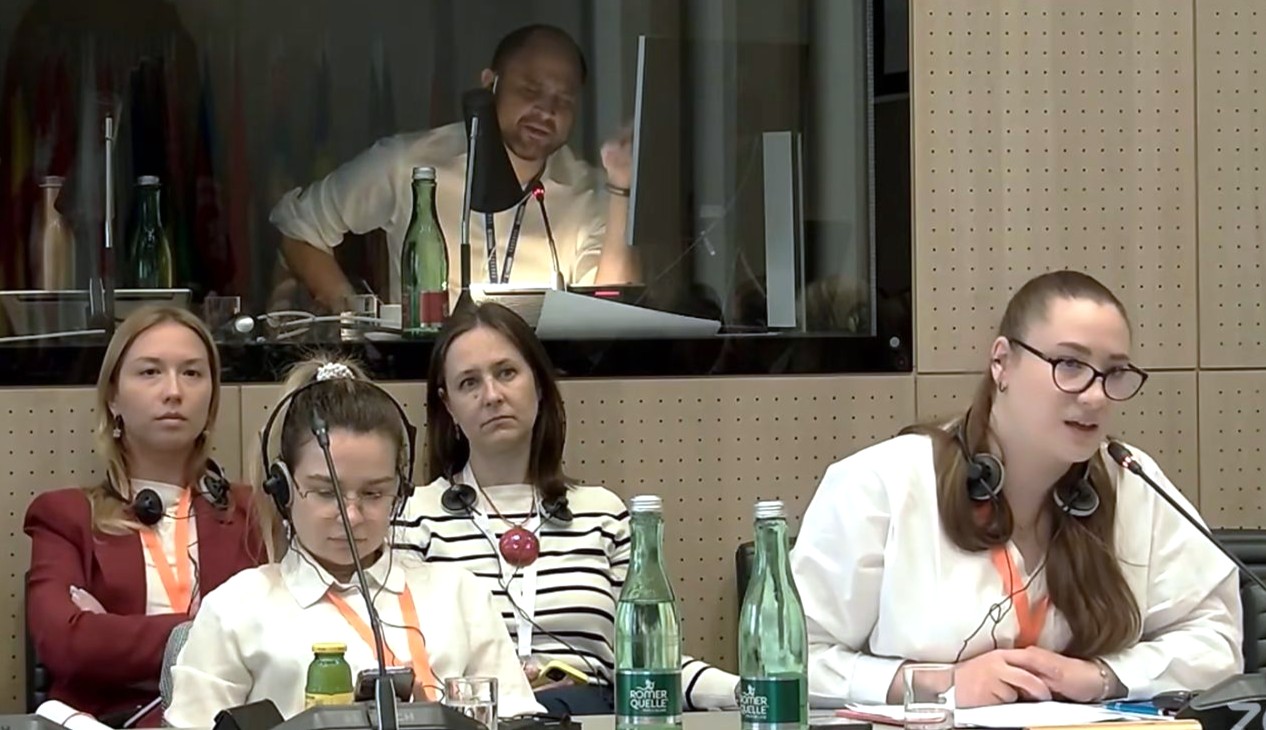 Tetiana Zhukova, ZMINA Senior International Advocacy Manager; Olena Mudra; Anna Liudva, representative of the Digital Security Lab; and Anastasiia Soloviova, ZMINA lawyer, at the OSCE Supplementary Human Dimension Meeting, Vienna, 12 May 2026
People affected by Russian aggression: from documentation to public policy
The Human Rights Centre ZMINA team continues to protect people affected by Russia’s armed aggression, including internally displaced persons, residents of the temporarily occupied territories and civilians unlawfully held by Russia. The organisation documented human rights violations, supported victims, prepared analytical papers and advocated for policy change. The goal is simple: to ensure that Ukraine has an effective support system for people affected by the war.
Representatives of the organisation joined a Working Group under the Ministry of Social Policy tasked with improving regulations governing support for civilians affected by the aggression. Together with its partners in the Coalition of Organisations Dealing with the Protection of the Rights of Victims of Armed Aggression against Ukraine, ZMINA helped develop the Strategy of State Policy on Internal Displacement for the period until 2030, which was approved by the Government. In early 2026, the organisation and its partners also secured the resumption of pension payments to IDPs who had not completed physical identification in time. The team also helped expand support measures for people deprived of their liberty as a result of the war, including by contributing to a government resolution intended to support those released from Russian captivity outside formal exchanges.
 Representatives of the Coalition of Organisations Dealing with the Protection of the Rights of Victims of Armed Aggression against Ukraine, Kyiv, February 2026
ZMINA consistently advocates for the rights of residents of the temporarily occupied territories, seeking to ensure that policies affecting them are effective and people-centred. The organisation draws attention to discrimination against residents of these territories and drafts amendments to national legislation. The issues that remain at the centre of its work are set out in a list of 17 priority steps for 2026, developed jointly with its partners.
Together with Bring Kids Back, ZMINA provides monthly updates to international partners and the Ukrainian public on Russia’s deportation and unlawful transfer of Ukrainian children, their return, the militarisation and indoctrination of children in the temporarily occupied territories, and efforts to hold those responsible to account.
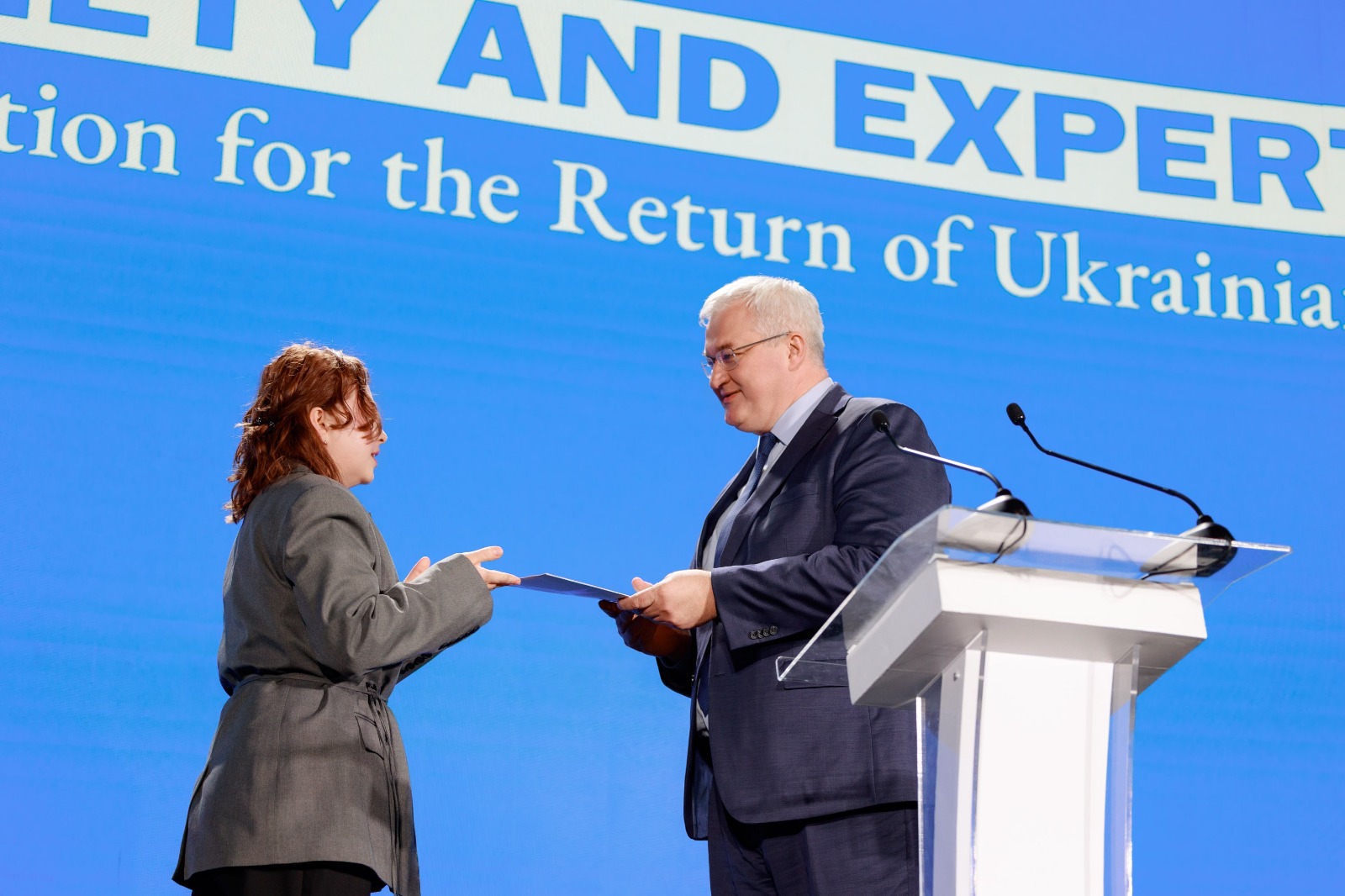 Onysiia Syniuk, ZMINA Head of the Research Department, hands over a joint statement by Ukrainian NGOs to Ukrainian Foreign Minister Andrii Sybiha for submission to the International Coalition for the Return of Ukrainian Children, Kyiv, 30 April 2026
ZMINA does not shy away from difficult issues, including approaches to accountability for collaboration, the problem of “civilian exchanges” and the use of polygraph tests on residents of the temporarily occupied territories applying for public-sector jobs. The organisation believes that issues affecting residents of the occupied territories must form part of the negotiation process. At the same time, human rights defenders contribute to the development of transitional justice policy by examining lustration, memory policies and other mechanisms.
Crimes with no statute of limitations
Throughout the year, ZMINA continued to document international crimes committed by Russian forces against civilians, combining in-depth interviews, open-source intelligence, and analytical and legal work. The team devoted considerable effort to demonstrating that systematic arbitrary detention, unlawful imprisonment, enforced disappearances, torture and politically motivated persecution of civilians in the occupied territories may constitute persecution as a crime against humanity under the Rome Statute of the International Criminal Court (ICC).
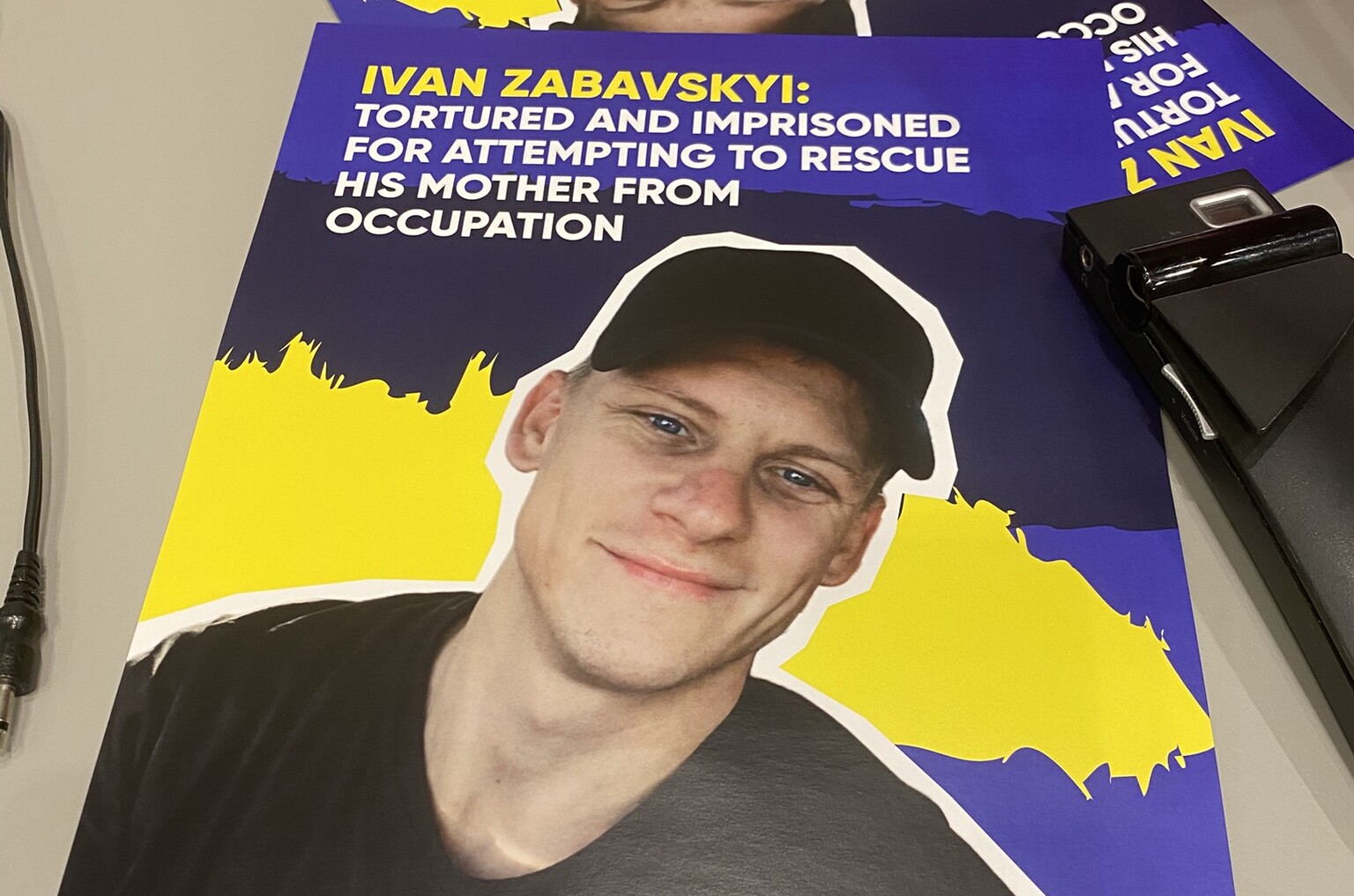 A leaflet featuring a photograph and the story of Ivan Zabavskyi, a civilian hostage from the Kharkiv region, distributed by ZMINA on the sidelines of an OSCE event in Vienna
The data collected formed the basis of analytical materials, complaints and submissions to national law enforcement agencies, as well as regular reporting to international mechanisms. In spring 2026, following a complaint by the Human Rights Centre ZMINA, the Prosecutor’s Office of the Autonomous Republic of Crimea and the city of Sevastopol opened criminal proceedings under Article 442-1 of the Criminal Code of Ukraine, “Crimes against Humanity”, concerning the systematic persecution of Ukrainian citizens through the denial of their right to a fair trial in occupied Crimea.
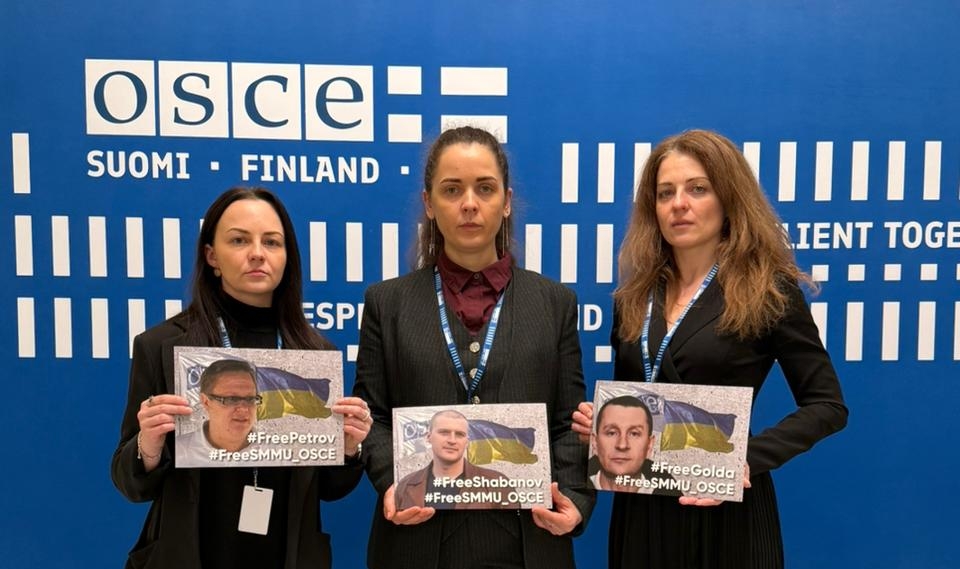 Viktoriia Nesterenko, ZMINA Project Manager; Marharyta Shabanova, wife of imprisoned OSCE staff member Dmytro Shabanov; and Yevheniia Kapalkina, Ukrainian Legal Advisory Group lawyer
 Supporting victims of international crimes and their families remains an essential part of this work. Over the year, ZMINA provided more than 300 legal consultations on protecting their rights and the available avenues for seeking justice, and assisted with applications to the Commission for Establishing the Fact of Deprivation of Personal Liberty. The organisation continued to identify and locate civilians abducted by Russia in the occupied territories, submitted the relevant lists to the competent Ukrainian authorities, monitored cases of politically motivated persecution and advocated internationally for the release and return home of all unlawfully detained Ukrainian civilians.
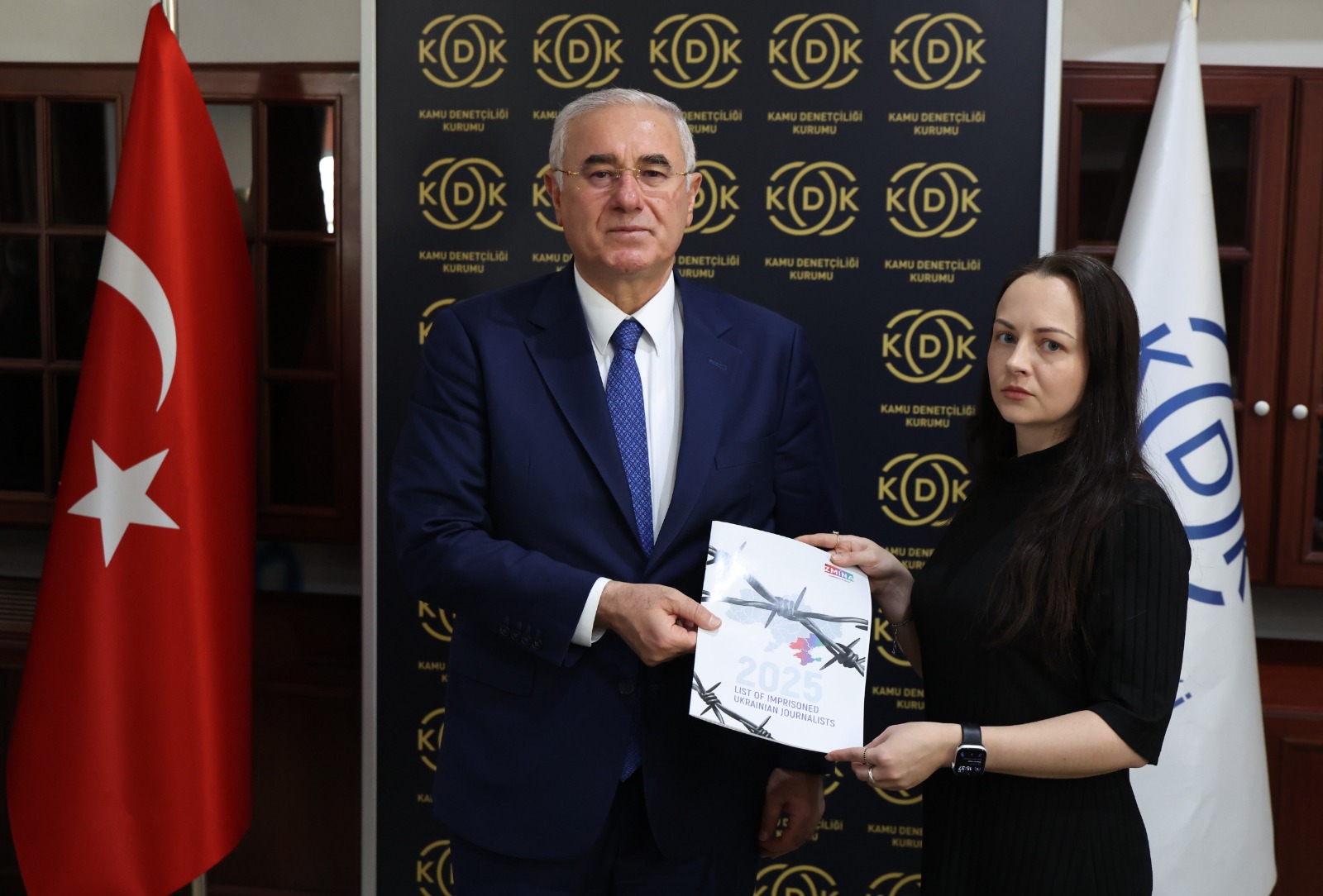 Viktoriia Nesterenko, ZMINA Project Manager, hands lists of unlawfully imprisoned Ukrainians to Türkiye’s Chief Ombudsman Mehmet Akarca, Ankara, 2026
Ukraine’s European path is also about human rights
Throughout the year, ZMINA worked to bring Ukraine closer to membership of the European Union. In October, the organisation and a coalition of civil society organisations published the second Shadow Report on Ukraine’s Progress towards EU Accession and successfully presented it in Ukraine and Brussels. This year, ZMINA is continuing this work and preparing its third Shadow Report.
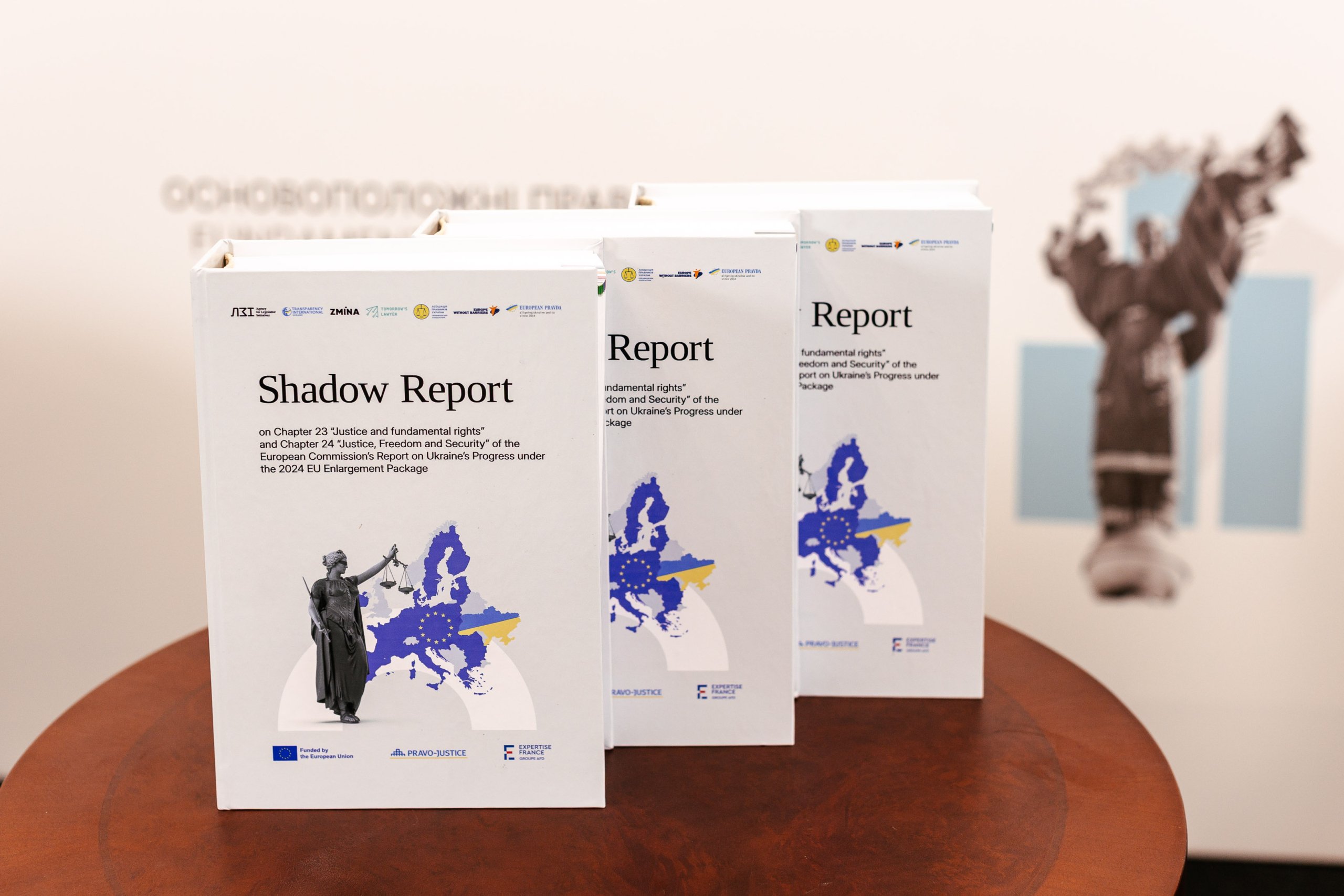 Shadow Report on Chapter 23 “Justice and fundamental rights” and Chapter 24 “Justice, freedom and security” of the European Commission’s report on Ukraine in 2024
It was equally important to consider the impact of Russian aggression on Ukraine’s European integration. In its analytical report, “European integration of Ukraine: new instruments and incentives to ensure the rights and opportunities of internally displaced persons and residents of the temporarily occupied territories of Ukraine”, ZMINA examined respect for the rights of internally displaced Ukrainians and those who continue to live in the occupied territories.
Throughout the year, the organisation advocated for the adoption of anti-discrimination legislation and reform of the Ombudsman’s Office, opposed controversial provisions in the draft Civil Code, developed proposals for the National Human Rights Strategy and presented its recommendations to Ukrainian and European officials.
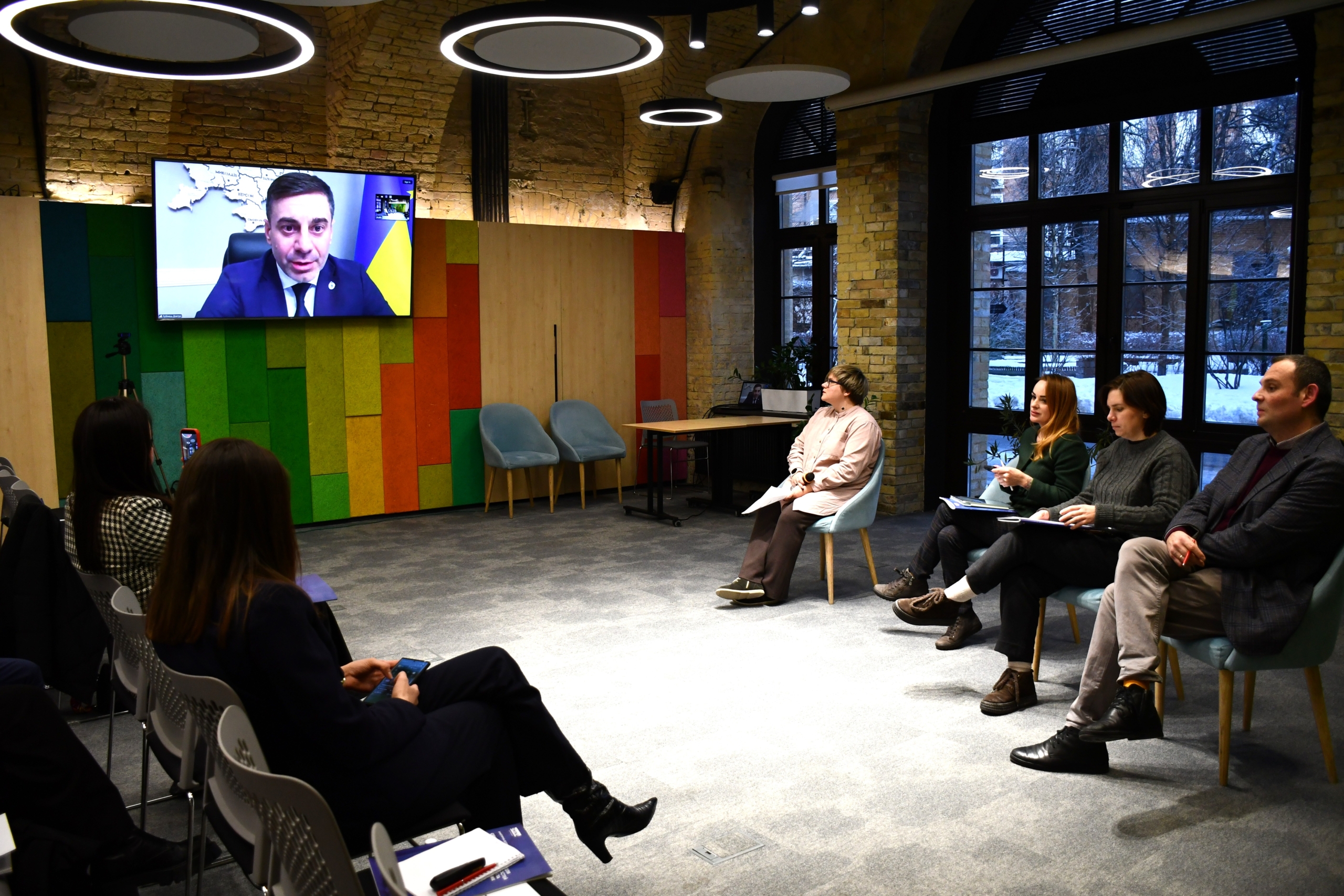 Presentation of the analytical report “European integration of Ukraine: new instruments and incentives to ensure the rights and opportunities of internally displaced persons and residents of the temporarily occupied territories of Ukraine”, Kyiv, January 2026
Making human rights work visible
Throughout the year, ZMINA not only documented war crimes, conducted research and advocated for change, but also brought these issues to wider public attention. The organisation’s experts regularly commented on current events and legislative developments, gave interviews and appeared on television and radio, while the findings of its research and advocacy work informed coverage by Ukrainian and international media.
Over the year, ZMINA’s team provided Ukrainian and international journalists with around 300 comments and interviews. The organisation’s work was covered by Suspilne, Radio Liberty, Hromadske Radio, Ukrainian Radio, Deutsche Welle, Ukrinform, Ukrainska Pravda, NV, The Kyiv Independent, QIRIM.Media, Crimea.Realities, Graty, Detector Media, Espreso and other Ukrainian and international media outlets. A further 13 op-eds and articles by ZMINA experts were published directly by other media outlets.
 Recording of the Hromadske Radio programme “I Hear Others”. Alena Lunova; Maksym Butkevych, human rights defender, journalist and host; and Daria Bura, journalist
In total, the Human Rights Centre ZMINA was mentioned 1,413 times in national and international media during this period. Each mention drew attention to specific issues that we sought to make visible: the rights of people in the temporarily occupied territories, enforced disappearances and arbitrary detention, the persecution of journalists and civil society activists, the rights of IDPs, access to housing, European integration, efforts to combat discrimination, the protection of civil society and accountability for war crimes.
ZMINA also continued to report on the human rights situation in Ukraine through its media website, zmina.info. Over the year, the Ukrainian-language edition alone published more than 8,500 news stories and articles, read by almost 3 million users in Ukraine and abroad.
 ZMINA at the Women’s March, Kyiv, 8 March 2026
Readers were particularly interested in content on the state of civil society during the war and respect for human rights amid restrictions imposed under martial law. The media website also regularly featured testimonies about war crimes committed by Russia, clear explanations of how national and international justice systems address these crimes, and information on the assistance and compensation available to people affected by the war.
Throughout the year, ZMINA held a series of public events that helped draw attention to systemic problems and shape the public agenda. In particular, the organisation presented a study on patterns of arbitrary detention and enforced disappearance under occupation, raised issues concerning state policy towards people affected by the war, and presented Green and White Papers on Memorialisation, the Shadow Report on European integration and a study on the state of civil society.
 Anastasiia Datsiv, ZMINA Advocacy Manager for European Integration; and Anastasiia Tlepova, ZMINA Project Manager
Through discussions, book launches, photo exhibitions and media commentary, ZMINA continued to raise awareness of political prisoners, the persecution of journalists, reintegration and the rights of people who remain in the occupied territories. These events included presentations of My Deportation by Osman Arifmemetov and Free Voices of Crimea, a photo exhibition about the children of Crimean Tatar political prisoners and a discussion at Docudays UA on the security and reintegration of people from the occupied territories.
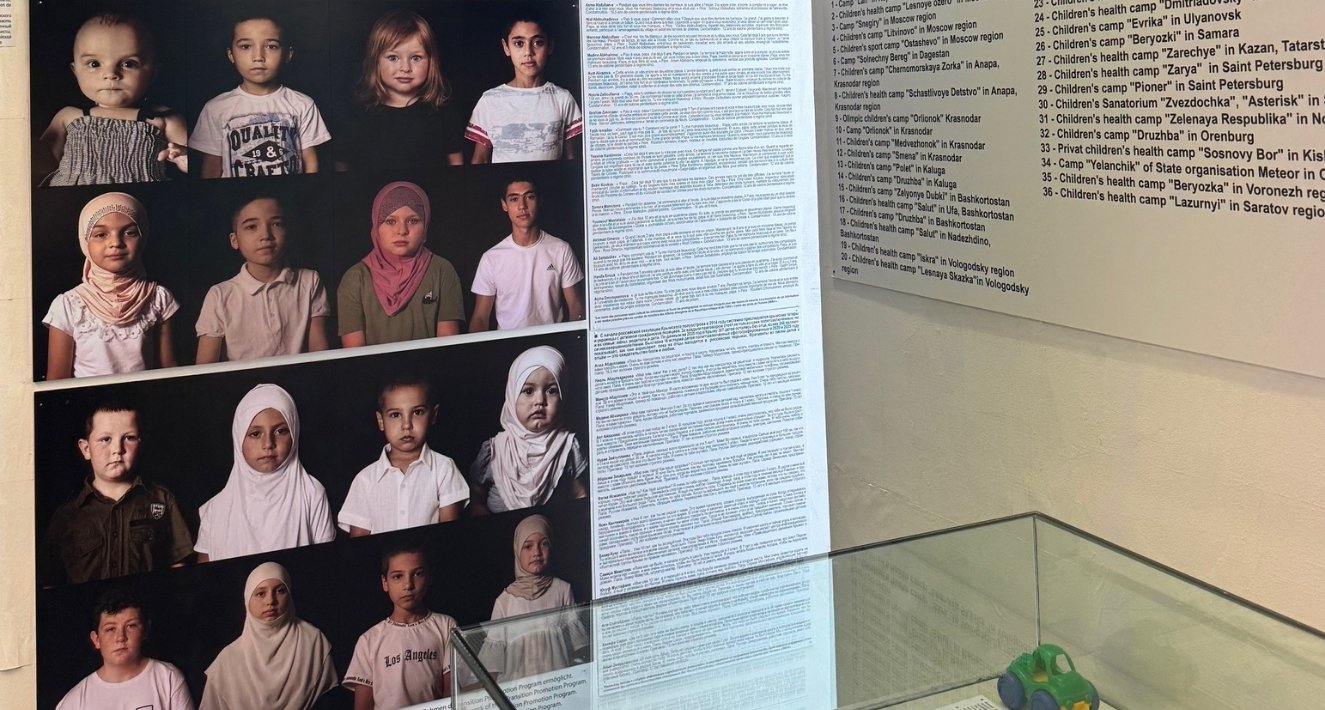 “The Childhood They Never Had”, a photo exhibition dedicated to the children of Crimean Tatar political prisoners
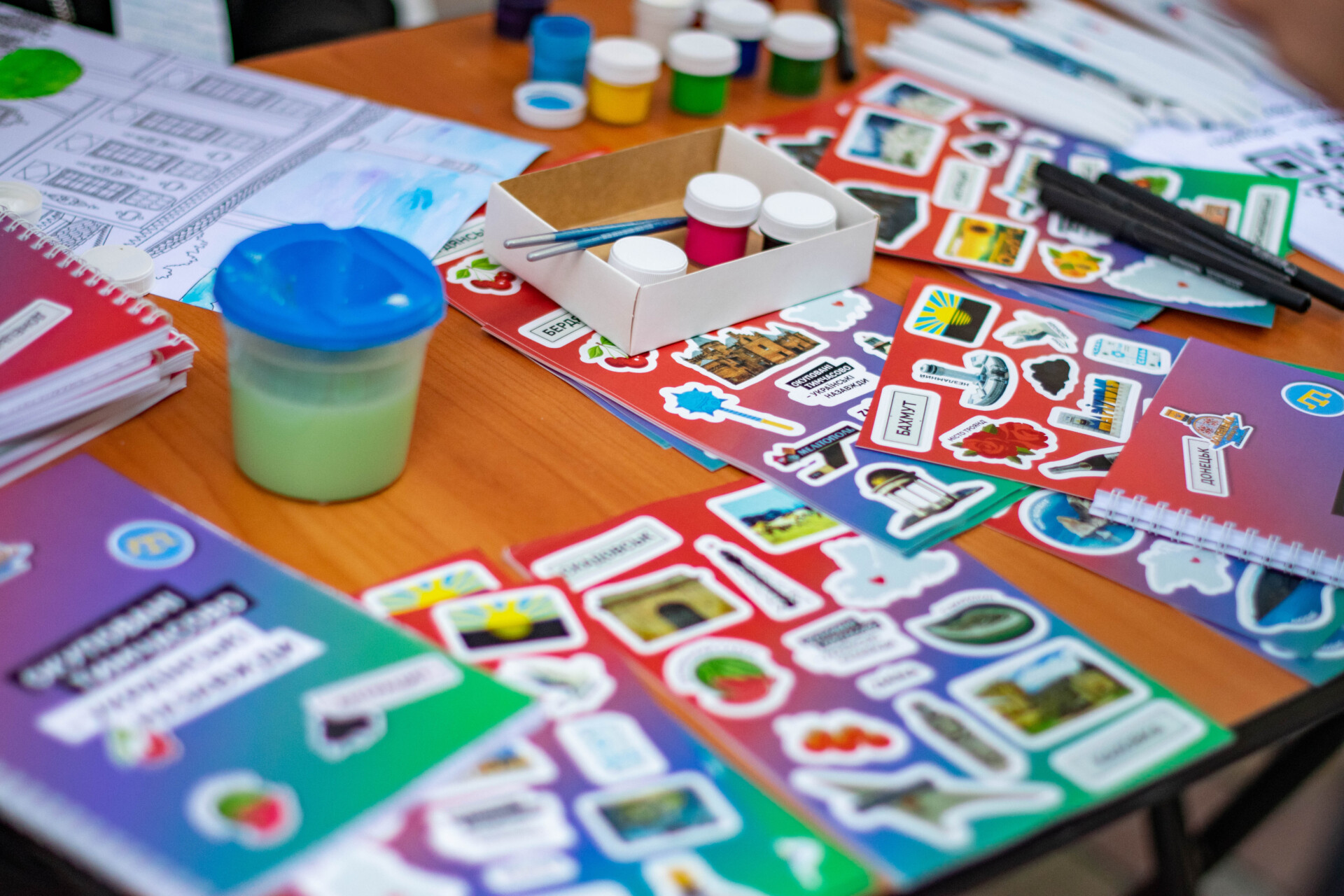
To maintain contact with Ukrainian prisoners of the Kremlin, ZMINA continued its “Letters to Free Crimea” campaign. Over the year, more than 1,000 letters and postcards were collected at various themed events in Ukraine and abroad. For political prisoners, each letter can be their only “window to the outside world”, providing psychological support amid isolation, torture and deportation to remote penal colonies in Russia. Most importantly, these letters help protect prisoners’ rights: those who receive regular correspondence become more visible to the prison administration, which realises that the public is monitoring their treatment and is therefore under greater pressure to respect their rights, reducing the risk of violations being committed with impunity.
In 2026, ZMINA’s communications work became increasingly linked to advocacy for specific policy changes. One notable example was a campaign to preserve IDPs’ access to housing programmes. A press conference held by the Human Rights Centre ZMINA and its partners in May 2026 brought together more than 100 people. They included IDPs who personally joined a public appeal urging the government not to take any decision that could jeopardise access to subsidised housing.
 Participants in a press conference on the risks of merging Derzhmolodzhytlo and Ukrfinzhytlo, Kyiv, 6 May 2026
In 2026, ZMINA became a partner of the Generation Nika Award, established in 2024 in honour of Kharkiv artist and poet Veronika Kozhushko, who was killed in a Russian missile strike on Kharkiv on 30 August 2024. The prize is awarded to writers and visual artists aged between 16 and 21. Its founders are Serhii Zhadan, the Serhii Zhadan Charitable Foundation, the Nika Generation Charitable Foundation, founded by Ihor and Tetiana Kozhushko, and the Kharkiv Literary Museum, headed by Tetiana Pylypchuk.
 Presentation of the Generation Nika almanac, Kyiv, 25 May 2026
Importantly, the organisation’s communications throughout the year were not limited to documents, reports and draft laws. Through the media, ZMINA helped tell the stories of real people: political prisoners, journalists, activists, displaced persons, and people who remain in the occupied territories or are trying to return from them.
This is why ZMINA’s media work encompassed not only research presentations and press conferences, but also the stories of political prisoners, books containing personal testimonies, photo exhibitions and discussions about life under occupation.
 Tetiana Pechonchyk accepts a human rights award on behalf of imprisoned Crimean citizen journalist Iryna Danylovych, Prague, 3 November 2025
ZMINA uses communication as a human rights advocacy tool to make problems visible, amplify the voices of those affected and ensure that the need for change is discussed not only within the human rights community, but also by the wider public and at government level.
International advocacy
The period from August 2025 to August 2026 was particularly busy for ZMINA’s international advocacy work. During this time, the team carried out 43 advocacy missions to Finland, Switzerland, Poland, Belgium, Chile, Czechia, Germany, Serbia, the United States, Bolivia, Türkiye, France, Austria and other countries. ZMINA representatives and victims spoke at events held by the UN, the OSCE, the Council of Europe and the European Commission, and met with government officials from several countries. Their advocacy focused on securing the release of Ukrainians held by Russia, the abduction and deportation of Ukrainian children, holding Russia accountable, European integration, and the protection of civil society and human rights defenders.
 Onysiia Syniuk, ZMINA Head of the Research Department, at the Munich Security Conference, 14 February 2026
On 5 September 2025, the Council of the European Union imposed restrictive measures – asset freezes and travel bans – against Vadym Bulhakov and Oleksii Pikin, senior officials at pre-trial detention centres in Crimea, under the EU Global Human Rights Sanctions Regime. In 2024, following the deaths of two Crimean political prisoners in Russian prisons after they were denied medical care, ZMINA repeatedly called for sanctions against prison officials whose inaction had left almost 100 Ukrainian political prisoners without medical assistance. These efforts produced results.
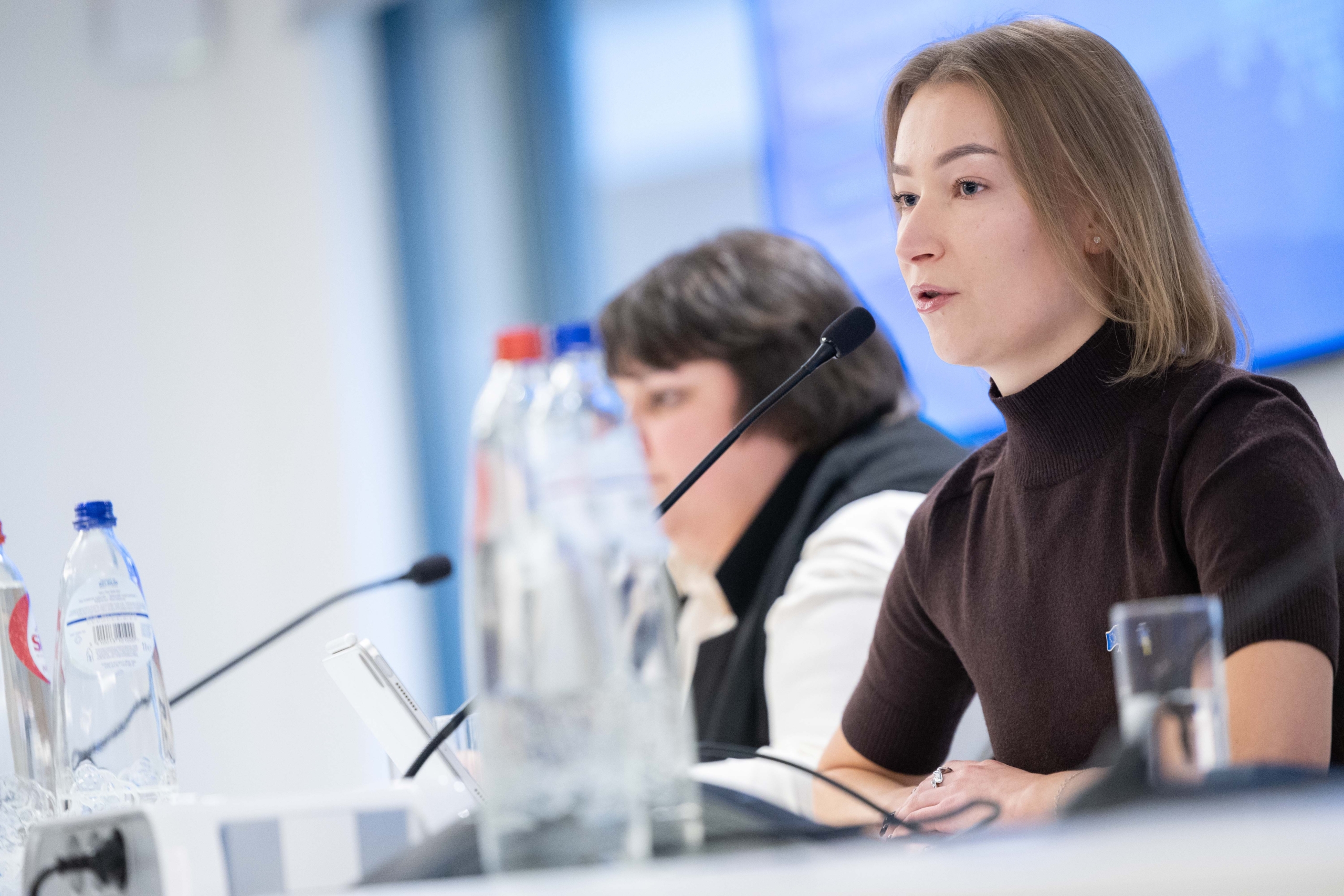 Anastasiia Datsiv at the presentation of the Shadow Report in Brussels, December 2025
ZMINA also continued its practice of preparing independent Shadow Reports to complement the European Commission’s EU Enlargement Report. In June 2026, the latest interim report was presented to the European Commission. Earlier, in October 2025, a coalition report containing more than 500 recommendations on Ukraine’s path towards EU membership was presented in Kyiv and Brussels. Independent civil society expertise is used directly to assess Ukraine’s progress and identify reform priorities during the EU accession process. The European Commission highly praised the recommendations in the previous Shadow Report, which were reflected in the reform roadmap; some have already been implemented at the national level.
In July 2026, ZMINA made a submission for the fourth cycle of the UN Human Rights Council’s Universal Periodic Review (UPR) of Ukraine and co-authored two further coalition submissions. Together, the three documents analysed Ukraine’s implementation of 42 of the 190 recommendations issued during the previous cycle in 2017. In addition, in March 2026, ZMINA spoke at an event held during a session of the UN Human Rights Council on arbitrary detention under occupation. In July 2026, it organised a discussion on Ukraine’s implementation of the Concluding Observations of the UN Committee against Torture. In October 2025, the organisation submitted documented evidence of violations of economic, social and cultural rights in the temporarily occupied territories to the UN.
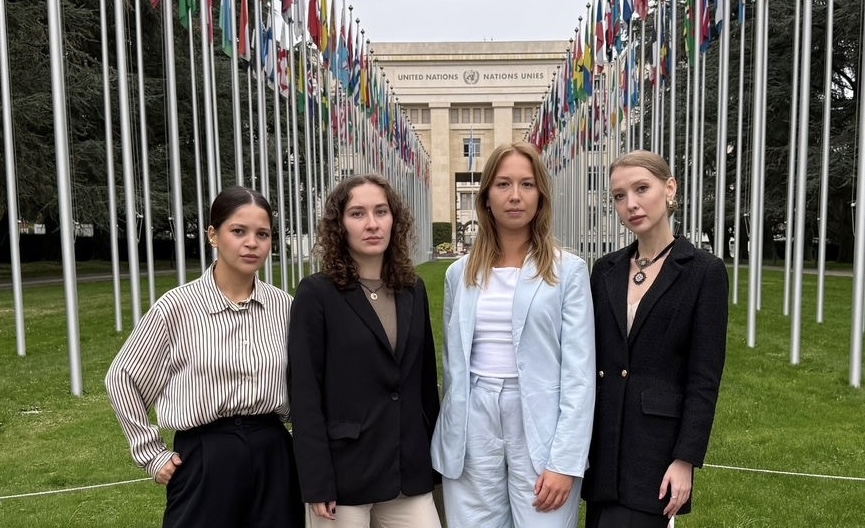 Leniie Umerova, Valeriia Kuberska, Tetiana Zhukova and Kateryna Rashevska, Geneva, October 2025
On 7 July 2026, the ECtHR granted a request for an oral hearing in the case of Ukrainian Helsinki Human Rights Union v. Russia, brought on behalf of ten Ukrainian children from residential institutions in Crimea whom Russia did not return to Ukraine after occupying the peninsula in 2014. At the Court’s invitation, ZMINA and the Public Interest Journalism Lab joined the proceedings as third-party interveners, providing analysis of the Russian legal regime, the forced passportisation, indoctrination and militarisation of children, and restrictions on travel to and from Crimea. Human rights defenders expect the judgment to set a precedent for protecting thousands of children deported since 2022 and provide additional leverage in pursuing the individual criminal responsibility of Vladimir Putin and Maria Lvova-Belova before the ICC.
On 17–18 November 2025, Kyiv hosted the third international conference, “Crimea Global. Understanding Ukraine through the South”, which brought together more than 200 participants from over 12 countries across Africa, Asia and Latin America, as well as Ukraine. Diplomats, experts, government officials, academics, journalists and human rights defenders discussed the security and humanitarian situation in Ukraine, the global challenges and consequences of the war, and ways to achieve a just peace and restore international order. As in previous years, Crimea was the conference’s overarching theme and a symbol of resistance to Russian colonial policy. ZMINA co-organised the event with the Mission of the President of Ukraine in the Autonomous Republic of Crimea, the Crimea Platform Office and the Media Initiative for Human Rights.
 Participants in Crimea Global, Kyiv, November 2025
What comes next
What began as responses to individual crises has grown into sustained, evidence-based work that uses legal tools to shape decisions at the national and international levels.
The work ahead includes the third Shadow Report and continued advocacy for anti-discrimination legislation and amendments to the law on the Ukrainian Parliament Commissioner for Human Rights; the implementation of the 17 priority steps concerning residents of the temporarily occupied territories; the continued development of the support system for people affected by the war; and documentation that should ultimately lead to convictions for crimes against humanity. As always, ZMINA will continue providing legal, security and information support to those working on the front line of civil society.
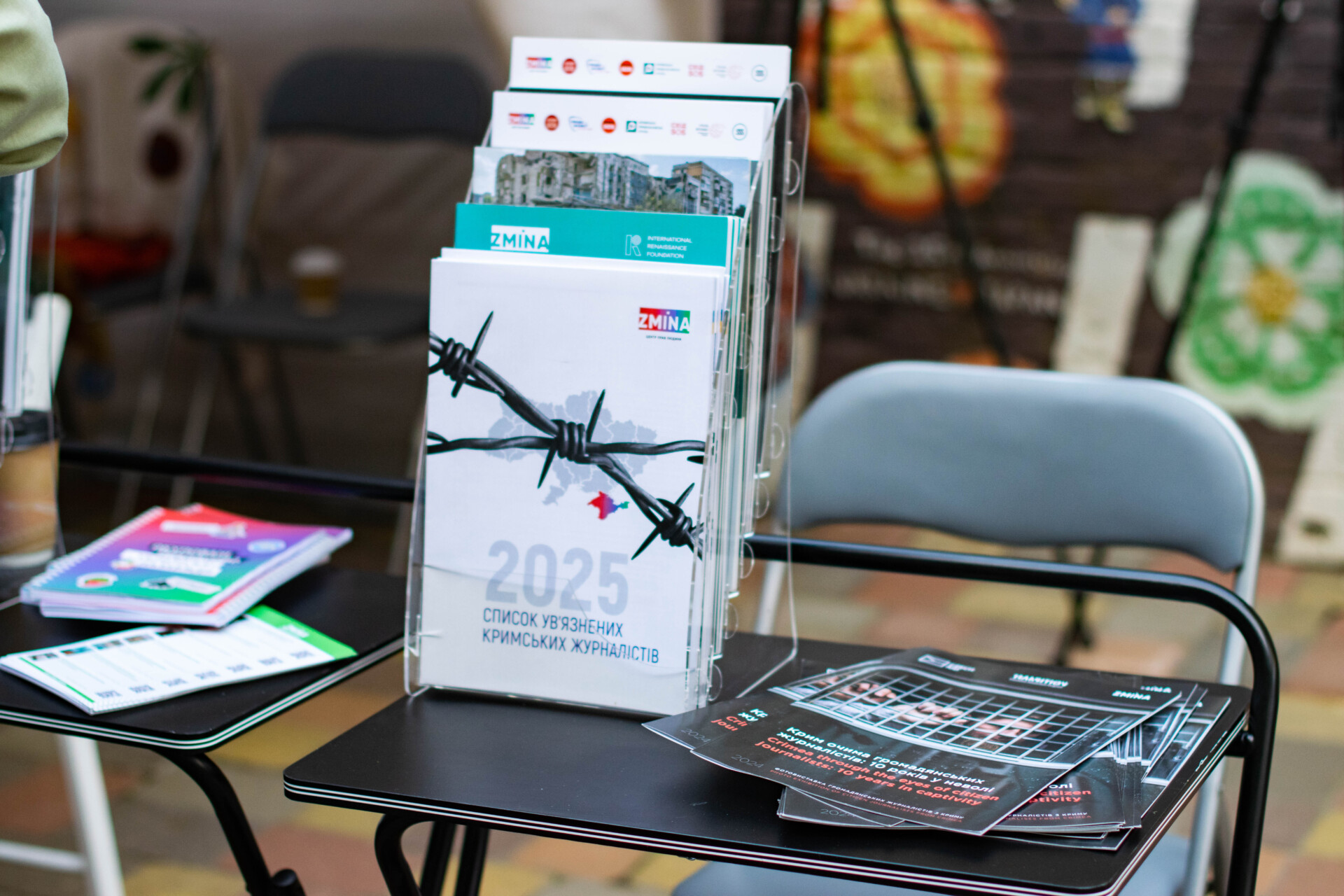
Behind every item on this list are people. Lawyers who take on cases that others turn down. Documentation specialists who spend years piecing together a mosaic of interviews and open-source data. Analysts, communications specialists and managers who keep the organisation running even as explosions are heard nearby. Journalists who deliver timely information to tens of thousands of engaged readers. ZMINA is a diverse team, but everyone shares the same vision: a future in which people are protected not because they are lucky, but because the system works as it should.
We thank everyone who has stood with us over these 14 years: our partners, donors, colleagues across the sector, journalists, and all those who read and support our work. There is still much work ahead – but we are not afraid to take it on.